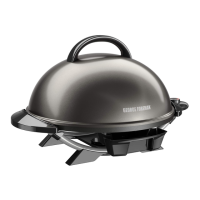
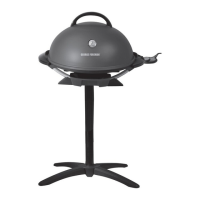
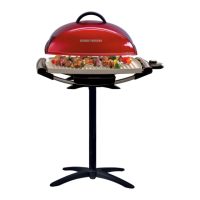
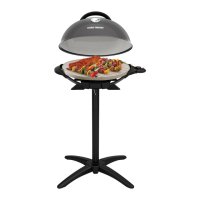
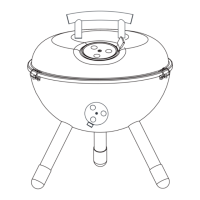
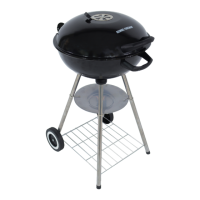
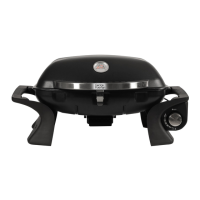
The provided manual describes the George Foreman 1 Burner Gas BBQ, model GFSBBQ1. This is a portable gas barbecue designed for outdoor use.
Function Description
The George Foreman GFSBBQ1 is a gas-powered barbecue intended for cooking food outdoors. It features a single burner with automatic ignition, allowing for easy lighting and temperature control. The appliance is designed to be used with a gas cylinder (butane or propane) and includes a lid for preheating and more even cooking. It is suitable for grilling various types of food, including meat and poultry.
Important Technical Specifications
- Model: GFSBBQ1
- Type: 1 Burner Gas BBQ
- Ignition: Automatic
- Gas Type & Supply Pressure (Country Dependent):
- Propane (G31) 37 mbar (for BE, CH, CY, CZ, ES, FR, GB, GR, IE, IT, LT, LU, LV, PT, SK, SI)
- Butane/Propane 30 mbar (for BE, CY, DK, EE, FI, HU, LT, NL, NO, SE, SI, SK, RO, HR, TR, BG, LU, MT)
- Butane/Propane 50 mbar (for AT, CH, DE, SK)
- Butane/Propane 37 mbar (for PL)
- Main Burner Injector Size:
- 0.93mm (for Propane 37 mbar and Butane/Propane 30 mbar)
- 0.82mm (for Butane/Propane 50 mbar)
- 0.86mm (for Butane/Propane 37 mbar)
- Total Nominal Heat Inputs (Hs): 3.5kW (249g/h for Propane 37 mbar; 255g/h for Butane/Propane 30/50/37 mbar)
- Pin Code: 2531CS-0025
- Certification: CE 2531/20
- Clearance: Must be installed with 1m clearance in all directions and not used underneath any overhead obstruction.
- Gas Cylinder Placement: The gas cylinder should not be placed inside or under the BBQ, or near any hot parts of the appliance.
Usage Features
Assembly:
The BBQ requires assembly, which involves:
- Attaching the handle to the lid using M5 Wing Nuts.
- Placing the lid onto the base and securing it with pins and pin clips.
- Pushing the thermostat leg through the lid and securing it with a wing nut.
- Placing the left and right grill trays in position.
- Sliding the grease tray into its supports on the base.
Tools required for assembly include a cross-head screwdriver and an adjustable spanner.
Gas Cylinder Connection:
- The gas cylinder must be positioned on the left side of the grill, away from heat and in a safe position.
- The regulator is pushed onto the gas bottle valve until it clicks.
- The gas hose is firmly pushed onto the regulator gas outlet and secured with a jubilee clip.
- The other end of the hose is firmly pushed onto the appliance's gas inlet and secured with a second jubilee clip.
- The hose must not be twisted, have undue tension, or touch hot parts of the grill.
- Gas flow is initiated by turning a small lever on the regulator from vertical (closed) to horizontal (open).
- Safety Note: Always test gas line connections for leaks with soapy water; bubbles indicate a leak.
Gas Cylinder Disconnection:
- Turn the small lever on the regulator from horizontal (open) to vertical (closed) to turn off the gas supply.
- Push the button release located below the small lever on the regulator and lift it away from the gas cylinder.
Lighting the BBQ (Automatic Ignition):
- Ensure the lid is open and the control dial is in the "OFF" position.
- Turn the gas cylinder valve to "ON" at the regulator.
- Press the control dial into the BBQ and hold for 3-5 seconds to allow gas flow.
- Turn the control dial anticlockwise to "HIGH". This should create a "snap" sound and an orange flame from the burner lighting tube.
- Continue holding the control dial for another 2 seconds to ensure ignition.
- The flame on "HIGH" should be approximately 12-20mm high and orange.
- The gas control can be turned fully anticlockwise for the minimum heat setting.
- Safety Note: If the burner doesn't light, turn the knob to "OFF", wait 5 minutes for gas to clear, then retry. If the burner goes out during operation, turn to "OFF", open the lid, wait 5 minutes, then relight.
Preheating:
- Preheat the grill by turning the control dial to "HIGH" and closing the lid.
- Preheating takes 10-15 minutes, depending on ambient temperature and wind.
- After preheating, the control dial can be adjusted as desired.
Cooking:
- Food can be barbecued with the lid up or down.
- Cooking with the lid down ensures more even cooking.
- For every 5 minutes the lid is down, open it for 1 minute to release heat.
Food Safety:
- Thoroughly defrost frozen meat and poultry in the refrigerator.
- Keep raw meat/poultry separate from cooked foods.
- Wash hands after handling raw meat/poultry.
- Wipe and disinfect surfaces that have contacted raw meat/poultry.
- Ensure the barbecue is hot for cooking meat/poultry.
- Place larger/thicker portions furthest from intense heat and turn regularly for thorough cooking.
- Use separate utensils for raw and cooked food, or wash thoroughly between uses.
- Check meat/poultry doneness by piercing; juices should run clear, and the product should be piping hot throughout.
Energy Saving Tips:
- Minimize the time the lid is open.
- Turn off the BBQ and gas supply as soon as cooking is completed.
- Do not preheat for longer than 10-15 minutes.
- Do not use a higher heat setting than required.
Maintenance Features
Cleaning and Care:
- Ensure the appliance is cold before cleaning.
- Empty and wash the grease tray in warm soapy water after each use.
- Clean grill trays by soaking and washing in warm soapy water.
- Wash interior surfaces of the grill housing cover with warm soapy water. Use a wire brush, steel wool, or scouring pad for stubborn spots.
- Periodically check the burner for insects and spiders that may clog the gas system.
- Clean venturi pipes on the burner very carefully to ensure no obstructions, using a pipe cleaner.
- Warning: Any modifications to the appliance are dangerous and not permitted.
Storage:
- The gas bottle must be stored outdoors in a well-ventilated area and disconnected from the grill when not in use.
- Disconnect the gas bottle outdoors and away from ignition sources.
- Store the BBQ indoors, in a garage, or a shed.
- After storage, always check for gas leaks and burner obstructions before use.
Troubleshooting:
The manual provides a comprehensive troubleshooting guide for common issues, including:
- Gas leaks: Damaged hose, mechanical failure of LP tank/valve, improper regulator connection. Solutions involve turning off gas, replacing parts, or re-securing connections.
- Fire through control panel: Due to partial blockage in the burner tube. Solution: turn off gas, cool, remove burner, inspect for spider nests/rust.
- Grease fire/excessive flames: Too much grease buildup. Solution: turn off gas, leave lid open to let flames die, clean food particles and grease.
- Burner not lighting with ignitor: Gas issues (burner not engaged, obstruction, no gas flow, loose coupling nut) or electrical issues (cracked electrode, improper electrode position, dirty/loose wires, shorting wires, sticky push button). Solutions involve checking gas supply, cleaning obstructions, adjusting/replacing electrodes or wires.
- Sudden drop in gas flow/low flame: Grease buildup, excessive fat in meat, excessive cooking temperature. Solutions: clean burners, trim fat, adjust temperature.
- Flames blow out: High winds, low LP gas, excess flow valve tripped. Solutions: reposition grill, refill LP tank, refer to "sudden drop in gas flow."
- Persistent grease fire: Grease trapped by food buildup. Solution: turn off gas, let fire burn out, clean all parts.
- Flashback (fire in burner tube): Blocked burner and burner tubes. Solution: turn off gas, clean burner/burner tubes.
- Flare-up: Grease buildup, excessive fat in meat, excessive cooking temperature. Solutions: clean burners, trim fat, lower temperature.
Guarantee and Customer Services:
- The product is guaranteed for 12 months from the original purchase date against faulty materials or workmanship.
- Refund or replacement is at the discretion of the retailer.
- Conditions apply: original proof of purchase, installation/use according to instructions, domestic use only.
- Warranty does not cover wear and tear, damage, misuse, or consumable parts.
- Statutory rights are unaffected.
- Customer Services & Spare Parts contact: 0345 209 7461 or https://www.georgeforeman.co.uk/


 To Next Page

 General