EasyManua.ls Logo

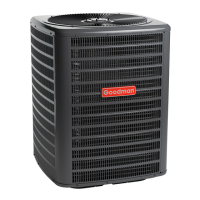
Goodman GSZ140311 - User Manual

Goodman GSZ140311
16 pages
Print Icon
To Next Page IconTo Next Page
Loading...
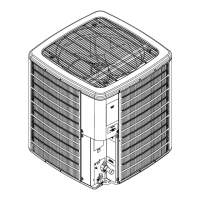
CONDENSING UNIT


is a registered trademark of Maytag Corporaon or its related companies and is used under license. All rights reserved.
© 2005-2013, 2016-2021
Goodman Manufacturing Company, L.P.

www.goodmanmfg.com -or- www.amana-hac.com
 

The following symbols and labels are used throughout
this manual to indicate immediate or potential safety
hazards. It is the owner’s and installer’s responsibility to
read and comply with all safety information and instructions
accompanying these symbols. Failure to heed safety
information increases the risk of personal injury, property
damage, and/or product damage.
WARNING

























WARNING
SHIPPING INSPECTION
Always keep the unit upright; laying the unit on its side
or top may cause equipment damage. Shipping damage,
and subsequent investigation is the responsibility of
the carrier. Verify the model number, specications,
electrical characteristics, and accessories are correct
prior to installation. The distributor or manufacturer will not
accept claims from dealers for transportation damage or
installation of incorrectly shipped units.

This product is designed and manufactured to comply
with national codes. Installation in accordance with such
codes and/or prevailing local codes/regulations is the
responsibility of the installer. The manufacturer assumes
no responsibility for equipment installed in violation of any
codes or regulations. Rated performance is achieved after
20 hours of operation.
Rated performance is delivered at the specied airow.
See outdoor unit specication sheet for split system models
or product specication sheet for packaged and light
commercial models. Specication sheets can be found at
www.goodmanmfg.com for Goodman® brand products or
www.amana-hac.com for Amana® brand products. Within
either website, please select the residential or commercial
products menu and then select the submenu for the type
of product to be installed, such as air conditioners or heat
pumps, to access a list of product pages that each contain
links to that model’s specication sheet.





Should you have any questions please contact the local
o󰀩ce of the EPA.
If replacing a condensing unit or air handler, the system
must be manufacturer approved and Air Conditioning,
Heating and Refrigeration Institute (AHRI) matched.


Outdoor units are approved for operation above 55°F in
cooling mode. Operation below 55°F requires the use of
an approved low ambient kit. Note: LAKT01 Low ambient
kit cannot be used with outdoor units containing ECM
motors.
Damage to the unit caused by operating the unit in a
structure that is not complete (either as part of new
construction or renovation) is not covered under the
warranty.

Questions and Answers

Overview

This manual describes the installation and service procedures for a condensing unit air conditioning system, providing comprehensive guidelines for safe and efficient operation, maintenance, and troubleshooting.

Function Description

The condensing unit air conditioning system is designed to provide cooling for residential and light commercial applications. It works in conjunction with an indoor evaporator coil and, in some configurations, a furnace or air handler, to circulate refrigerant and condition the air within a structure. The system is engineered to comply with national codes and regulations, with installation guidelines emphasizing proper clearances, refrigerant handling, and electrical connections to ensure optimal performance and safety.

The core function involves a refrigeration cycle where the condensing unit, typically located outdoors, compresses refrigerant. This compressed refrigerant then flows to the indoor evaporator coil, where it absorbs heat from the indoor air, providing cooling. The heated refrigerant returns to the outdoor unit to release heat to the ambient air, completing the cycle. The system's performance is rated at specified airflow and is achieved after approximately 20 hours of operation.

Usage Features

The system is designed for ease of use and reliability, with several features contributing to its operational efficiency.

  • Refrigerant Handling: The manual provides detailed instructions for handling refrigerants, emphasizing safety precautions due to their weight and potential to displace oxygen in enclosed spaces. It mandates the use of returnable service cylinders for refrigerant removal and stresses adherence to EPA regulations for disposal, prohibiting the burning of refrigerants due to the production of poisonous gases. For R-410A units, the manual highlights the susceptibility of POE oil to moisture absorption, urging installers to minimize system exposure to the atmosphere during installation to prevent compressor failure.
  • Line Set Installation: Specific guidelines are provided for interconnecting tubing, including recommended line diameters for various unit capacities and line lengths. It advises against direct contact of refrigerant lines with plumbing, ductwork, or structural elements to prevent sound and vibration transmission. The use of insulated hangers and separate insulation for suction lines is recommended. For longer line sets or significant vertical elevation changes, specialized application guidelines (TP-107 R-410A Long Line Set Application Guidelines) are referenced to ensure optimum performance.
  • System Evacuation and Charging: The manual details the Deep Vacuum Method for system evacuation, which is recommended to ensure the system is free of non-condensable air and moisture. This method involves evacuating the system to less than 500 microns and holding the vacuum to confirm leak-free operation. For charging, the manual distinguishes between fixed orifice and expansion valve systems. Fixed orifice systems are charged by superheat, while TXV-equipped systems are charged by subcooling. Precise instructions are given for connecting gauges, measuring temperatures, and adjusting refrigerant charge to achieve optimal superheat or subcooling values.
  • Electrical Connections and Overcurrent Protection: The unit requires 24 Volt minimum, 25VA service from the indoor transformer for low voltage control wiring. High voltage connections must conform to NEC or CEC and all local codes, with undersized wires explicitly warned against due to potential equipment damage or fire. Approved overcurrent protection devices include time delay fuses and HACR type circuit breakers, selected to accommodate the motor-compressor's starting and acceleration loads.
  • Three-Phase Compressor Rotation: For three-phase compressors, the manual provides a method to verify proper rotation by observing suction and discharge pressures upon energization. Incorrect rotation, which results in noisier operation and reduced current draw, can be corrected by switching any two leads at the unit contactor.
  • Low Ambient Operation: Outdoor units are approved for operation above 55°F in cooling mode. For operation below this temperature, an approved low ambient kit is required, with a specific note that the LAKT01 kit is incompatible with outdoor units containing ECM motors.

Maintenance Features

The manual outlines routine maintenance recommendations to ensure the longevity and efficient operation of the system.

  • Filter Maintenance: Regular checking and replacement or cleaning of indoor air filters are crucial. The manual recommends monthly inspection, emphasizing that operating the unit without a filter can lead to dust and lint buildup, reducing efficiency, damaging equipment, and posing a fire risk. It also suggests considering high-efficiency filters for better capture of airborne particles.
  • Outdoor Coil Cleaning: While cleaning the outdoor coil is recommended, it is specified as a task for a qualified servicer due to the risk of puncturing tubing and causing refrigerant loss. The manual advises against constructing fences or decks near the unit without consulting a dealer to avoid restricting airflow, which can impair operation.
  • Compressor and Motor Maintenance: The compressor motor is hermetically sealed and does not require additional oiling. Similarly, indoor and outdoor fan motors are permanently lubricated, eliminating the need for routine lubrication by the homeowner.
  • Bi-annual Checkup: A bi-annual maintenance checkup by a qualified servicer is strongly recommended before the heating and cooling seasons to ensure the system operates optimally.
  • Troubleshooting Guide: A detailed troubleshooting chart is provided, correlating common complaints (No Cooling, Unsatisfactory Cooling, System Operating Pressures) with possible causes and recommended test methods or remedies. This guide helps in diagnosing issues such as power failure, faulty components, refrigerant problems, and airflow imbalances.
  • Service Valve Operation: Instructions for opening service valves are precise, requiring the stem to be opened until it is 1/8" from the retainer to avoid refrigerant loss. For valves without retainers, the stem should be backed out until it contacts the rolled lip of the valve body. The manual clarifies that these are not back-seating valves, and excessive force is not required.

Goodman GSZ140311 Specifications

General IconGeneral
TypeHeat Pump
SEER Rating14
HSPF Rating8.2
RefrigerantR-410A
Compressor TypeScroll
Voltage208/230V
Phase1
Warranty10 years

Related product manuals