Need help?
Do you have a question about the Goodwe HomeKit and is the answer not in the manual?
Lists all items included in the HomeKit package, such as the device, accessories, and manuals.
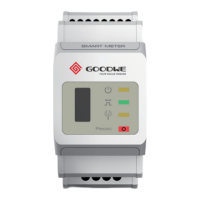
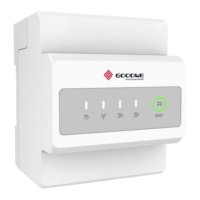
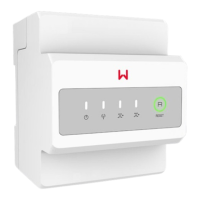
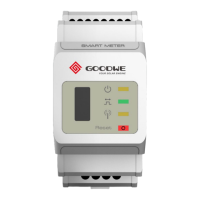
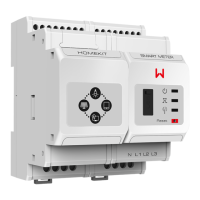
Provides a detailed view of the HomeKit device, highlighting its ports, buttons, and indicator LEDs.
Details the Current Transformer (CT) components used for measurement, including dimensions and connections.
Specifies the environmental requirements for HomeKit installation, including protection class and operating temperature.
Instructions on how to mount the HomeKit device onto a DIN track, including release and securing mechanisms.
Details the status and meaning of various indicator LEDs (Power, Energy consumption, Communications).
Explains the functions of the reset button based on the duration of the press, from communication reset to data clearing.
Describes the purpose of the USB port, primarily for after-sales maintenance.
The HomeKit is a sophisticated device designed for precise measurement, statistics, analysis, and management of electrical energy at various load points within a household or commercial setting. It integrates seamlessly with the GoodWe SEMS and APP system, providing users with comprehensive monitoring capabilities.
The primary function of the HomeKit is to measure and calculate power and energy at three critical points: the Inverter Output Point, the Grid Point, and the Household Load Point. This is achieved through its equipped Single-Phase Meter and two-channel external Current Transformers (CTs). The device then uploads this measurement and calculation data to a server in real-time, utilizing either Wi-Fi or an Ethernet cable for connectivity. This real-time data transmission enables users to monitor their energy consumption and generation patterns through the GoodWe SEMS portal and mobile application.
A key feature of the HomeKit is its ability to support the Export Power Limit function. When connected to an inverter via an RS485 cable, the HomeKit can help manage and limit the amount of power exported back to the grid, which is crucial for compliance with local regulations or optimizing self-consumption strategies.
The device is designed for ease of operation and installation, boasting a compact form factor and high precision in its measurements. It provides detailed data detection for active power, reactive power, power factor, and frequency, offering a comprehensive overview of the electrical system's performance. Furthermore, it calculates active and reactive power energy, providing valuable insights into overall energy consumption and generation.
The HomeKit is primarily intended for household loads monitoring, making it an ideal solution for homeowners looking to understand and manage their energy usage more effectively. Its integration with the GoodWe SEMS and APP system allows for remote monitoring and control, providing convenience and flexibility. Users can access detailed energy reports, analyze trends, and identify areas for potential energy savings directly from their smartphones or computers.
The device features several LED indicators that provide immediate visual feedback on its operational status. The Power LED indicates whether the device is powered on or off. The Energy Consumption LED offers insights into energy flow: a blinking light signifies selling to the utility grid or successful communication with the HomeKit, while a steady on light indicates purchasing from the utility grid. An off state for this LED suggests exceptional communication issues between the inverter and HomeKit.
Communication status is also clearly indicated. A double blinking light on the Communications LED means the HomeKit is attempting to connect to the router, while a quadruple blinking light indicates it's trying to connect to the server. A steady on light confirms successful connection to the server, and an off state suggests that communication parameters for connecting to the router or server have not been set in the SEMS Portal.
For installation, the HomeKit is designed to be mounted on a DIN track. The process involves pulling to release a retaining clip, mounting the device on the track, and then pushing the retaining clip up until a click sound confirms secure installation. This ensures a stable and professional setup.
The wiring connection is straightforward, with clear instructions for connecting the CTs. CT1 is designated for the Grid Point, and CT2 for the Inverter Output Point. The arrow direction on the CTs must point from the Inverter side towards the Grid. It's important to note that the HomeKit is specifically designed for Single-Phase grid applications. For proper measurement, L1 and L2 on the HomeKit side must be short-connected as per the wiring diagram to avoid measurement errors.
The HomeKit includes a Reset Button that offers different functionalities based on the duration of the press, providing essential maintenance and troubleshooting capabilities.
Additionally, the HomeKit is equipped with a USB Port. This port is specifically designated for after-sales maintenance, allowing technicians to connect to the device for diagnostics, firmware updates, or other service-related tasks. This feature ensures that the device can be easily serviced and updated, extending its lifespan and maintaining optimal performance. The device is designed for indoor use, with an IP20 protection class, and operates within a wide temperature range, ensuring reliability in various indoor environments.
 General
| Category | Measuring Instruments |
|---|---|
| Frequency | 50/60 Hz |
| Communication | Wi-Fi |
| Compatibility | GoodWe Inverters |
| Operating Temperature | 60°C |
| Measurement Parameters | Voltage, Current, Power, Energy |
| Display | LCD |

 To Next Page