Need help?
Do you have a question about the Gorenje F 317 B and is the answer not in the manual?
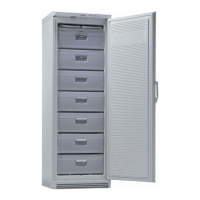
This document describes the operation, maintenance, and safety guidelines for an upright freezer. It is intended for domestic use, designed for freezing fresh food and storing frozen food for up to one year.
The upright freezer operates using a cooling system with a compressor, which produces noise during operation. The refrigerating system is filled with refrigerant and insulating substances. The appliance features a control panel with an ON/OFF switch, an operation mode selection switch, a sound alarm button with a red light, a temperature selector, and an external temperature meter.
The ON/OFF Switch (1) turns the appliance on or off, indicated by a green light. The Operation Mode Selection Switch (2) allows selection between continuous and automatic operation. In continuous operation, indicated by a yellow light, the cooling system runs constantly, suitable for freezing large amounts of fresh food or deep-freezing already frozen foods. In automatic operation, the yellow light is off, and the interior temperature is controlled by a thermostat that cycles the cooling system on and off. The frequency of these cycles depends on the thermostat setting, door opening frequency, and ambient temperature.
The Sound alarm button, red light (3) triggers an alarm and illuminates a red light if the freezer compartment is not at the correct temperature or if the door remains open for too long. This alarm can be stopped by pressing the button or by closing the door. The Temperature Selection (4) knob controls the thermostat in automatic operation. The most suitable setting is typically in the middle, but higher settings (towards max 7) can accelerate cooling for fresh food loads or in warmer ambient temperatures. Lower settings (towards min 1) can save energy when the freezer contains smaller amounts of frozen food. The External Temperature Meter (5) provides an approximate temperature reading inside the freezer, with changes visible about 48 hours after adjusting the thermostat.
The freezer includes Freezing Compartments (1) for freezing fresh foods and Storing Baskets (2) for organizing frozen food packages. Some models also feature Cold Accumulators (5) in the upper part of the freezing compartment. These accumulators help maintain a uniform temperature, ensuring higher food quality and reducing energy consumption. They can be removed to create space for freezing fruits or making ice, and can also be used to keep foods and bottles cold during trips or picnics. A Defrost Water Outlet (4) is provided for draining water during defrosting.
An integrated heating element around the door rim, controlled by the compressor, prevents the door gasket from freezing to the freezer housing.
Before initial use, the appliance should stand for about 2 hours after transport to reduce the risk of cooling system malfunctions. It should then be thoroughly cleaned, especially the interior.
Placing and Installation: The freezer should be placed in a dry, well-ventilated room, away from heat-emitting devices and direct sunlight. Specific clearances from electric/gas cookers and oil/coal stoves are recommended, along with adequate free space behind and above the appliance for ventilation. The appliance should be placed on a solid, level base, using adjustable feet if available. Spacers attached to the condenser prevent it from being installed too close to the wall, ensuring proper air circulation.
Electrical Connection: The appliance requires a 220-240 volt, 50 cycle AC supply and must be earthed. It comes with a moulded 13 amp 3-pin mains plug fitted with a 13 amp fuse. Fuse replacement requires a 13 amp fuse approved to BS1362, and the removable fuse cover must be refitted. If the plug is unsuitable or removed, the cut-off plug should be safely disposed of to prevent electric shock. Wiring instructions for a 13 amp plug are provided, detailing connections for earth (green/yellow), neutral (blue), and live (brown) wires.
Switching On the Empty Freezer: After connecting to power, the freezer is switched on. The sound alarm will activate due to the inappropriate temperature; it can be turned off by pressing the alarm button. The mode selection switch should be set to continuous operation. Fresh food can be loaded several hours after the red signal lamp turns off.
Freezing Fresh Foods:
Storing Frozen Foods: Frozen foods are stored in baskets or directly on cooling shelves if baskets are removed. For commercially frozen foods, follow the storage time and temperature recommendations on the packaging. When purchasing, choose adequately packed foods with complete data, stored in freezers at -18°C or colder. Avoid packages with frost, indicating prior thawing. Prevent packages from thawing during transport, as temperature rise shortens storage time.
Changing the Direction of Opening the Door: If the door opening direction is inconvenient, it can be changed as holes are pre-prepared. This involves unscrewing and re-fixing the kick-plate, lower hinge, and upper hinge fastener, and replacing the door hinge fixture and plugs. If equipped, the handle also needs to be moved to the other side. Ensure the gasket is not creased and seals well; if not, it may need to be heated and stretched.
Storing Time During Power Supply Interruption: In case of power failure, avoid opening the freezer. If the interruption lasts longer than 17 hours, food should be removed.
Freezer Defrosting: Frost and ice layers on the inner walls should be defrosted when they reach 3-5 mm thickness.
Cleaning the Appliance:
Switch Off the Appliance When Not in Use: If the appliance will not be used for a longer period, disconnect the power supply, empty, defrost, and clean it. Leave the door slightly open.
Bulb Replacement (for models with interior illumination): Disconnect the appliance from the power supply. Remove the plastic cover with a screwdriver and replace the bulb with a new E14, max. 15 W bulb. Dispose of the old bulb appropriately. Note that light bulb consumption is not covered by in-guarantee service.
Trouble-Shooting Guide: The manual provides guidance for common issues that can often be resolved by the user.
The manufacturer reserves the right to alter specifications without influencing appliance operation.
 General
| Appliance placement | Freestanding |
|---|---|
| Energy Efficiency Class | A+ |
| Total Net Capacity | 94 liters |
| Noise Level | 40 dB |
| Dimensions (H x W x D) | 85 x 60 x 63 cm |
| Freezing capacity | 8 kg/24h |
| Climate class | SN, N, ST, T |
| Defrost System | Manual |
| Storage time during power failure | 12 hours |
| Star rating | 4* |
| Width | 595 mm |

 To Next Page