This document provides detailed instructions for the use of an upright refrigerator and freezer from Gorenje.
Function Description
The appliance is designed for storing fresh food at temperatures above 0°C in the refrigerator compartment and for freezing and long-term storage of frozen food (up to one year, depending on the type of food) in the freezer compartment. It is intended for household and similar applications, including staff kitchen areas, farm houses, hotels, motels, bed and breakfast environments, and catering.
The refrigerator compartment features:
- Control unit: Used to switch the appliance on/off, set temperature, and control ECO and intensive freezing functions.
- LED lighting: Automatically switches on when the door is opened.
- Glass shelves: Adjustable for flexible storage.
- Fruit and vegetables drawer with humidity control: Designed to store fruit and vegetables, providing humidity and preventing drying out. The integrated humidity regulator allows setting the humidity level (closed vents for higher humidity, open vents for lower humidity).
- Low door shelves: For smaller packages, tubes, cans.
- Bottle shelf: For storing bottles.
- Adjustable door shelves: Height-adjustable shelves on the interior side of the door for cheese, butter, eggs, yogurt, etc.
- Egg/Ice tray: Can be used for eggs or as an ice tray.
- Fan*: Contributes to even temperature distribution, faster cooling, and reduces dew accumulation. Recommended for room temperatures over 30°C, high humidity, or rapid cooling of large food amounts.
- Air Ionizer (IonAir)*: Advanced fan system that distributes ionized air, equalizing temperature and keeping food fresh longer by mimicking a natural microclimate.
The freezer compartment features:
- Upper drawer
- Deep drawer
- Bottom drawer
- Glass shelves
Important Technical Specifications
- Refrigerant: The appliance contains a small amount of environmentally friendly yet flammable gas R600a.
- Voltage and frequency: Indicated on the rating plate inside the appliance. The appliance will withstand short-term deviations from the nominal voltage, but not more than +/- 6%.
- Climate classes: The appliance is designed to operate correctly within specific ambient temperature ranges:
- Extended temperate (SN): +10 to +32 °C
- Temperate (N): +16 to +32 °C
- Subtropical (ST): +16 to +38 °C
- Tropical (T): +16 to +43 °C
- Relative humidity: Should be < 75%.
- Refrigerant amount: Indicated on the rating plate. There should be at least 1 m³ of space per 8 grams of refrigerant.
- Energy efficiency class: This product contains a light source of energy efficiency class (F).
- Maximum load on door shelf: 5kg.
- Bottle rack capacity: Maximum load of 9 0.75-litre bottles or 13 kilograms total weight.
- Freezing capacity: Maximum amount of fresh food that can be inserted at once is specified on the appliance rating plate.
Usage Features
- Installation: Install in a dry, well-ventilated room, away from heat sources and direct sunlight. Ensure at least 3 cm clearance from electric/gas cookers and 30 cm from oil/solid fuel stoves, or use an insulating panel. An opening/vent of at least 200 cm² behind the appliance and 5 cm clearance above is required for condenser cooling.
- First use: Allow the appliance to rest in a vertical position for at least 2 hours before connecting to power mains. Do not place food inside until the set temperature is reached (several hours).
- Temperature setting: Rotate the dial clockwise to set the desired temperature. Positions towards the symbol mean cooler temperatures, and positions towards the symbol mean warmer temperatures. The recommended setting is "eco".
- Intensive cooling and freezing: Activate this function (rotate dial to *) 24 hours before inserting a large amount of food or before cleaning to cool/freeze food faster and retain nutrients. It deactivates automatically after approximately two days if not manually turned off.
- Refrigerator compartment open door indicator: LED lighting flashes if the door is open for more than 2 minutes.
- Food storage:
- Store food in closed containers or appropriate packaging to prevent odor transfer and humidity loss.
- Observe expiry dates.
- Do not store flammable, volatile, or explosive substances.
- Store high-alcohol content bottles tightly sealed and upright.
- Avoid prolonged contact of organic solutions, essential oils, or butter acid with plastic surfaces.
- Store quickly perishable food at the back of shelves where temperature is lowest.
- Do not store fruit (bananas, pineapples, papaya, citruses) and vegetables (zucchini, eggplant, cucumbers, bell peppers, tomatoes, potatoes) sensitive to low temperatures in the refrigerator.
- In the freezer, do not store lettuce, eggs, apples, pears, grapes, peaches, yogurt, soured milk, sour cream, and mayonnaise.
- Freezing food:
- Use the freezer only for freezing appropriate food.
- Use quality, fresh food and suitable, air/water-tight packaging.
- Label packages with food type, amount, and freezing date.
- For large amounts, activate super freeze 24 hours prior.
- Place fresh food in the upper section of the freezer, not in contact with already frozen food.
- For smaller amounts (1-2 kg), super freeze is not required.
- Storing industrially frozen food: Observe manufacturer's instructions and expiry dates. Choose undamaged packaging, stored at -18°C or lower. Avoid food covered in frost. Protect from thawing during transport.
- Defrosting frozen food: Use partially or completely defrosted food as soon as possible, as microorganisms reactivate and food spoils quickly. Partial thawing decreases nutritive value.
Maintenance Features
- Cleaning:
- Always unplug the appliance before cleaning.
- Clean exterior surfaces with a soft cloth and water or a mild suds solution.
- Lacquer-coated and aluminum surfaces can be cleaned with lukewarm water and mild detergent.
- Clean plastic materials with cleaners with low alcohol content (e.g., window cleaners).
- Clean appliance interior with lukewarm water and some vinegar.
- Do not wash interior equipment parts in a dishwasher.
- Regularly check and clean the gutter and opening for discharging thawed frost deposits in the refrigerator interior to prevent clogging (e.g., with a plastic straw).
- Regularly remove frost or ice build-up (3-5 mm thick) in conventional freezers to prevent increased power consumption. Do not use sharp objects or solvents.
- Keep the condenser unit on the exterior back wall clean from dust and deposits using a soft non-metal brush or vacuum cleaner.
- Defrosting:
- Automatic Refrigerator Defrosting: The refrigerator defrosts automatically. Accumulated ice melts and drains into a tray above the compressor for evaporation. Ensure the drain opening is not blocked.
- Conventional Freezer Defrosting: Defrost manually when frost/ice reaches 3-5 mm. Activate super freeze 24 hours before to cool food. Remove food, unplug, and clean. To speed up, place a pot of hot water on a glass shelf.
- No Frost Freezer Defrosting: Defrosts automatically. If ice builds up due to abnormal use, unplug, remove food, clean, and then switch on and set desired temperature before returning food.
- Troubleshooting: The manual provides solutions for common issues like the appliance not working, continuous cooling system operation, excessive ice build-up, condensate on shelves, and water dripping/leaking. It also addresses difficulty opening the door and LED lighting not working. If issues persist, contact an authorized service center.

 Need help?
 General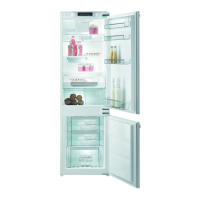




 To Next Page