EasyManua.ls Logo

Graf PLATIN - User Manual

Graf PLATIN
18 pages
Print Icon
To Next Page IconTo Next Page
Loading...
1 / 18
SHALLOW EXCAVATION

Other manuals for Graf PLATIN

Question and Answer IconNeed help?

Do you have a question about the Graf PLATIN and is the answer not in the manual?

Summary

Graf Platin Fill Materials

Backfill Materials

Approved porous fill materials for tank backfilling, including washed sand and 7mm minus.

Wrong Backfill - Non Porous Materials

Prohibited non-porous fill materials like builders sand, clay, and cement to avoid voiding warranty.

1. General notes

1.1 Safety

Adherence to occupational health and safety legislation and Australian Standards for installation safety.

1.2 Identification of water pipes and outlets

Proper marking of water pipes and outlets with "RAINWATER" and adherence to local plumbing regulations.

1.3 Maintenance

Guidelines for tank maintenance, referencing confined spaces legislation and occupational safety.

1.4 Site

Considerations for excavation and trenching legislation, shoring, battering, and depth specific regulations.

1.5 Lifting of Tanks

Compliance with state/territory legislation regarding lifting and moving of Graf water tanks.

5. Installation and assembly

5.1 Construction site pre-check

Verifying ground suitability, groundwater levels, expected loads, and underground services before installation.

5.2 Trench

Excavation requirements, trench width, depth sizing, and foundation layer specifications for tank installation.

5.3 Insertion and filling

Procedures for inserting tanks, initial water filling, and backfilling with compacted porous material.

5.4 Plumbing connections

Requirements for plumbing pipe declines, overflow connections, and routing of lines within empty pipes.

6. Assembling the telescopic dome shaft

6.1 Assembling the telescopic dome shaft

Attaching the telescopic dome shaft to the tank, ensuring proper seal fit and alignment.

6.2 Telescopic dome shaft on which persons may walk

Instructions for installing dome shafts designed for pedestrian traffic, including backfill compaction.

6.3 Telescopic dome shaft over which passenger cars may drive

Guidelines for installing trafficable dome shafts, including concrete layering for vehicle loads.

7. Assembly of the extension riser

7.1 Assembling the extension riser

Connecting extension risers to the tank dome for increased coverage heights and proper seal installation.

8. Inspection and servicing

Inspection and Servicing Schedule

Regular checks for leaks, cleanliness, stability, and periodic 5-year servicing of the entire system.

9. Minimax Filter Package Installation

9.1 Minimax Internal Filter

Details of the filter package components, flow difference, and mesh size specifications.

9.2 Technical Specifications

Diagrams and dimensions related to the Minimax filter and overflow siphon.

9.3 Installation of inflow pipe and overflow siphon

Guidance on connecting inflow pipes and the emergency overflow siphon to the tank.

9.4 Filter Installation

Connecting filter body to PVC pipe with attention to pipe length and secure fitting.

9.5 Insert the filter cartridge into the tank

Procedures for inserting the filter, using rubber ring adaptors and Spannfix collars for secure connection.

9.6 Commissioning

Steps for initial setup, including cleaning the filter sieve and ensuring correct flow direction.

9.7 Regular Maintenance

Ongoing checks for filter cleanliness, debris, and system stability to ensure optimal water yield.

10. Pictorial Installation of the Graf Platin Tank

10.1 Installer Support Service

Information on obtaining expert advice and support for installing Graf Tanks & Filters.

11. Storm Water Detention;Retention

11.1 Detention Tank (Detain)

Utilizing the tank as a detention system to capture and release rainwater to manage storm flow.

11.2 Detention;Retention Tank (Detain & Retain)

Using the tank for water savings by collecting and slowly releasing rainwater for property use.

11.4 Two 5,000 L Tanks Detention;Retention System

Configuration for a dual 5,000-litre tank system for storm water detention or retention.

11.5 Height of Detention Outlet

Volumetric measurement data for a 5000L Platin tank, detailing litre increase by water depth.

Overview

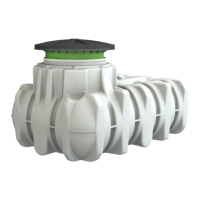
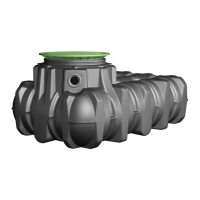
The Graf Platin® Underground Rainwater Tank is a robust and versatile solution for rainwater harvesting, designed for shallow excavation and suitable for various applications, including pedestrian and vehicle loading. This system is engineered for durability and ease of installation, offering a 12-year warranty.

Function Description:

The Graf Platin® system is an underground rainwater storage tank designed to collect, filter, and store rainwater for various uses. It is suitable for both detention and retention purposes, allowing property owners to manage stormwater runoff while also utilizing collected rainwater for non-potable applications such as flushing toilets, filling washing machines, and watering gardens. The system incorporates an integrated filter technology to ensure the quality of the collected water. Its shallow excavation design minimizes installation depth, making it a practical choice for many sites. The tank can be installed in green areas or under areas used by passenger cars, with specific installation guidelines for each scenario to ensure structural integrity and safety.

Important Technical Specifications:

The Graf Platin® tanks are available in three main capacities: 1500 Litres, 3000 Litres, and 5000 Litres.

  • 1500 Litres:
    • Weight: 82 kg
    • Length (L): 2100 mm
    • Width (W): 1250 mm
    • Height (H): 700 mm
    • Total Height (Htot*): 1015 mm
    • Minimum Hole Size (L x W x H): 2300 x 1450 x 1155 mm
  • 3000 Litres:
    • Weight: 180 kg
    • Length (L): 2450 mm
    • Width (W): 2100 mm
    • Height (H): 735 mm
    • Total Height (Htot*): 1050 mm
    • Minimum Hole Size (L x W x H): 2650 x 2300 x 1190 mm
  • 5000 Litres:
    • Weight: 250 kg
    • Length (L): 2890 mm
    • Width (W): 2300 mm
    • Height (H): 950 mm
    • Total Height (Htot*): 1265 mm
    • Minimum Hole Size (L x W x H): 3090 x 2500 x 1405 mm

The system is designed for a minimal installation depth, with coverage heights ranging from 455mm to 755mm for standard and trafficable dome shafts. For areas used by passenger cars, the minimum coverage above the tank shoulder is 700 mm and maximum 1000mm, with a concrete support layer (load class B25 = 250 kg/m²) around the collar area of the telescopic dome shaft. The maximum load for areas used by passenger cars is 3.5 tonnes. The tank is groundwater stable, with permissible immersion depths specified for installation in groundwater.

Installation Conditions and Materials:

  • Backfill Materials: Preferred materials are 7mm Minus or Washed Sand. These must be porous. Non-porous materials like Builders Sand, Clay, Cement, or Types C & D Crushed Rock are explicitly prohibited as they may void the warranty.
  • Hole Base: A 100mm compacted base of 20mm Type B Crushed Rock (porous) is required.
  • Trench Dimensions: The base area of the trench must exceed the tank dimensions by > 100 mm on each side. The distance from solid constructions must be more than the depth of the trench away from the structure.
  • Groundwater: If the tank is immersed deeper into groundwater than specified, sufficient dissipation must be ensured, possibly via an annular drainage system.
  • Multiple Tanks: When connecting multiple tanks, the GRAF Platin Interconnect Tank Seal (Red) and basic 100mm PVC pipes are used. Connecting holes must be pre-cut with a special GRAF 124mm hole saw. A minimum distance of 500mm between tanks is required.
  • Filling: Tanks must be 1/3 filled with water before backfilling to prevent deformities. Backfilling is done in 30 cm layers with 7mm Minus material, manually compacted. Mechanical compaction machines must not be used.
  • Plumbing: All feed and overflow pipes must have a decline of at least 1%. Overflow to public stormwater must be protected against reflux with a Reflux Valve (AS/NZS3500.1:2003). Suction, pressure, and control lines should be routed inside an empty pipe with a decline, connected above the maximum water level.

Usage Features:

  • Shallow Excavation: The design allows for minimal digging, reducing installation time and costs.
  • Vehicle Loading: Specific models and installation methods allow the tank to be installed under driveways or areas with light vehicle traffic (up to 3.5 tonnes).
  • Modular Design: Multiple tanks can be connected to increase storage capacity, suitable for larger properties or higher water demand.
  • Integrated Filtration: The Minimax Filter Package ensures clean rainwater collection. It includes a filter body, basket, spray cleaner, and rodent guard. The filter is suitable for roof areas up to 350 square metres with a mesh width of 0.35mm.
  • Telescopic Dome Shaft: Allows for infinite adaptation to site surfaces, accommodating varying earth coverage depths. It can be inclined by 5 degrees.
  • Extension Riser: Available for larger coverage heights, extending the earth cover capacity up to 955mm (standard lid) or 1055mm (vehicle lid).
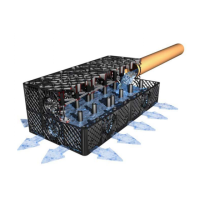
  • Stormwater Detention/Retention: The tank can function as both a detention tank (slowly releasing water to the stormwater system) and a retention tank (storing water for property use), helping to manage stormwater runoff and conserve water.

Maintenance Features:

  • Regular Inspection: The entire system should be checked for leaks, cleanliness, and stability at least every three months.
  • Comprehensive Servicing: A full service is recommended every 5 years, involving:
    • Draining the tank completely.
    • Cleaning surfaces and internal parts with water.
    • Removing all dirt from the tank.
    • Checking that all internal parts are firmly seated.
  • Filter Maintenance: The Minimax filter sieve should be checked for dirt and debris immediately after the first rainfall post-installation, and after any major rainfall events or long dry spells. The filter sieve can be cleaned in a dishwasher (40° - max. 60°). The spray cleaner, if connected, provides additional insurance against filter blockage and can be operated manually or automatically.
  • Overflow Siphon Check: The overflow siphon should be checked and cleaned during filter service.
  • Accessibility: The telescopic dome shaft and extension riser provide easy access to the tank interior for inspection and servicing. The cover is designed to be sealed and tightened to prevent unauthorized entry.

The Graf Platin® Underground Rainwater Tank is certified to Quality standard ISO9001-2008 and AS/NZS 4766-2006, ensuring high quality and compliance with Australian and New Zealand standards.

Graf PLATIN Specifications

General IconGeneral
BrandGraf
ModelPLATIN
CategoryWater Heater
LanguageEnglish

Related product manuals