28
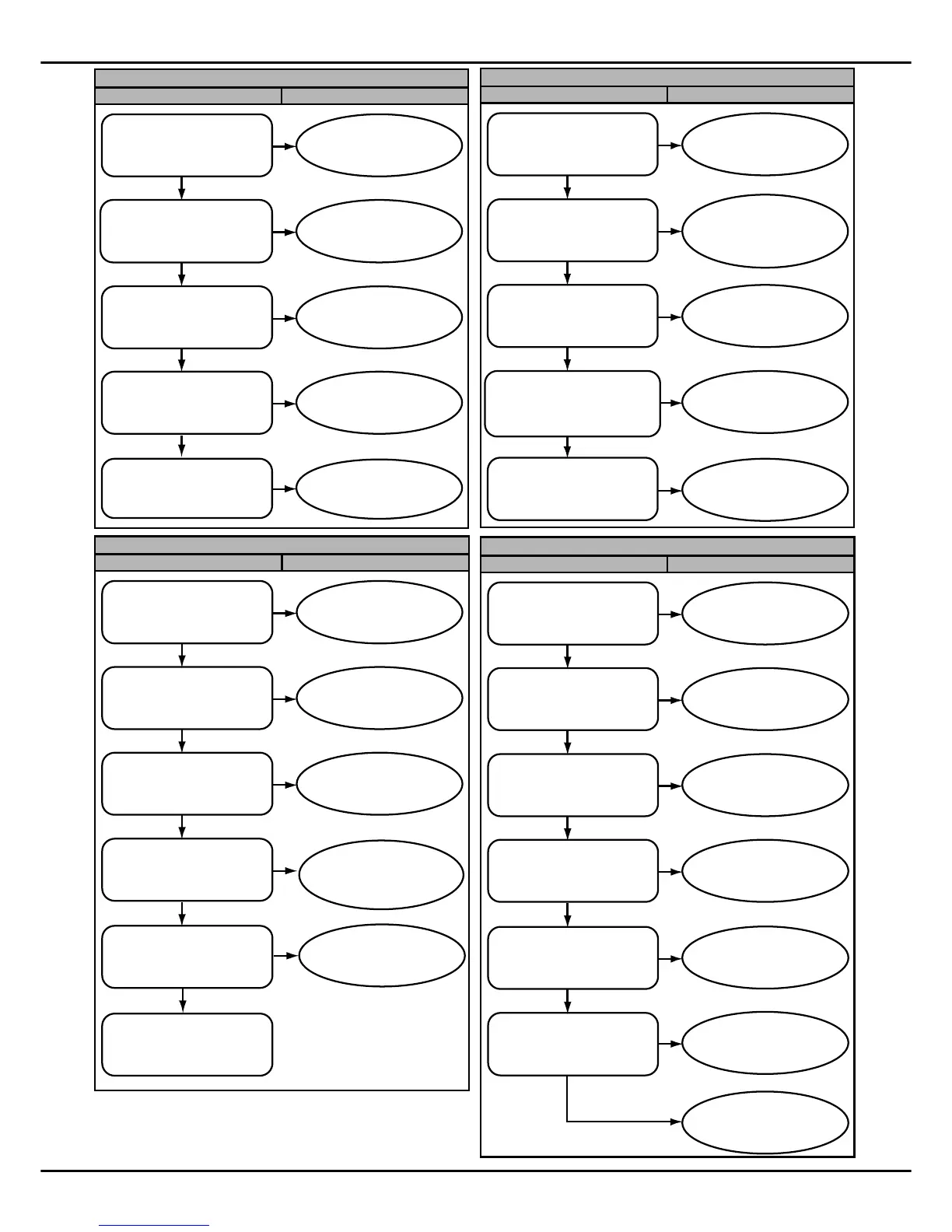
C5/E7 (Compressor discharge sensor(T5) is seated fault)
Diagnosis Handling
Check that sensor is properly
seated on discharge pipe.
Yes
Check whether wiring of T3/T5
sensors and pressure transduce
(PT) are wired in accordance
with wiring diagram
Yes
Check whether there’re other
heat sources around T3,T5
Yes
Check whether resistance of
T5 is within the range of
TABLE2
Yes
Power off and restart to see
whether there’s the same fault
Fix the discharge temp.
sensor to the compressor
discharge pipe, re-power
on to start the unit
No
Wiring according to the
nameplate and re-power
on to start the unit
No
Remove all the heat
sources
No
Replace T5 temp. sensor
No
Replace the main control
board
Yes
H3/P3 (Compressor over current protection)
Diagnosis Handling
Check whether the service
valves are open
Yes
Check whether compressor
wiring is normal
Yes
Check whether compressor
insulation resistance is greater
than 100kΩ
Yes
Restart to check whether the
high and low pressure
difference is at least 30 PSIG
after compressor running 10 min
Yes
Power off and restart to check
whether there’s the same fault
Open the service valve
No
Wiring correctly according
to the wiring diagram and
re-power on to start
the unit
No
Replace compressor
No
No
Replace the main control
board
Yes
H5/P2 (Low pressure(PT) Protection in cooling)
Diagnosis
Handling
Yes
Check whether indoor unit is
normal by valve, filter and
airflow
Yes
Yes
Measure and compare low
pressure with the value from
check button to see whether
they are same.
Check whether refrigerant
amount is correct according to
subcooling in charge mode
(force mode)
Yes
No
Exclude indoor unit fault
reasons and restart
No
No
Adjust refrigerant
amount and restart
No
F5/Hb (High pressure(PT) protection in Heating)
Diagnosis Handling
Yes
No
Check whether the indoor air
inlet temp. is over 86°F
No
Check whether outdoor side
ambient temp. is over 86°F
No
Measure and compare high
pressure with the value from
check button to see whether
they are same
No
Check whether the sensor
was broken according to
Table 3
No
Yes
Remove e.g. indoor
side E-heat or other
heat sources
Yes
Replace outdoor unit
EXV
Yes
Not applicable to start
heating
Yes
Replace the pressure
transducer
Replace the main control
board
No
Yes
Check whether the service
valves are open
Open the service valve
Check whether the service
valves are open
Open the service valve
Check whether indoor unit is
normal by valve, filter and
airflow
Exclude indoor unit fault
reasons and restart
Check whether the sensor was
broken according to Table 3
Yes
Replace the pressure
transducer
Replace TXV of indoor unit
in cooling,or replace outdoor
unit EXV in heating
No
Replace the main control board
Replace compressor


 To Next Page