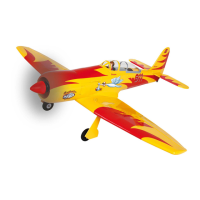
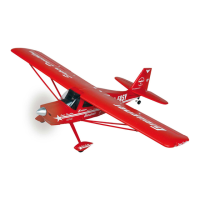
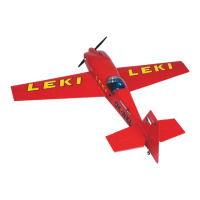
The LEKI EXTRA 330SC is a superbly maneuverable RC aerobatic model, designed for enthusiasts seeking a compact yet high-performance aircraft. Its small dimensions make it exceptionally easy to transport, a significant advantage for modelers who frequently travel to flying sites. Despite its size, the model is highly pre-fabricated, simplifying the assembly process for users. However, it is crucial to note that careful attention to the construction stages outlined in the instructions is essential to ensure safe and successful operation. The all-up weight of the model must not exceed 1000 g, a critical specification for maintaining its flight characteristics and safety.
Function Description:
The LEKI EXTRA 330SC is an RC aerobatic model designed for advanced flight maneuvers. It operates on a 2 LiPo cell power system and requires a HoTT radio control system with at least four functions for full control. The model's design emphasizes agility and precision, making it suitable for a wide range of aerobatic stunts. The control surfaces, including ailerons, elevator, and rudder, are designed for responsive and accurate input, allowing pilots to execute complex flight patterns. The model's brushless motor provides ample power for aggressive flying, while the propeller system is optimized for efficient thrust.
Important Technical Specifications:
- Model Type: RC aerobatic model
- Power System: 2 LiPo cells
- Maximum All-Up Weight: 1000 g
- Recommended Radio Control System: Graupner HoTT 2.4 GHz (e.g., COMPUTER SYSTEM MX-16, Order No. 33116) with at least four functions.
- Motor: Brushless motor COMPACT 345Z (Order No. 7738)
- Propeller: ELECTRIC PROP 10x5" (Order No. 1326.10x5)
- Speed Controller: COMPACT CONTROL 45 (Order No. 7224)
- Battery: LiPo 2/1600 7.4 V/1.6 Ah (Order No. 7634.2)
- Servos: DES 476 BB (5 required, Order No. 7915)
- Servo Extension Leads: 100 mm (2 required, Order No. 3935.11), 180 mm (2 required, Order No. 3935.18)
- Receiver: GR-12 HoTT receiver (included with radio system)
- Center of Gravity (CG): 72 mm from the leading edge of the wing.
- Rudder Deflections (Recommended): Ailerons 25 mm (each direction), Elevators 25 mm (each direction), Rudder 50 mm (all measured at the inboard or bottom edge of the rudder).
Usage Features:
- Assembly: The model is highly pre-fabricated, but requires careful assembly following the provided instructions. Users need to gather specific RC system accessories, tools, and adhesives (not included) before starting.
- Adhesive Usage: Quick-drying glue with activator is generally recommended, applied to one face with activator sprayed on the opposite. UHU ALL PURPOSE ADHESIVE Power is specified for certain parts like aileron hinges and cockpit canopy. Caution is advised when using cyano-acrylates, recommending protective goggles and keeping them out of reach of children.
- Wing Assembly: Involves gluing aileron hinges, fitting servos into the wing, and connecting pushrods. Longer servo levers are included for extreme flight maneuvers.
- Motor Installation: The motor spindle, mount, and locking ring are attached to the motor. Motor leads require soldering G 3.5 connectors and insulating with heat-shrink sleeves. A test run is recommended to ensure correct propeller rotation (to the right when viewed in flight direction).
- Fuselage and Tail Group Assembly: Involves securing the motor, adjusting the motor bonnet for a 1 mm gap between the spinner back plate and fuselage, and screwing it into place. The motor bulkhead is glued in through cooling air intakes.
- Tailplane and Vertical Stabilizer: Rudder hinges are glued using UHU ALL PURPOSE ADHESIVE Power. The tailplane is centered and glued into the fuselage, with a slit cut for the lowest rudder hinge to accommodate the vertical stabilizer.
- Control Linkages: The rudder is controlled by leads on two sides, connected to a central rudder servo. The two-part elevator is controlled by two separate servos. Servo attachment elements are included with the servos.
- Undercarriage and Cockpit Canopy: Involves assembling the undercarriage struts, wheel covers, and attaching the wheels. The transitional cowling is trimmed and slid onto the struts. The pilot bust can be omitted to save approximately 30 g for more agile flight characteristics. The cockpit canopy is glued on with UHU ALL PURPOSE ADHESIVE Power.
- Decals: Individual decals and name placards are to be cut out and applied to the model as shown in the illustrations.
- Receiver and Battery Installation: Servo leads are connected to the receiver in a recommended sequence. The speed controller and receiver are secured with hose binders, and the LiPo battery with hook-and-loop cable ties.
- Pre-flight Check: Essential before every flight. Includes checking all working systems, control surface neutrality and deflection, and ensuring the motor runs correctly (with someone holding the model securely).
- Balancing: The model's balance must be checked in ready-to-fly condition with the LiPo connected. The center of gravity should be 72 mm from the leading edge of the wing, adjusted by moving the LiPo battery.
- Flying: First flights should be in neutral wind conditions. Ground starts from a smooth runway or hand starts into the wind are recommended. Minimal aileron and elevator corrections are needed for a straight climb. Fine trim is adjusted via the trim slider. Landing should always be directly into the wind with the motor idling, reducing air speed with up-elevator just before touch-down.
- Safety Notes: Emphasizes the importance of valid third-party insurance, reading all instructions, adult supervision for young persons, adherence to legal regulations for model aircraft, using genuine Graupner parts, avoiding short-circuits, and understanding the risks associated with LiPo batteries and propellers. It also stresses the importance of checking the model's condition before each flight, ensuring vacant radio frequencies, and maintaining a safe distance from people and objects. Flying in extreme temperatures (-5°C to +35°C) is not recommended.
Maintenance Features:
- Post-flight Battery Care: After each session, the battery should be removed, discharged to the recommended level, and stored in a safe place (out of reach of children, at +5°C to +25°C).
- Regular Checks: Users are advised to regularly check the model and all its attached components (propeller, gearbox, RC components, etc.) for good condition and any damage. Any faults must be corrected before flying again.
- Adhesive Residue: Immediately wipe off excess adhesive with wood pulp paper to prevent it from getting on hands or the model's surface.
- Propeller Maintenance: Ensure the propeller is free from any obstructions and that it rotates correctly. If the motor rotation is incorrect, switch any two leads and re-insert.
- General Care: The manual implies that proper assembly and adherence to operating instructions contribute to the longevity and reliable performance of the model, minimizing the need for extensive maintenance beyond routine checks and repairs.

 Need help?


 To Next Page
 General