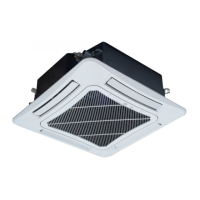
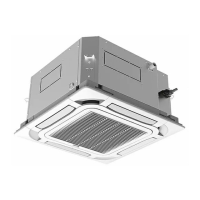
This document serves as the Owner's Manual for Gree Commercial Air Conditioners, specifically focusing on Multi Variable Air Conditioners with Ducted Type Indoor Units. It provides essential information for installation, operation, and maintenance to ensure safe and correct usage of the product.
Function Description:
The device is a commercial air conditioner, part of Gree's Multi Variable Refrigerant Flow (VRF) system, designed for ducted indoor unit applications. Its primary function is to provide heating and cooling for commercial spaces, ensuring a comfortable indoor environment. The system allows for multiple indoor units to be connected to a single outdoor unit, offering flexibility and energy efficiency for various building layouts and demands. The ducted type indoor unit is designed for concealed ceiling installation, allowing for discreet integration into the building's aesthetics while delivering conditioned air through a ductwork system.
Important Technical Specifications:
The manual lists several models of ducted type indoor units, including:
- GMV-ND22PHS/B-T
- GMV-ND25PHS/B-T
- GMV-ND28PHS/B-T
- GMV-ND32PHS/B-T
- GMV-ND36PHS/B-T
- GMV-ND40PHS/B-T
- GMV-ND45PHS/B-T
- GMV-ND50PHS/B-T
- GMV-ND56PHS/B-T
- GMV-ND63PHS/B-T
- GMV-ND71PHS/B-T
- GMV-ND80PHS/B-T
- GMV-ND90PHS/B-T
- GMV-ND100PHS/B-T
- GMV-ND112PHS/B-T
- GMV-ND125PHS/B-T
- GMV-ND140PHS/B-T
- GMV-ND160PHS/B-T
- GMV-ND180PHS/B-T
Rated Working Conditions:
- Rated Cooling: Indoor Dry Bulb Temp 27°C, Wet Bulb Temp 19°C; Outdoor Dry Bulb Temp 35°C, Wet Bulb Temp 24°C.
- Rated Heating: Indoor Dry Bulb Temp 20°C, Wet Bulb Temp 15°C; Outdoor Dry Bulb Temp 7°C, Wet Bulb Temp 6°C.
Communication Line Requirements:
- For indoor unit and wired controller: Total length L (m) ≤ 250m, Wire size 2×0.75~2×1.25 mm², Material Standard IEC 60227-5. The cord should be circular with twisted cores. Shielded wire is recommended in environments with intense magnetic fields or strong interference.
- For indoor unit and indoor (outdoor) unit: Total length L (m) ≤ 1000m, Wire size ≥ 2×0.75 mm², Material Standard IEC 60227-5. If wire diameter is enlarged to 2×1 mm², total communication line length can reach 1500m. Shielded wire is recommended in environments with intense magnetic fields or strong interference.
Power Cord Size and Air Switch Capacity:
For GMV-ND22~180PHS/B-T models:
- Power Cord Size: 220~240V-1ph-50Hz or 208~230V-1ph-60Hz
- Air Switch Capacity: 6A
- Minimum Sectional Area of Ground Wire: 1.0 mm²
- Minimum Sectional Area of Power Cord: 1.0 mm²
Copper wire only should be used for power cords, with operating temperature within rated value. For power cords longer than 15m, the sectional area should be increased.
Installation Dimensions (Unit: mm):
| Model |
A |
B |
C |
D |
E |
F |
G |
| GMV-ND22~50PHS/B-T |
740 |
500 |
830 |
300 |
754 |
700 |
700 |
| GMV-ND56~80PHS/B-T |
1040 |
500 |
1130 |
300 |
754 |
1000 |
700 |
| GMV-ND90~125PHS/B-T |
1440 |
500 |
1530 |
300 |
754 |
1400 |
700 |
| GMV-ND140~180PHS/B-T |
1440 |
500 |
1580 |
300 |
754 |
1400 |
700 |
External Static Pressure:
Working range: 0 Pa to 200 Pa.
- GMV-ND22~50PHS/B-T: Static pressure notch 2 (0 Pa) to 9 (150 Pa).
- GMV-ND56~160PHS/B-T: Static pressure notch 2 (0 Pa) to 9 (200 Pa).
- GMV-ND180PHS/B-T: Static pressure notch 2 (0 Pa) to 9 (170 Pa).
Default static pressure notch for all models at ex-factory is 5.
Usage Features:
- Concealed Installation: Designed as a concealed ceiling type unit, it integrates seamlessly into the interior design.
- Wired Controller: The unit can be controlled via a wired controller. One wired controller can manage up to 16 indoor units. An indoor unit can also connect to two wired controllers (master and slave).
- Remote Control Option: Users can purchase a remote controller and receiver separately for additional control convenience.
- Preheating Function: Under standby status, the product consumes some power to maintain normal system communication and preheat refrigerant and lubricant. For long periods of non-use, power should be cut off. Before reusing, the unit should be energized and preheated in advance.
- Safety Features: Includes various protection mechanisms such as indoor fan protection, E-heater protection, water full protection, freeze protection, power insufficiency protection, and overcurrent protection.
- Error Code Display: The unit provides error codes for troubleshooting, covering issues like indoor unit error, sensor errors, communication errors, and module protection.
Maintenance Features:
- Filter Cleaning: Filters should be removed from the inlet of the indoor unit and cleaned regularly (usually once every two weeks in dusty environments). Dust can be removed with a vacuum cleaner, or filters can be washed with warm water and mild detergent, then dried in the shade.
- Seasonal Maintenance (Before Use):
- Check for blockages at the air inlet and outlet of both indoor and outdoor units.
- Verify secure grounding.
- Ensure all power cords and communication cables are securely connected.
- Check for any error codes after energizing.
- Seasonal Maintenance (After Use):
- Run the unit in fan mode for half a day on a sunny day to dry the inner parts.
- For long periods of non-use, cut off the power supply to save energy.
- Professional Service: Installation, movement, and maintenance should only be performed by designated dealers or qualified technicians. Users are advised not to disassemble or maintain the unit themselves to avoid damage, electric shock, or fire hazards.
- Drainage System Testing: After electrical work, approximately 1L of purified water should be injected into the drain pan to test the drainage system, ensuring no leakage and proper operation of the water pump (if equipped). This test is strongly recommended before ceiling decoration.
- Air Duct Maintenance: Insulating layers on air-out, air-return, and fresh air ducts should be maintained to prevent heat loss and moisture. Air duct junctions must be well-sealed to prevent air leakage. Filters should be added to the air-return opening.
- Troubleshooting Guide: The manual includes a troubleshooting section to help identify common issues such as the unit not starting, stopping after a short run, poor cooling/heating effect, or the indoor fan not starting during heating. This guide helps users perform initial checks before contacting service.



 To Next Page

 General