17
LIQUID
LIQUID
LIQUID
LIQUID PROPANE
PROPANE
PROPANE
PROPANE CYLINDER
CYLINDER
CYLINDER
CYLINDER REQUIREMENTS
REQUIREMENTS
REQUIREMENTS
REQUIREMENTS
(20-lb
(20-lb
(20-lb
(20-lb .
.
.
. Cylinder)
Cylinder)
Cylinder)
Cylinder)
A dented or rusty Liquid Propane C ylinder may be hazardous and should be checked by your supplier.
Never use a c ylinder with a damaged valve. The Liquid Propane C ylinder must be constructed and
marked in accordance with the specifications for Liquid Propane C ylinders by the United States
Department of Transportation (DOT) or the National Standard of Canada, CAN/CSA-B339, Cylinders,
Spheres and Tubes for Transportation of Dangerous Goods Commission.
The 20-lb . C ylinder must have a shut off valve terminating in a valve outlet specified, as applicable, for
connection type QCC1 in the standard for compressed gas cylinder valve outlet and inlet connection
ANSI/CGA-V-1.
Storage of an outdoor cooking gas appliance indoor is permissible only if the cylinder is disconnected and
removed from the outdoor cooking gas appliance. The C ylinder system must be arranged for vapor
withdrawal. The cylinder must include a collar to protect the C ylinder valve.
Manifold pressure: (operating) 11 inches water column (W.C.), (non-operating) 11.2 inches water column
(W.C.).
Liquid Propane C ylinder s must be provided with a listed overfilling prevention device.
Remove the plastic valve cover from the Liquid Propane C ylinder. Make sure the grill gas hoses do not
contact the grease pan or grill firebox when the Liquid Propane C ylinder is placed into the cart.
CONNECTING
CONNECTING
CONNECTING
CONNECTING THE
THE
THE
THE LIQUID
LIQUID
LIQUID
LIQUID PROPANE
PROPANE
PROPANE
PROPANE CYLINDER
CYLINDER
CYLINDER
CYLINDER
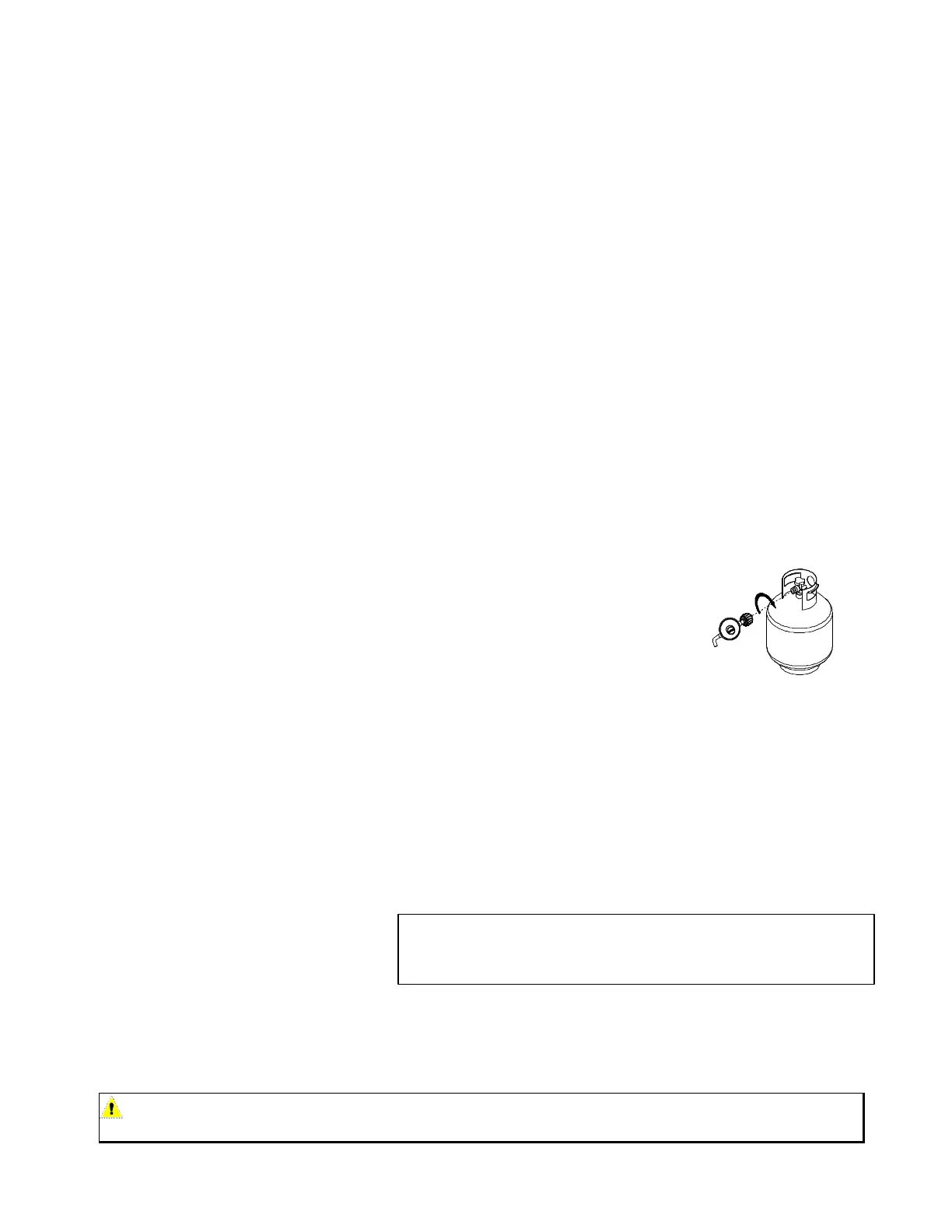
To connect the Liquid Propane G as S upply C ylinder:
a) The cylinder valve should be in the “ OFF ” position. If not, turn the valve
clockwise until it stops.
b) Make sure the cylinder valve has the proper type-1 external male thread
connections per ANSI Z21.81.
c) Make sure the burner valves are in the “ OFF ” position.
d) Inspect the valve connections, port and regulator assembly. Remove debris and inspect the hose
for damage.
e) When connecting the regulator assembly to the valve, use your hand to tighten the nut clockwise
until it stops. Use of a wrench could damage the quick coupling nut and result in a hazardous
situation .
f) Open the cylinder valve fully by turning the valve counterclockwise.
g) Before lighting the grill, use a soap and water solution to check all the connections for leaks.
h)
If
a leak is found, turn the cylinder valve “ OFF ” and do not use the grill until a local Liquid Propane
dealer can make repairs.
WARNING
WARNING
WARNING
WARNING
Never attempt to use damaged or obstructed equipment. See your local Liquid Propane dealer for repair.
Please make sure the cylinder valve connection device
shall properly and safely mate with the connection device
attached to the inlet of the pressure regulator.


 To Next Page