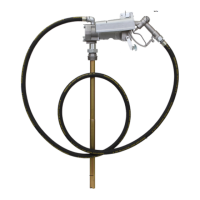
The Electric Oil and Fuel Pump (EOP) is a versatile, world-class device designed for light-duty fluid transfer in industrial, automotive, heating, and marine applications. This pump is equipped with a centrifugal electric motor featuring double insulation, ensuring safe operation even with water and emulsions. Constructed from chemically inert materials, it offers durability and compatibility with a range of fluids.
Function Description:
The EOP is primarily used for the vertical mounting and transfer of fuel and oil. It incorporates a Bent Spring Device, a crucial safety feature that prevents media outflow due to siphon action in the event of accidental damage to the delivery hose or dispensing nozzle. The pump is designed to fit most drum sizes, thanks to its built-in 2" Bung adaptor.
Key Components (Referencing Part Description):
- Pump Body (1): The main unit, housing the motor and other internal mechanisms, including the lever (8) and On/Off Switch (10).
- Rubber Hose (2): A 4-meter long, 3/4" diameter hose, which can be cut to the required length for intake and delivery.
- Dispensing Nozzle (3): Includes the trigger (9), allowing for controlled fluid dispensing.
- Intake Filter (4): Ensures that only clean fluid enters the pump, protecting internal components.
- Stainless Steel Tube (5): Provides structural support for the intake.
- Hose Clamps (6): Used to secure hoses to the pump and nozzle connections.
- Bent Spring Device (7): A safety mechanism to prevent siphoning.
- Lever (8): Used for manual priming.
- Trigger (9): Activates fluid flow through the dispensing nozzle.
- On/Off Switch (10): Controls the electric motor.
Important Technical Specifications (Across Models EOP/DC/12, EOP/DC/24, EOP/AC/110, EOP/AC/230):
Supply Voltage:
- EOP/DC/12: 12V DC
- EOP/DC/24: 24V DC
- EOP/AC/110: 110V AC
- EOP/AC/230: 230V AC
Max. Flow Rate:
- DC Models: Up to 9.25 GPM (35 LPM)
- AC Models: Up to 10.5 GPM (40 LPM)
Electric Motor:
- All Models: 0.43 HP Centrifugal Motor
Amp Draw from the Battery (DC Models):
- EOP/DC/12: 9.2 Amp
- EOP/DC/24: 5.6 Amp
Amp Draw (AC Models):
- EOP/AC/110: 2.9 Amp
- EOP/AC/230: 1 Amp
Absorbed Power:
- EOP/DC/12: 110 W
- EOP/DC/24: 135 W
- EOP/AC/110: 320 W
- EOP/AC/230: 224 W
Insulation Category:
- DC Models: III
- AC Models: II
Discharge Head: 1 meter (all models)
Hose Dimensions:
- Suction Pipe: 3/4" ID x 1 m long
- Delivery Hose: 3/4" ID x 3 m long
Tank Adaptor: 2"G & M64x4 (all models)
Inlet/Outlet: 3/4" Hose Barb (all models)
Dispensing Nozzle: Manual Polypropylene Nozzle with 3/4" Hose Barb (all models)
Battery/Power Cable:
- DC Models: 3 m long with Battery Clamps
- AC Models: 2 m long with Plug (EOP/AC/110), 3 m long with Plug (EOP/AC/230)
Water/Dust Protection: IPX4 (protection against splashing water) (all models)
Noise Level: 70 dB (all models)
Working Temperature Range: -10°C to +40°C (14°F to 104°F) (all models)
Certifications:
- UL & cUL Listed: No (all models)
- CE: Yes (all models)
Fuel Compatibility: Not for use with Petrol & other Flammable Fuels.
Recommended Use: Diesel, Kerosene, Water, Emulsions, Mineral & Synthetic Oils, Heating Oils, Antifreeze, etc.
Usage Features:
Installation:
- Prepare Intake Hose: Cut the rubber hose to the required length to reach the bottom of the drum, ensuring a square cut.
- Attach Suction Hose: Insert one end of the cut suction hose into the intake nozzle on the pump body (1) and secure with a hose clamp.
- Assemble Filter: Attach the intake filter (4) to the suction hose and fasten with a hose clamp.
- Mount Pump: Screw the pump body (1) onto the drum or tank, ensuring it is in a vertical position.
- Assemble Delivery Hose: Connect the delivery hose to the delivery nozzle of the pump body. Fasten the bent spring (7) over the delivery nozzle with a clamp, orienting the straight end of the spring towards the top of the pump.
- Attach Dispensing Nozzle: Connect the dispensing nozzle (3) to the opposite end of the delivery hose and secure with a hose clamp.
- Connect Power: Connect the pump to the appropriate power source.
Commissioning and Use:
- Priming Procedure: Open the nozzle by pressing the trigger (9). Start the pump by repeatedly activating the lever (8) until liquid begins flowing from the dispensing nozzle.
- Start Motor: Once fluid flows, use the switch (10) to start the motor and proceed with fueling.
- Finish Operation: Release the trigger and switch off the motor.
Emergency Operation (Manual Transfer):
In case of power failure or for transferring small quantities of liquid, the pump can be operated manually:
- Keep the trigger (9) of the dispensing nozzle pressed.
- Activate the lever (8) repeatedly.
- Proceed with the transfer.
Safety Warnings:
- The motor and switch are not anti-explosive. Do not use in areas with explosion risk.
- Do not use the pump for gasoline, flammable liquids with PM < 55°C, food liquids, corrosive chemical products, and solvents.
- Do not smoke or use open flames during refueling.
- Avoid spilling diesel.
- Never operate the pump when empty.
- Do not leave the motor running under closed delivery (trigger not pressed) for more than five minutes.
- The pump only works in a vertical position.
- The pump must only be used under operator surveillance.
- Before connecting to power, ensure voltage compliance. Power outside specified limits can damage electrical components.
- Max. acceptable voltage variation is +/- 5% of the nominal value.
Priming Procedure Repetition: The priming procedure must be repeated after an extended stop, if liquid does not flow, if the motor is restarted, or after a power failure.
Maintenance Features:
Disassembly and Maintenance:
The EOP requires minimal maintenance. However, periodic inspection and, if necessary, cleaning of the intake filter (4) are recommended. The condition and efficiency of the hoses (2) and dispensing nozzle (3) should also be checked regularly to ensure a long working life.
Electrical Cable: If the electric cable is damaged, it must be replaced by a technically qualified person to prevent any risk.
Installation Environment: Ensure that the pump's installation location is not susceptible to overflowing.
Wetted Components: The components that come into contact with the fluid are made from POM, Polypropylene, Stainless Steel, Nitrile Rubber, Viton, and PTFE, ensuring chemical resistance and durability.

 Need help?
 General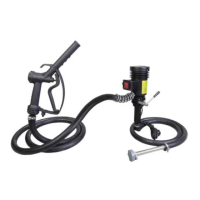

 To Next Page