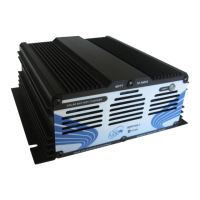
Need help?
Do you have a question about the GSL MPPT60-1 and is the answer not in the manual?
Provides status updates on battery charge level via LED signals.
Indicates the battery is in a healthy state.
Signals that the battery charge is critically low.
Mandatory PV disconnection before battery or load disconnect.
Risk of MPPT damage if panels are shorted without optional diode.
Lithium batteries require built-in voltage protection systems.
MPPT must only be operated with a suitable battery connected.
Use of MIHV or equivalent is recommended for battery and load protection.
Only use PV systems with an open circuit voltage below 84V.
Equipment must be installed by qualified personnel; GSL accepts no responsibility for incorrect wiring.
Use wires suitable for at least 80A; larger wires recommended for runs over 3m.
Install in a dry place, away from direct sunlight and flammable materials.
A battery fuse (BF) is required, located close to the battery, sized for wire and load ratings.
Always check battery and PV panel polarity before connecting.
Protects against panel short and panel voltage, slightly decreasing charge current.
Minimum 18V for 12V systems or 36V for 24V systems for full output power.
MPPT is a converter maintaining PV voltage for maximum power to load/battery.
Charges from high voltage PV, offers less interference and accurate voltages.
Details daily load capacity based on battery voltage and panel wattage.
MPPTs are becoming common due to cost-effectiveness in solar systems.
Deep cycle batteries recommended for cyclical solar systems, min 180Ah capacity.
Higher PV temperatures reduce maximum power point voltage and gain.
MPPT outperforms conventional regulators above 3% of nominal panel power.
Minimize interference by reorienting aerials, moving equipment, or grounding.
 General
| Model | GSL MPPT60-1 |
|---|---|
| Max Output Current | 60A |
| Communication Protocol | RS485 |
| Battery Voltage | 12V/24V/36V/48V |
| MPPT Efficiency | 99% |
| Efficiency | 98% |
| Operating Temperature | -20°C to +55°C |
| Protection | Overload, Over Temperature, Reverse polarity, Short circuit |

 To Next Page