mixture the more carbon monoxide and the less carbon dioxide there is in theexhaust. It
can
beseen from Figure 1 that motor manufacturers generally specifya mixturestrength
at idle that is slightly richer than the stoichiometric ratio. Under some conditions, such as
starting an engine from cold, or during acceleration, very much richer mixtures are
used.
In mixtures weaker than the stoichiometric ratio
(i.e. less fuel, or more air), there is
more oxygen in the air than required for complete combustion of the petrol, and the
surplus oxygen appears in the exhaust gas. The level of carbon monoxide is very low,
since virtually all the carbon in the petrol is completely burnt to carbon dioxide. There is
however a smaller percentage of
carhon dioxide present in the exhaust than at the
stoich~ometric ratioof air and fuel, simply due tothe diluting effect of the extra air passing
through the engine. Engines are commonly designed to run with such weak mixtures
under light load driving conditions, though not at idle.
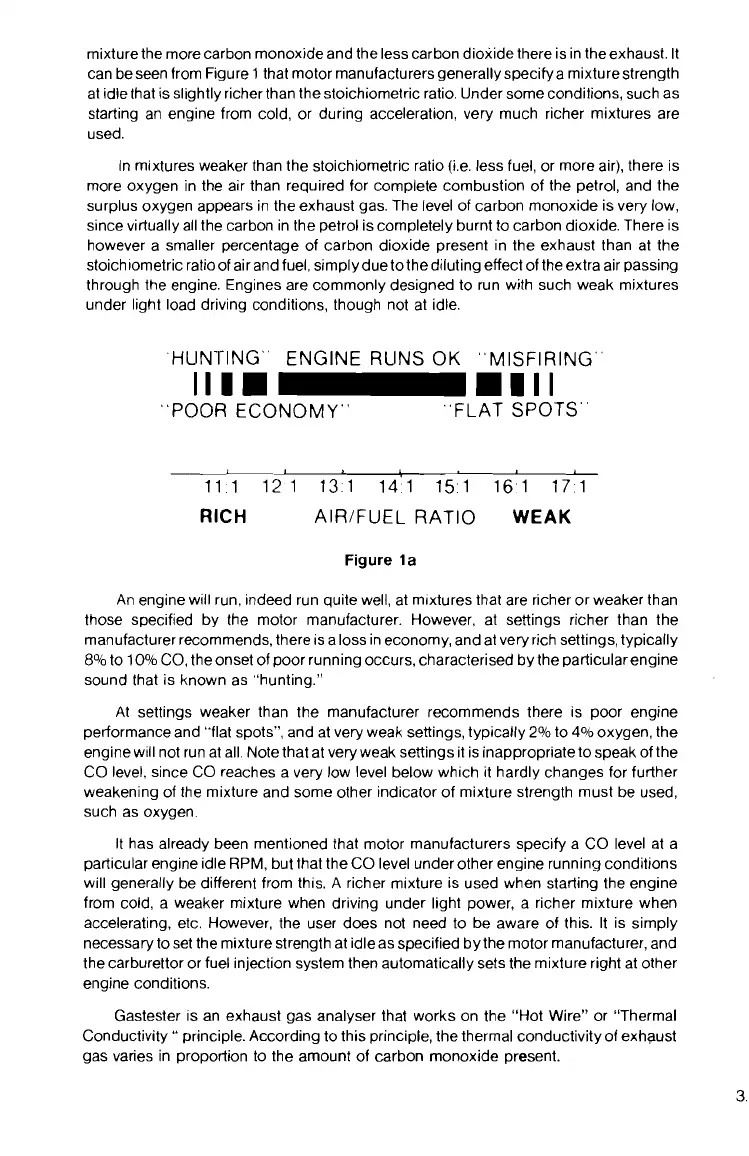
'HCIN'rING'' ENGINE RUNS OK "MISFIRING
'POOR ECONOMY" FLAT SPOTS
RICH
AIRIFUEL RATIO
WEAK
Figure
la
An engine will run, indeed run quite well, at m~xtures that are richer or weaker than
those specified by the motor manufacturer. However, at settings richer than the
manufacturer recommends,
thereis a loss in economy, and at veryrich settings, typically
8%
to 10°/o CO, the onset of poor running occurs, characterised by the particular engine
sound that is known as "hunting."
At settings weaker than the manufacturer recommends there is poor engine
performance and "flat spots", and at very weak settings, typically
2%
to 4Oboxygen, the
engine will not run at all. Note that at very weak settings it is inappropriate to speak of the
CO level, since CO reaches a very low level below which it hardly changes for further
weakening of the mixture and some other indicator of mixture strength must he used,
such as oxygen.
It has already been mentioned that motor manufacturers specify a CO level at a
particular engine idle
RPM,
but that the CO level under other engine running conditions
will generally be different from this. A richer mixture is used when starting the engine
from cold, a weaker mixture when driving under light power, a richer mixture when
accelerating, etc. However, the user does not need to be aware of this. It is simply
necessaryto set the mixture strength at
idleas specified by the motor manufacturer, and
the carburettor or fuel injection system then automatically sets the mixture right at other
engine conditions.
Gastester is an exhaust gas analyser that works on the "Hot Wire" or "Thermal
Conductivity
"
principle. According to this principle, the thermal conductivity of exhaust
gas varies in proportion to the amount of carbon monoxide present.


 To Next Page
 Loading...