18
Maintenance
■ Common Faults and Troubleshooting
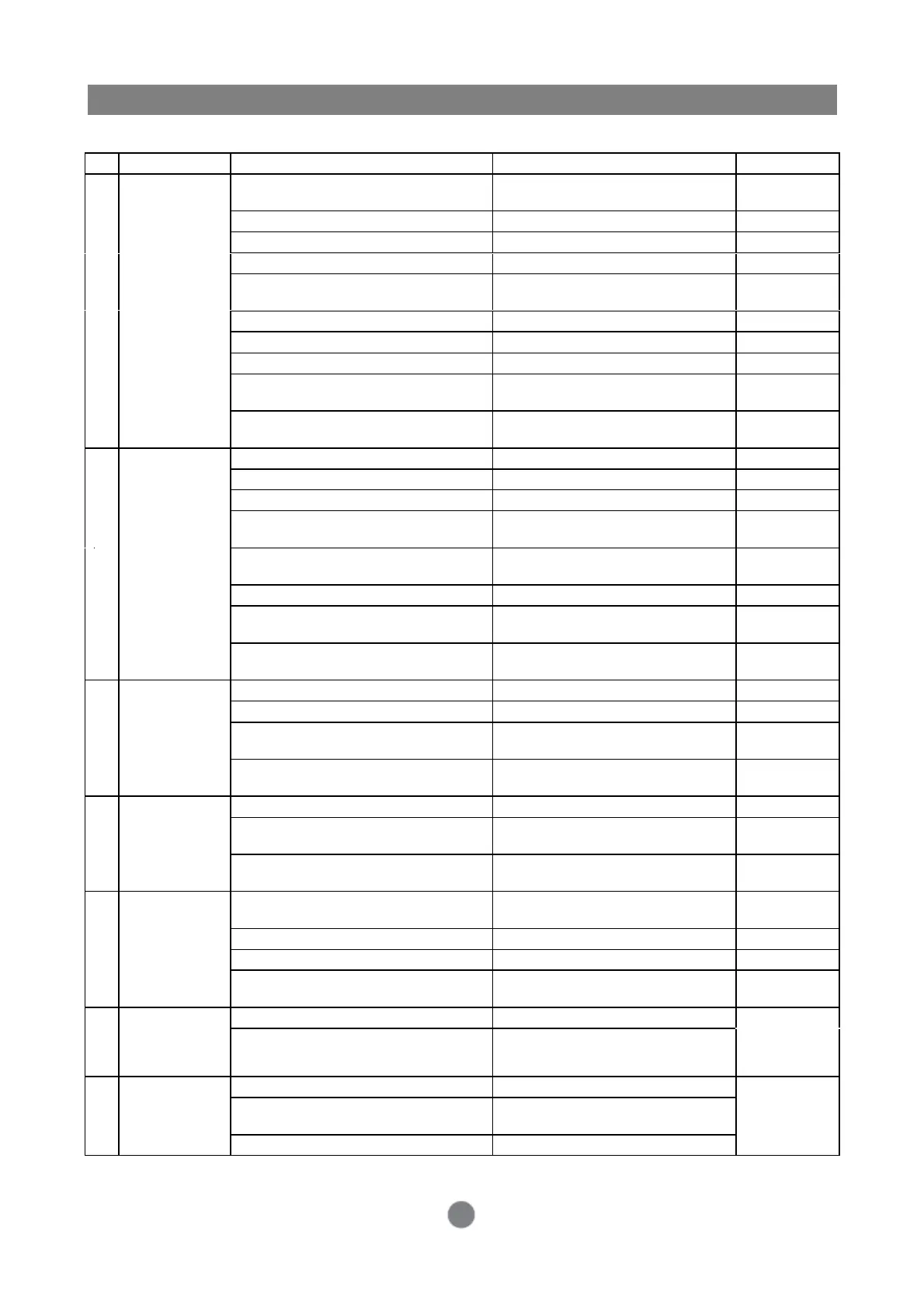
S/N Fault description Possible cause Troubleshooting Remarks
1
Too high
exhaust
pressure
1. Air or non-condensable gas found in
the system
Discharge and empty, if necessary,
the non-condensable gas
Cooling/heating
2. High suction pressure Refer to “High Suction Pressure"
Cooling/heating
3. Undesirable high-pressure switch Replace the high-pressure switch Cooling/heating
4. Dirty or clogged fin of the condenser Clean the air-side heat exchanger Cooling
5. Insufficient air capacity or faulty fan
of the condenser
Check the fan Cooling
6. High charge of refrigerant Adjust the charge of refrigerant Cooling
7. High ambient temperature Inspect the ambient temperature Cooling
8. Insufficient water flow Check the water flow Heating
9. Water-side heat exchanger scaling
or with foreign matters inside
Clean up the incrustation scale Heating
10. High outlet temperature of
water-side heat exchanger
Check the water temperature Heating
2
Low suction
pressure
1. Insufficient refrigerant Adjust the charge of refrigerant Cooling/heating
2. Undesirable low-pressure switch Replace the low-pressure switch Cooling/heating
3. Insufficient water flow Check the water flow Cooling
4. Low water inlet temperature at
water side
Check the water temperature Cooling
5. Water-side heat exchanger scaling
or with foreign matters inside
Clean up the incrustation scale Cooling
6. Insufficient air capacity Check the fan Heating
7. Short circuit found in air circuit
Check the cause of short circuit and
take troubleshooting
Heating
8. Incomplete defrosting
Replace the poor 4-way valve or
defrosting sensor
Heating
3
Too low exhaust
pressure
1. Lack of refrigerant Adjust the charge of refrigerant Cooling/heating
2. Low suction pressure Refer to “Low Suction Pressure"
Cooling/heating
3. Low ambient temperature of air-side
heat exchanger
Check the ambient temperature Cooling
4. Too low water temperature at water
side
Check the water temperature Heating
4
1. Too high charge of refrigerant Adjust the charge of refrigerant Cooling/heating
High suction
pressure
2. High water inlet temperature at
water side
Check the water temperature Cooling
3. High ambient temperature of
air-side heat exchanger
Check the ambient temperature Heating
5
Overtemperature
of exhaust
temperature
sensor
1. Poor ventilation around the unit
Clean up the obstacles around the
unit, or add air ducts
Heating
2. Too low ambient temperature Shut down Heating
3. Dirty or clogged filter at fluorine side Replace the filter Cooling/heating
4. Incomplete frosting (for heating) or
no frosting
Change the frosting parameters Heating
6
Open circuit or
short circuit of
temperature
sensor
1. Damaged sensor Replace the sensor
Cooling/heating
2. Poor connection of sensor Reconnect the sensor
7
Abnormal noise
1. Loose metal plate bolts Retighten bolts
2. Liquid impact due to entry of liquid
refrigerant into the compressor
Adjust the charge of refrigerant or the
poor throttling device
Cooling/heating
3. Poor compressor Replace the compressor


 To Next Page
 Loading...