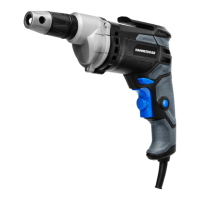
The device described in the manual is a HAMMERHEAD 4.3 AMP DRYWALL SCREW GUN, Model HASG043. It is a corded power tool designed for driving screws, particularly in drywall applications, with features aimed at precision and user safety.
Function Description:
This drywall screw gun is primarily used for driving screws into various materials, with a specific emphasis on drywall. Its design incorporates a depth adjustment knob and a depth stop to control how deep screws are driven, preventing over-driving and ensuring a consistent finish, which is crucial for sensitive surfaces like plasterboard. The tool offers both forward (clockwise) and reverse (counterclockwise) rotation, allowing for both driving and removing screws. A variable speed dial provides control over the operating speed, enhancing safety and precision during use. The tool is equipped with a trigger switch for activation and a lock-on button for continuous operation without holding the trigger. A belt clip is included for convenience, allowing the user to keep the tool within reach while keeping hands free.
Important Technical Specifications:
- Motor: 120V~, 60Hz, 4.3A
- No-Load Speed: 0-4,200 /min (revolutions per minute)
- Bits Holder Size: 1/4" (6.35 mm)
- Tool Type: Class II tool (indicating double insulation for safety)
- Certification: ETL US Listed by Intertek Testing Services, complying with United States Standards.
Usage Features:
- Depth Adjustment: The depth adjustment knob (A) and depth stop (G) allow for precise control over screw depth. Rotating the knob clockwise increases screw depth, while rotating it anti-clockwise decreases it. This feature is particularly beneficial for achieving flush or recessed screw heads in drywall without damaging the surface.
- Forward/Reverse Lever: The forward/reverse lever (E) controls the direction of rotation. Pushing it to the left (from the operator's perspective) enables forward (clockwise) rotation for driving screws, and pushing it to the right enables reverse (counterclockwise) rotation for removing screws. An interlock prevents reversing while the motor is running, requiring the tool to come to a full stop first. A central position on the switch prevents the tool from being switched on, acting as a safety measure.
- Variable Speed Dial: The variable speed dial (B) allows the user to adjust the operating speed. Turning the dial clockwise increases speed, and anti-clockwise decreases it. This feature provides flexibility and control, especially when working with different materials or requiring specific driving speeds.
- Trigger Switch and Lock-on Button: The trigger switch (C) activates the tool. The lock-on button (D) can be engaged while the trigger is depressed to maintain continuous operation, reducing user fatigue during extended use. Releasing the lock-on button requires pressing and releasing the trigger switch.
- Bit Installation: Bits are inserted into the depth adjustment head, which contains a magnet in the output shaft to securely hold the bits. The manual emphasizes ensuring the bit is fully inserted.
- Belt Clip: A belt clip (F) is provided for convenient storage and accessibility, allowing the user to hang the tool on their belt.
- Operation for Screwing: The process involves selecting the correct screw bit, holding the screw and screw gun, aligning the bit with the screw head, selecting forward rotation, and gradually squeezing the trigger switch to achieve the desired speed until the depth stop touches the working face.
- Operation for Unscrewing: For unscrewing, the depth adjustment knob should be rotated clockwise to ensure the depth stop is clear of the working face, allowing the bit to fully engage the screw head. Reverse rotation is selected, and the trigger is gradually squeezed until the screw is removed.
Maintenance Features:
- Cleaning: The manual advises against using solvents for cleaning plastic parts, as they can cause damage. Instead, clean cloths should be used to remove dirt, carbon dust, and other debris.
- Lubrication: The tool's bearings are pre-lubricated with a high-grade lubricant sufficient for the unit's life under normal operating conditions, meaning no further lubrication is required.
- Service and Repair: Any replacement of the supply cord or carbon brushes must be performed by a qualified repair person to ensure safety. The tool should only be serviced by a qualified service technician.
- Extension Cords: If an extension cord is necessary, it must have adequately sized conductors to prevent voltage drop, power loss, or overheating. Grounded tools require 3-wire extension cords with 3-prong plugs and receptacles. A table is provided with recommended extension cord sizes (AWG and mm²) based on the tool's ampere rating and cord length.
- Troubleshooting: A troubleshooting guide is included to help users identify and resolve common issues such as the product not starting, not reaching full power, or unsatisfactory results. It covers possible causes like power supply issues, defective cords, electrical defects, unsuitable extension cords, low voltage power sources, blocked air vents, worn bits, or unsuitable bits for the workpiece material, along with corrective actions. For complex issues, users are advised to contact an authorized service center.
The manual includes extensive safety warnings, emphasizing the importance of reading and understanding all instructions. Key safety points include wearing eye protection (goggles, safety glasses with side shields, or a full-face shield), avoiding operation in explosive atmospheres, keeping the work area clean and well-lit, ensuring electrical safety (matching plugs, avoiding body contact with grounded surfaces, not exposing tools to rain, proper cord handling, using GFCI in damp locations), and personal safety (staying alert, using personal protective equipment, preventing unintentional starting, proper dressing, maintaining balance, and using dust extraction if available). Specific warnings for screwdrivers include holding the tool by insulated gripping surfaces to avoid electric shock if fasteners contact hidden wiring, switching off before putting the tool down, ensuring adequate lighting, keeping the area free of tripping hazards, using only good condition accessory bits, checking clearance, not touching hot bits, keeping hands away from the workpiece, and supporting the work properly. Children and frail people should not use the tool and should be supervised if in the work area.


 To Next Page
 General