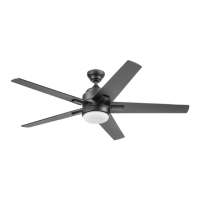
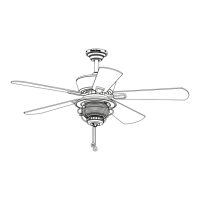
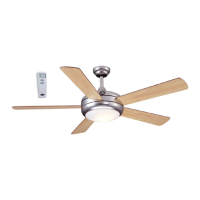
This document describes the Talamore Ceiling Fan, Model #TAL60MBK8LR, a device designed to provide air circulation and illumination in residential settings. The fan is suitable for damp locations, as indicated by its ETL listing.
Function Description
The Talamore Ceiling Fan serves a dual purpose: air circulation and lighting. It features a DC motor, which operates only after the blades are installed, ensuring proper assembly before use. The fan offers six speed settings, ranging from lowest (1) to highest (6), allowing users to adjust airflow according to their comfort needs. A reverse function is also available, which requires the fan to be set to a low speed before activation. This function allows for seasonal adjustment of air circulation, pushing air down in warmer months for a cooling effect and pulling air up in cooler months to redistribute warm air.
In addition to standard fan operation, the Talamore Ceiling Fan includes specialized modes:
- Breeze Mode: This mode automatically cycles through fan speeds from 1 to 6, simulating a natural breeze.
- Vacation Mode: Designed for energy efficiency and security, this mode switches the light kit on for 5 minutes every 2 hours, giving the impression that someone is home.
The integrated LED light kit provides illumination with adjustable color modes. Users can select from:
- Warm white
- Bright warm white
- Natural white
- Bright white
- Daylight
The light can be turned on or off with a quick tap of the designated button on the remote control. Holding the button down allows for continuous increase or decrease in light intensity, functioning as a dimmer. If the light button is pressed for more than 7 seconds, it activates the dimmer function, cycling through light levels over an 8-second period. The light also features an auto-resume function, which recalls the last brightness setting when turned off and resumes at the same speed when turned back on.
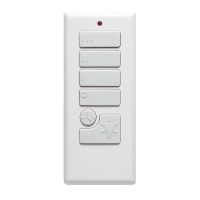
The fan is controlled via a remote control transmitter, which communicates wirelessly with the remote control receiver installed within the fan's canopy. The remote control can be programmed to multiple receivers or fans, though users are advised to turn off wall switches to other programmable devices if this is not desired.
Usage Features
The Talamore Ceiling Fan offers two primary mounting methods:
- Downrod Mount: This is the standard mounting method, suitable for ceilings 8 ft. or higher. It can also be used for angled or vaulted ceilings, provided the ceiling angle does not exceed 17 degrees. A longer downrod (not included) may be necessary for taller ceilings or to ensure proper blade clearance on angled ceilings.
- Closemount: This method is suitable for standard ceilings lower than 8 ft. high. In this configuration, the downrod, yoke cover, and canopy cover are not used.
Installation requires careful attention to electrical connections, which must comply with local codes, ordinances, the National Electrical Code, and ANSI/NFPA 70-1999. It is recommended to consult a qualified electrician or a do-it-yourself wiring handbook if unfamiliar with electrical wiring. The fan must be mounted to an outlet box marked "ACCEPTABLE FOR FAN SUPPORT OF 35 LBS. OR LESS," and the outlet box must be securely attached to the building structure, capable of supporting the fan's moving weight (at least 35 lbs.). Only a metal octagonal outlet box should be used for ceiling mounting.
Safety precautions during installation include:
- Shutting off electricity at the main switch or circuit breaker before beginning work.
- Avoiding the use of power tools for assembly, especially for blades, to prevent serious injury or damage.
- Wearing gloves when handling fan parts with sharp edges.
- Ensuring a minimum clearance of 7 ft. from the blades to the floor and at least 30 in. from the end of the blades to any obstruction.
- Not bending the blades during installation, balancing, or cleaning.
- Not inserting objects between rotating fan blades.
- Using only parts provided with the fan to avoid voiding the warranty.
- Ensuring the outlet box is properly grounded with a green or bare ground wire.
- Not using a full-range dimmer switch to control fan speed, as this can cause a loud humming noise and poses a risk of fire or electrical shock.
The remote control transmitter requires two AAA batteries (included). Batteries should be inserted with correct polarity, and mixing old and new batteries or different types (alkaline, carbon-zinc, rechargeable) is not recommended.
Maintenance Features
Regular maintenance is recommended to ensure the longevity and optimal performance of the Talamore Ceiling Fan:
- At least twice a year, the lower canopy should be lowered to check the downrod assembly, and all screws on the fan should be tightened.
- The motor housing should be cleaned with only a soft brush or lint-free cloth to avoid scratching the finish.
- The blades should be cleaned with a lint-free cloth. A light coat of furniture polish may occasionally be applied to wood blades for added protection.
- Before performing any maintenance, the main power supply to the fan must be shut off.
- Water or a damp cloth should not be used to clean the ceiling fan.
The LED light kit has a total wattage of 20 watts, and users should not attempt to replace the LEDs themselves, as the light source is designed for this specific application and should not be serviced by untrained personnel. For any servicing needs, the customer service department should be contacted.
Troubleshooting guidance is provided for common issues such as the fan not moving, noisy operation, excessive wobbling, and light failure, offering possible causes and corrective actions. A small amount of "wobble" is considered normal and not a defect.
The fan comes with a limited lifetime warranty, covering defects in workmanship and materials from the date of purchase for the original purchaser. Replacement of defective parts within the first year is covered, and for the balance of the warranty, customers can contact customer service for repair or replacement. The warranty does not cover damage from accident, misuse, improper installation, or the use of non-manufacturer parts. It also excludes changes in brass finish, rusting, pitting, tarnishing, corroding, or peeling due to varying climatic conditions, and any glass components.



 To Next Page
 General