Cyclapse Classic
Product Guide - Revision B
The lid can be hinged on either side, and is quickly removable using captive clamps. The clamps will accommodate small padlocks.
We have developed a robust and very simple method for removing the camera from the housing for maintenance or configuration,
and ensure replacement in exactly the same orientation each time. A sliding 'sled' is attached to the camera base. This sled should not
need to be removed from the camera when servicing the camera system. The camera sled will slide onto a rail in the base of the
housing, aligning the camera but allow movement fore and aft. A 'stop' is attached to the rail, to hold the front of the shoe down
against the rail, and positively locate the position of the shoe along the rail. A single retainer behind the camera on the shoe will slip
through the rail, and anchor the camera sled. It's a very simple system but also quite rigid. Given the variety of camera sizes, we have
developed a family of camera sleds and offer an appropriate model to suit the chosen camera.
There are a number of mounts developed specifically for the Cyclapse housing, as well as for solar panels. For additional detail on
the housing, and the optional external mounting solutions, please refer to the product guide for the camera housing, at
cyclapse.com/000292/product_guide.pdf.
Battery Pack
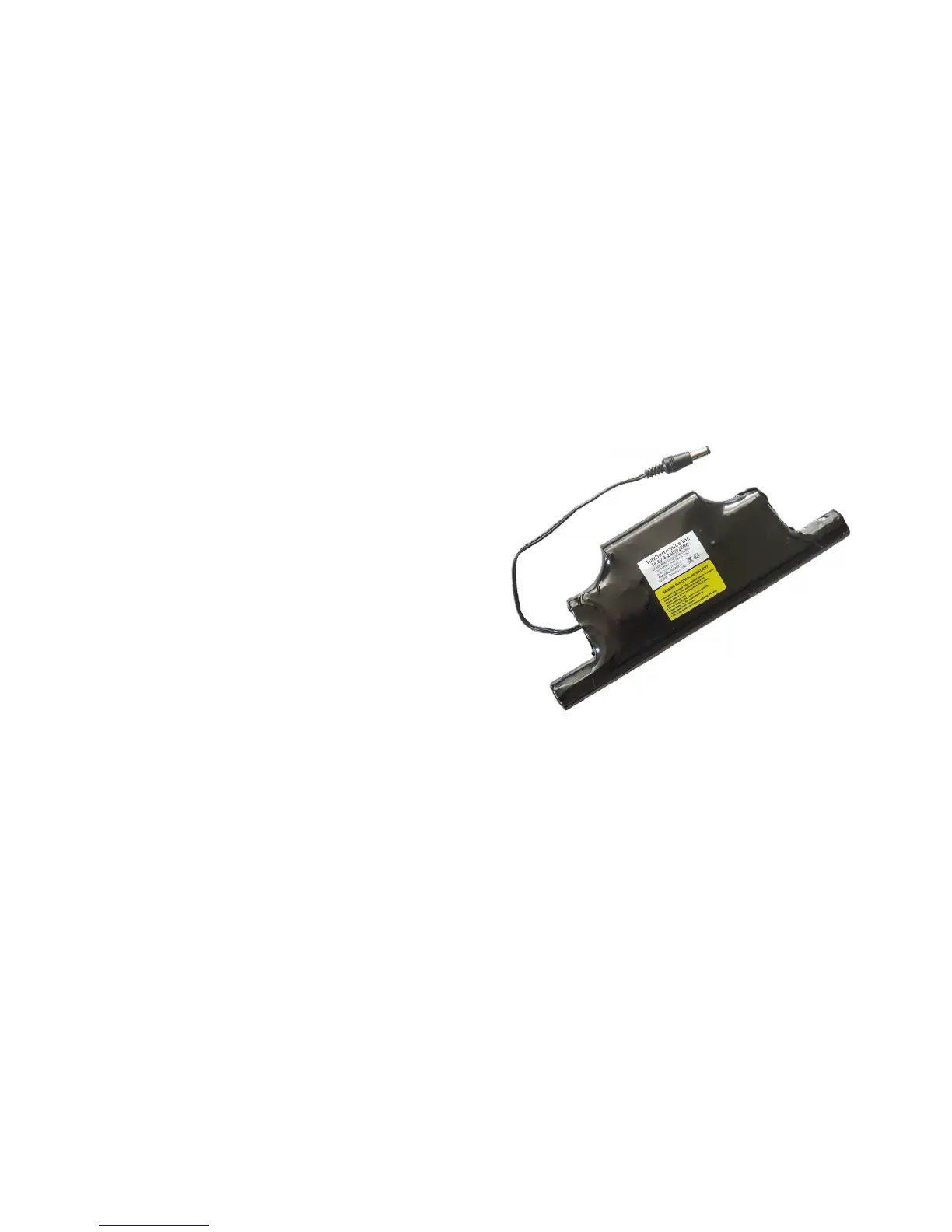
The Cyclapse Classic includes a high capacity Lithium-Ion Polymer (LiPoly) rechargeable battery pack (Harbortronics P/N 000457),
having a nominal voltage of 14.8V, and 92Wh capacity. A dual battery option is advised for systems that take more than 200 pictures
per day, or cameras that draw significant amounts of power. Like all rechargeable batteries, the effective capacity will gradually
decline over time and use. The battery packs should provide service for 3-5 years of constant use.
The most common battery chemistry for long term, remote applications
is lead-acid. Unfortunately, lead-acid batteries have a number of
drawbacks. An equivalent capacity lead acid battery would weight about
7 pounds, vs 0.8 lbs for the LiPoly pack, and would be almost as large as
the housing itself. ALL Lead acid batteries (even the sealed ones) can
vent gases during charge and discharge, making them dangerous to
install within a sealed housing. Most other secondary (rechargeable)
battery types have high self-discharge, meaning that they won’t work
well in a long term application. LiPoly batteries however, have low self-
discharge, are very light-weight, and quite compact. Good stuff, but not
cheap!
The advantages of the LiPoly battery pack for this application outweigh
the significantly higher price, and allow the high capacity battery to
reside inside the housing making the entire unit quite portable.
External Power Sources
There are a number of ways to keep the battery packs in the Cyclapse Classic charged during long term operation in remote locations.
When images are stored in the camera memory card, a single fully charged LiPoly battery pack has enough capacity for about two
months of operation while taking about a dozen pictures per day. Eventually though, the battery will need to be charged!
In most operations, rather than waiting for the battery to discharge before recharging, a low current charge power source is used to
keep the battery pack topped-off.
Solar power, AC mains, and external batteries are the primary means of providing power to most most remotely located equipment.
Wind power can certainly be used in some locations, but this has not been well developed to date.
Solar Panel
A 10 watt solar panel (Harbortronics P/N 000440) is the recommended charge power source for the Cyclapse Classic. This is
sufficient to keep the battery pack charged for the vast majority of installations when taking 200 or more pictures per day. If your
installation site does not get frequent full sun exposure, or you have other power concerns, please contact us. We can supply
extension cables to re-locate the solar panel at a distance from the camera.
A custom aluminum bracket with a ball-head mount is available, along with attachments for various installation structures. For
greatest charge power, orient the solar panel so that it faces toward the mid-day sun. For additional detail on the mounts, please refer
to the product guide for the camera housing, at cyclapse.com/000292/product_guide.pdf.
The solar panel cable is about 10 ft long, and is mated with the back of the Cyclapse housing via a water-tight connector. We are also
happy to provide any reasonable length Charge Power Extension cable (Harbortronics P/N 000673) to allow for remote installation of
the solar panel.
Harbortronics Inc 8 8/4/2015



 To Next Page