
 Need help?
Do you have a question about the Harman Kardon HK 990 and is the answer not in the manual?
Details the power indicator LED status and the system power on/off button.
Buttons to access input/speaker setup and manage record output.
Details on controlling the HK 990 and other Harman Kardon devices.
Buttons for play, pause, stop, skip, search, volume, and mute.
Configuring input types (analog/digital) and associated settings.
Choosing between Direct Path, DSP Path, and EQ modes for audio processing.
Details on EQ1, EQ2, and EQ3 presets for room correction.
Procedure for automatic speaker and room calibration using the microphone.
Explanation of frequency sweeps for Far Field, Near Field, and BassQ calibration.
Using the EQ Preset button to cycle through BassQ, EQ2, and EQ3 modes.
Steps for powering on, selecting speakers/sources, and adjusting volume.
List of common problems and their likely solutions.
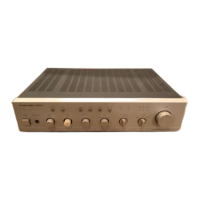
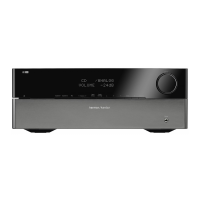
The Harman Kardon HK 990 Integrated Amplifier is a powerful and refined audio component designed to deliver exceptional sound quality. It boasts a muscular amplifier capable of driving demanding loudspeaker loads without strain. The HK 990 offers both discrete optical and coaxial digital inputs, as well as a pure analog signal path, providing flexibility for various audio sources.
A key feature is its fourth-generation Real-Time Linear Smoothing (RLS IV) digital-to-analog conversion technology, which employs dual conversion using two stereo AD1955 high-grade DACs in a Dual Mono configuration for superior audio fidelity. The amplifier also includes 2.2-channel EzSet/EQ room optimization, which allows for quick and accurate system setup tailored for two channels and two subwoofers. Dual subwoofer outputs further enhance bass management capabilities. An audiophile-quality phono preamp section is integrated, supporting both Moving Magnet (MM) and Moving Coil (MC) cartridges, making it suitable for vinyl enthusiasts.
The HK 990 incorporates High Current Capability, providing instantaneous current necessary to precisely drive and control nearly any loudspeaker system. Its ultrawide-bandwidth amplifier design ensures improved transient accuracy and phase linearity, while low negative feedback contributes to enhanced dynamic accuracy. The use of discrete electronic circuitry throughout the design aims to provide the highest performance level. Dual-path technology allows for either pure analog or pure digital audio processing within the same product, catering to different preferences.
Symmetric (balanced) XLR analog inputs are available, offering lower noise levels and higher Signal-to-Noise performance for compatible sources. The HRS link feature allows Harman Kardon CD players to lock themselves to the amplifier's external clock, creating a jitter-free connection that simulates having the CD playback inside the amplifier itself.
The amplifier's internal design includes dual differential input stages with their own high-voltage supply, resulting in high gain, low noise, and excellent channel separation. A cascoded predriver stage significantly reduces high-frequency distortion, leading to crystal-clear high frequencies free from harshness. The Thermal Tracking Mechanism utilizes ThermalTrak™ output stage transistors with internal temperature sensors to bias the output stage current in real time, ensuring stable performance.
Sophisticated electronic protection circuitry safeguards the amplifier from short-circuit conditions, damaged speakers, and faulty wires by employing current limiting or output relays without impairing sound quality. A DC servo ensures that the DC level of the amplifier output remains within contained limits. Multiple protection circuits will automatically switch the amplifier off in cases of overcurrent, overvoltage, overtemperature, or DC protection events. The power supply features dual toroidal transformers and up to 15,000µF of supply filtering per channel, contributing to high channel separation and tight bass control, even with low-impedance loads.
The HK 990 features a dual-line dot-matrix display for clear messages and status indications. Record out functionality is available in both digital and analog domains, with two analog outputs and one coaxial digital output. A/B speaker switching allows for connecting and selecting between two pairs of loudspeakers. IR remote extension jacks enable control of the amplifier when it is placed within a cabinet. A Harman Kardon system remote is included for controlling compatible Harman Kardon CD players and tuners, in addition to the amplifier itself.
For setup, the HK 990 offers an intuitive process. Input Setup allows users to configure the physical connection for each source (analog/digital) as well as adjust gain, bass, and treble settings. The Speaker Setup menu enables users to switch subwoofers on and off, select crossover frequency, and run the automatic EzSet/EQ speaker setup. The EzSet/EQ system uses a microphone to calibrate the speaker system, adjusting relative levels, delay, and crossover frequency, and equalizing the low, mid, and high-frequency responses of both main speakers and subwoofers to optimize for room acoustics. This calibration data is stored in flash memory and is retained even if the amplifier is disconnected from AC mains.
The Level Settings menu provides adjustments for speaker balance (left/right) and individual subwoofer levels. The amplifier supports different audio modes, including Direct Path for pure analog signal processing that bypasses all digital processing, and DSP Path which allows access to tone control circuits and routes analog signals through A/D and D/A converters. EQ Presets (EQ1 LF, EQ2 LF+MF, EQ3 LF+MF+HF) apply frequency corrections based on the EzSet/EQ calibration, progressively correcting low, mid, and high frequencies.
For operation, users can select desired input sources via front panel buttons or the remote control. The Record Out selector allows users to choose the source to be routed to the recording outputs, enabling digital recording of analog sources and vice versa. The amplifier's remote control offers comprehensive functions for device selection, volume adjustment, track navigation, and setup menu access.
Maintenance involves ensuring proper ventilation by not blocking openings. Cleaning should be done with a dry cloth. For battery replacement in the remote control, users should replace all four AAA batteries simultaneously and remove them if the remote will be unused for extended periods to prevent corrosion. All servicing should be referred to qualified personnel. The device is designed to be disconnected from AC mains by unplugging the power cord.
 General
| Damping factor | 200 |
|---|---|
| Amplifier class | - |
| Frequency range | 20 - 100000 Hz |
| Input sensitivity | 350 mV |
| Audio output channels | 2.2 channels |
| Peak power per channel | 150 W |
| Signal-to-Noise Ratio (SNR) | 75 dB |
| Total Harmonic Distortion (THD) | - % |
| Dynamic power per channel (4 Ohm) | 440 W |
| Dynamic power per channel (8 Ohm) | 220 W |
| Video in | 0 |
| Pre out port | Yes |
| Headphone outputs | 1 |
| Line inputs (RCA) | 8 |
| Digital audio optical in | 2 |
| Purpose | Home |
| Product color | Black |
| Connectivity technology | Wired |
| AC input voltage | 230 V |
| AC input frequency | 50 Hz |
| Power consumption (standby) | 1 W |
| Power consumption (typical) | 1000 W |
 Weight and Dimensions
| Depth | 444 mm |
|---|---|
| Width | 440 mm |
| Height | 116 mm |
| Weight | 19600 g |


 To Next Page