tone rendering, but produce a more acceptable pictorial result.
In all these cases a filter lightens objects of its own colour, and darkens objects of its complementary colour. Apart from isolated
instances in pictorial photography, such contrast control is very valuable in copying and scientific work (e.g., photomicrography).
All filters cut out some part of the light and thus, as a compensation, an increase in exposure time is necessary when using them. This
is stated on most filters in the form of a filter factor indicating by how much (e.g., 2 times, 3 times) the exposure must be increased
with that filter. The factors are approximate for they depend not only on the nature of the filter but also on the exact colour sensitivity
of the film and on the colour of the prevailing light.
With orthochromatic films the scope for control with filters is more limited, since the film is insensitive to the orange and red band of
the spectrum Hence there is no point in controlling tones by blue or green filters, and no possibility of doing so by red and orange
ones. Only yellow filters are of use with ortho films.
INDUSTRIAL SHOTS
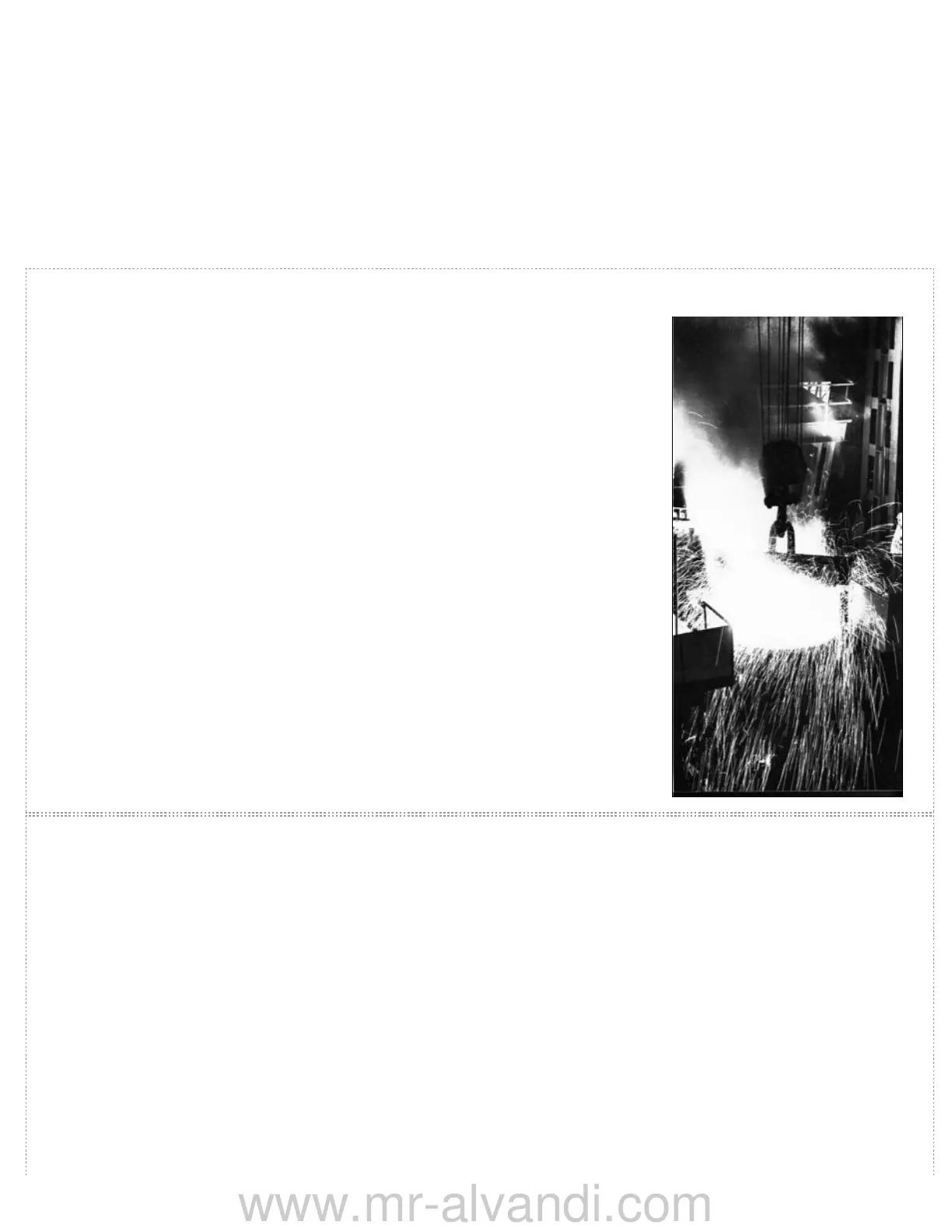
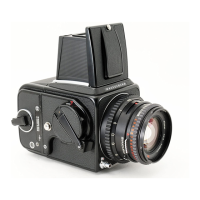
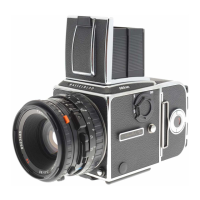
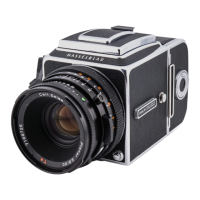
INDUSTRIAL SHOTS like this picture taken in a steel works, prove the versatility of the
Hasselblad. Although this utilizes only a part of the film area, the wide angle of view to be
covered from top to bottom makes the Hasselblad Super Wide particularly useful. All the
prevailing light comes from the glowing steel and the sparks; this requires a comparatively
slow shutter speed, which however adds a touch of deliberate blur by recording the flying
sparks as lines of light.
PORTRAITURE and ADVERTISING PHOTOGRAPHY




 To Next Page