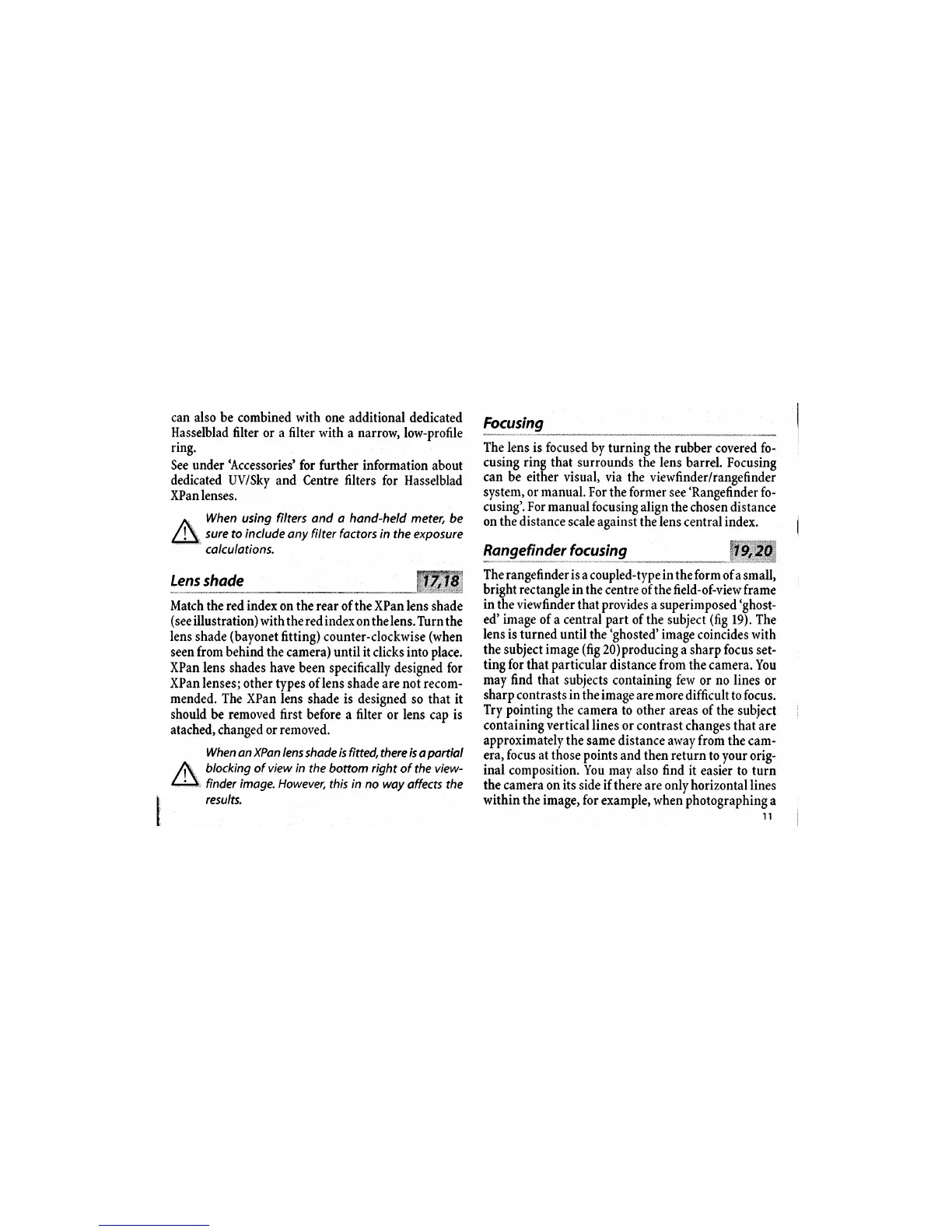
can also
be combined with one additional
dedicated
Hasselblad filter
or
a filter
with a narrow, low-profile
ring.
See under'Accessories' for further information
about
dedicated UV/Sky and Centre filters for Hasselblad
XPanlenses.
When
using
filters
and a hand-held meter,
be
sure
to
include
ony
filter factors
in the exposure
calculotions.
Lens
shade
ffit
Match
the
red index
on the rear of the XPan lens
shade
(see
illustration) withthered index
onthelens. Turn the
lens shade
(bayonet
fitting)
counter-clockwise
(when
seen
from behind
the camera) until it clicks into place.
XPan lens
shades
have
been specifically designed for
XPan lenses; other
types of
lens
shade are not recom-
mended.
The
XPan
lens shade is designed
so that it
should
be
removed first
before a filter or lens
cap
is
atached, changed or
removed.
When
an
XPan lens
shade
is fitted,there
is
a
partial
blocking of
view in
the bottom right
of the
view-
finder image.
However, this in no way
affects the
results.
P.sr:ing"
The lens
is focused
by turning the rubber
covered fo-
cusing
ring
that surrounds
the
lens
barrel. Focusing
can be either visual, via
the viewfinder/rangefinder
system, or manual. For
the
former
see'Rangefinder
fo-
cusing'.
For
manual focusing
align the
chosen
distance
on the distance
scale against the lens
central index.
IStg_SljN:y
fo,9u1jns
,_
$ili$$$itf;
The rangefinder is
a coupled-type in
the
form
of a small,
bright
rectangle
in the
centre of the field-of-view frame
in
the viewfinder
that
provides
a superimposed'ghost-
ed' image
of a central
part
of the
subject
(fig
19). The
lens is turned until
the'ghosted'image coincides with
the subject image
(fig
20)producing
a sharp focus set-
ting
for
that
particular
distance
from
the camera. You
may find that
subjects containing few
or
no lines
or
sharp contrasts
in
the image aremore
difficult to focus.
Try pointing
the camera
to other areas of the
subject
containing vertical lines
or contrast changes that
are
approximately the
same distance away from
the cam-
era, focus at those points
and then return
to your orig-
inal
composition. You may
also
find
it easier to
turn
the camera
on
its
side if there are only horizontal
lines
within the image, for
example, when'photographing
a








 To Next Page