EasyManua.ls Logo

Heathkit IG-4505 - Page 35

Heathkit IG-4505
54 pages
Print Icon
To Next Page IconTo Next Page
To Previous Page IconTo Previous Page
Loading...
Page
35
HEATHIEIT®
OPERATION
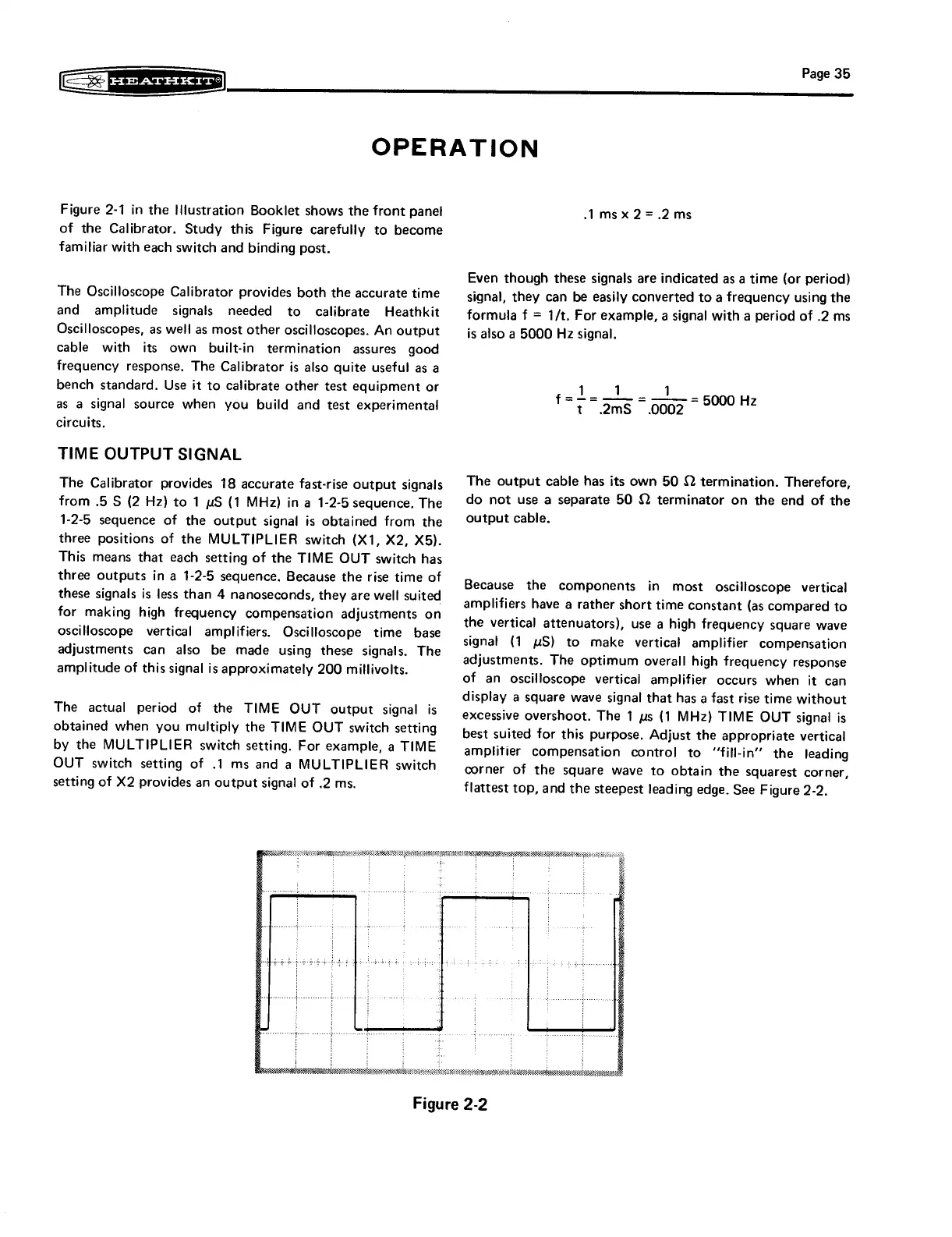
Figure
2-1
in
the
Illustration
Booklet
shows
the
front
panel
of
the
Calibrator.
Study
this
Figure
carefully
to
become
familiar
with each
switch
and
binding
post.
The
Oscilloscope
Calibrator
provides
both
the
accurate
time
and
amplitude
signals
needed
to
calibrate
Heathkit
Oscilloscopes,
as
well
as
most
other
oscilloscopes.
An
output
cable
with
its
own
built-in
termination
assures
good
frequency
response.
The
Calibrator
is
also
quite
useful
as
a
bench
standard.
Use
it
to
calibrate
other
test
equipment
or
as
a
signal
source
when
you
build
and
test
experimental
circuits.
TIME
OUTPUT
SIGNAL
The
Calibrator
provides
18
accurate
fast-rise
output
signals
from
.5
S
(2
Hz)
to
1
wS
(1
MHz)
ina
1-2-5
sequence.
The
1-2-5
sequence
of
the
output
signal
is
obtained
from
the
three
positions
of
the
MULTIPLIER
switch
(X1,
X2,
X5).
This
means
that
each
setting
of
the
TIME
OUT
switch
has
three
outputs
in
a
1-2-5
sequence.
Because
the
rise
time
of
these
signals
is
less
than
4
nanoseconds,
they
are
well
suited
for
making
high
frequency
compensation
adjustments
on
oscilloscope
vertical
amplifiers.
Oscilloscope
time
base
adjustments
can
also
be
made
using
these
signals.
The
amplitude
of
this
signal
is
approximately
200
millivolts.
The
actual
period
of
the
TIME
OUT
output
signal
is
obtained
when
you
multiply
the
TIME
OUT
switch
setting
by
the
MULTIPLIER
switch
setting.
For
example,
a
TIME
OUT
switch
setting
of
.1
ms
and
a
MULTIPLIER
switch
setting
of
X2
provides
an
output
signal
of
.2
ms.
.Imsx2=.2ms
Even
though
these
signals
are
indicated
as
a
time
(or
period)
signal,
they
can
be
easily
converted
to
a
frequency
using
the
formula
f
=
1/t.
For
example,
a
signal
with
a
period
of
.2
ms
is
also
a
5000
Hz
signal.
=
6000
Hz
The
output
cable
has
its
own
50
2
termination.
Therefore,
do
not
use
a
separate
50
Q
terminator
on
the
end
of
the
output
cable.
Because
the
components
in
most
oscilloscope
vertical
amplifiers
have
a
rather
short
time
constant
(as
compared
to
the
vertical
attenuators),
use
a
high
frequency
square
wave
signal
(1
wS)
to
make
vertical
amplifier
compensation
adjustments.
The
optimum
overall
high
frequency
response
of
an
oscilloscope
vertical
amplifier
occurs
when
it
can
display
a
square
wave
signal
that
has
a
fast
rise
time
without
excessive
overshoot.
The
1
ws
(1
MHz)
TIME
OUT
signal
is
best
suited
for
this
purpose.
Adjust
the
appropriate
vertical
amplitier
compensation
control
to
“‘ill-in’’
the
leading
corner
of
the
square
wave
to
obtain
the
squarest
corner,
flattest
top,
and
the
steepest
leading
edge.
See
Figure
2-2.
Figure
2-2

Related product manuals