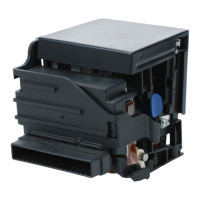
The Hengstler C-56 is a thermal printer designed primarily for printing documents and receipts in self-service gasoline pumps, terminals, and vending applications. It is a built-in module, intended to be operated as part of an overall system.
Function Description:
The C-56 thermal printer operates by using a printhead with a horizontal resolution of 203 dpi (dots per inch), allowing for printing of lines with a maximum width of 56 mm. A stepper motor drives a platen via gearing, ensuring a vertical dot resolution of 203 dpi, corresponding to a paper movement of 0.125 mm. All printer functions are controlled by an integrated controller.
Paper is inserted through upper and lower paper guides and led over the platen. An automatic paper insertion process begins when the reflective LED sensor L1a (or L1b, if installed) in the upper guide detects the front paper edge. The paper is then transported until its front edge can be seized in the eject chute. The LED L2 signals that the printer is ready by flashing slowly. If the paper edge is not detected within approximately 5 seconds, the printer assumes a malfunction, and LED L2 flashes rapidly, indicating "No paper/paper end," at which point the paper loading process is aborted.
The optional reflective LED sensor L1b, if installed, detects paper edges and recognizes position identification marks (Black Marks) on the back side of the paper. The ejected paper is cut by the user pulling it straight over a triangular cutter knife, which provides a clean cut. Further paper transport is program-controlled. An optional reflective LED sensor L3 detects the presence of paper in the eject chute, and its status can be queried via the C-56 status bytes. An optional reflective LED sensor L4, located outside the paper reservoir, detects when the paper roll diameter decreases below a fixed dimension, indicating low paper. This is a hardware alternative to the default paper low system, which relies on black marks at the end of the paper roll.
The printer is designed for use with endless thermal paper with a paper weight ranging from 50 to 60 g/m². The paper width can vary from 58 to 60 mm (2.28" to 2.36"). Documents can be any length greater than 120 mm, typically falling within the range of 120 to 297 mm. The horizontal and vertical print density of 203 dpi ensures good quality for graphics such as logos.
Important Technical Specifications:
- Dimensions (HxWxD): 184.5 x 129.5 x 169.5 mm. A free space of H = 45 mm and W = 60 mm is required for opening the printer.
- Weight: Approximately 0.56 kg.
- Operating Voltage:
- +24 VDC ±5%, SELV (EN60950). Current consumption: 0.1 A (standby), up to 6 A (operation). Recommended safety fuse: 6 A, delayed-action.
- +12 VDC ±5%, SELV (EN60950). Current consumption: 0.1 A (standby), up to 6 A (operation). Recommended safety fuse: 6 A, delayed-action.
- UL - Certificate: E174318.
- Interface:
- Mini USB 1.1 industrial: Cable length < 3 meters. Transmission rate: 1.5 MBit/s and 12 MBit/s. Supports Windows XP/7/8/10 and LINUX printer graphics drivers.
- Micro RS232: Cable length < 3 meters. Communication protocol: Hardware DTR/CTS, None. Baud Rate: 4800, 9600, 19200, 38400, 57600, 115200 (default). Parity: Off (default), On. Data Bits: 8. Stop Bits: 1 (default), 2.
- Noise Level: < 55 dB(A) according to ISO 3744.
- Operating Conditions: Temperature: +5 °C to +50 °C (-30°C to +70°C). Humidity: 20% to 80% (90%), no condensation.
- Storage Conditions: Temperature: -40° C to +85° C. Humidity: 5% to 95%, condensation not permitted.
- Printing Method: Thermal direct.
- Number of Dots: 448.
- Dot Resolution (horizontal): 8 Dots/mm (203 dpi).
- Paper Transport (vertical resolution): 0.125 mm / Dotline (in accordance with horizontal resolution).
- Max. Printing Width: 56 mm.
- Printing Speed: Up to 220 mm/sec (24 VDC) or 160 mm/sec (12 VDC).
- Paper Width: 58 mm (2.28") to 60 mm (2.36").
- Length of Document: 120 mm up to endless.
- Maximum Reverse Paper Distance: 150 mm; longer may lead to paper jams.
- Chute Sensor: Optional chute sensor.
- Paper Pre-End Detection: Printing mark onto the topside; optional hardware paper pre-end sensor.
- Printhead Temperature Monitoring: Thermistor.
- Workload: Max. 20 documents / min. (at 120 mm paper length).
- EMC: EN55022 - Emission (Class "A" appliance, may cause radio interference in residential areas). EN55024 - EMS Immunity (electrostatic discharges and burst effects may cause short printing interruptions, but automatic recovery function restores original state).
Usage Features:
The C-56 printer is designed for ease of use and quick setup. After connecting to a host system (PC) via USB 1.1/2.0 or RS232 and to a properly rated 24 VDC or 12 VDC power supply, and installing necessary driver software, the printer is ready for operation.
- Power Connection: The power supply connection must be made exclusively with the supplied cable, ensuring the power supply is switched off before plugging in or removing the connector. The locking tab of the connector should always face the paper insert side.
- Data Connection: Connect the mini-USB port to a USB interface or the micro-RS232 port to an RS232 interface using the provided cables. For RS232, a cable tie should be used to secure the cable. Windows will automatically recognize a new USB device and install appropriate driver software.
- Paper Loading:
- Remove protective sheathing from the paper roll and cut the paper end at right angles to the direction of feed. Truncated, lacerated, or folded paper edges, or perforations/rounded edges, are not acceptable as they can cause paper jams.
- Place the paper roll into the paper tray with the thermal sensitive surface facing outside or upward.
- Insert the paper into the printer mechanism. Automatic paper insertion starts once the sensor in the paper guide detects paper.
- Cut off any paper appearing in the eject chute by pulling it straight out.
- Safety: The printer uses electrically conductive housing materials to eliminate electrostatic charging. It must be grounded, either through its mounting holes (using a ground wire with lug) or by being mounted in an electrically conductive and grounded panel with sufficient electrical contact. The printhead should not be lifted during printing to prevent damage from overheating.
Maintenance Features:
The C-56 thermal printer is designed for minimal servicing and features a modular design for easy component replacement.
- Component Replacement: Its main modules can be replaced by operational staff within less than 2 minutes without requiring any adjustments. This includes the thermal printer mechanism, basic unit with paper tray, hinge pins, and eject chute.
- Clearing Paper Jams:
- Detach any document already in the eject chute and manually retract the remaining paper.
- If paper is between the printhead and platen, press down the "printhead up" lever (see Fig. 5) to remove friction, then pull the paper back by hand.
- If a partly printed document remains, pull the hinge pin back to tilt the printer mechanism open. The document will then be visible and can be pulled out over the eject chute.
- Eject the document by twisting the motor pinion gear clockwise until it leaves the platen's friction area.
- Remove the document, then tilt the printer mechanism back into its operating position and secure it by snapping the hinge pin.
- For paper scraps in the eject chute, tilt the printer mechanism open and remove them. If the chute is clogged, it may need to be dismounted and cleaned.
- Troubleshooting: The integrated controller signals various malfunctions:
- Paper Insert Error: Occurs if paper is held back too long or fed skewed during automatic insertion. Corrective action: pull paper back and restart loading.
- No Paper Insertion: If the motor stalls with a rattling sound, possibly due to a temporary depression of the platen. Corrective action: lift the printhead using the head lift lever, insert paper, release the lever, and continue auto loading.
- Paper End: Detected by sensor L1 (a or b). Corrective action: remove the document and repeat loading, or load a new paper roll.
- Paper Pre-End: Recognized by sensor L1 (pre-end mark) or L4 (hardware paper low sensor). Printing continues until "Paper End" is detected.
- Undefined Error: If no other obvious disorder, the printer may be blocked by the operating system. Corrective action: disconnect the USB cable from the PC for about 1 minute to deactivate/reactivate driver software.
- Paper Quality: Only recommended paper quality should be used to ensure the service life of the thermal printhead and maintain printer warranty.
- Storage: During storage and transit, paper should be left inserted between the thermal printhead and platen.

 Need help?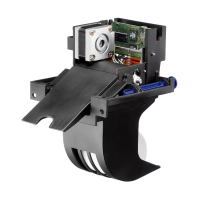

 To Next Page
 General