
 Need help?
Do you have a question about the HIKVISION DS-K3G201 and is the answer not in the manual?
Provides a general description of the DS-K3G201 series turnstile's material and application.
Details the turnstile's composition, divided into mechanical and electronic parts.
Lists key mechanical components like electromagnets, frame, and drive shaft.
Describes electronic components such as card reader, main board, and direction indicator.
Guides on preparing for and executing pedestal installation, including diagrams.
Illustrates the correct orientation for turnstile installation for card swiping.
Provides dimensional guidance for installing the turnstile adjacent to a wall.
Specifies the required hole layout and expansion screw size for mounting.
Explains how to connect the AC electric supply to the turnstile system.
Details how to connect external access control boards to the turnstile.
Overviews the main board components and interfaces.
Lists and describes the various interfaces and connectors on the main board.
Explains the purpose and operation of the function keys on the main board.
Provides a step-by-step example for changing turnstile operation time.
Describes the system menu structure and available settings.
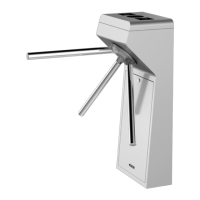
The DS-K3G201 Series Tripod Turnstile is a robust and aesthetically pleasing access control device designed for managing entry and exit at various locations, particularly construction sites. Constructed from SUS304 stainless steel plate, it boasts a beautiful appearance, sturdy build, and high durability, making it resistant to damage from external forces. This turnstile is engineered to integrate seamlessly with other access control systems, such as card readers and face recognition terminals, providing a comprehensive solution for pedestrian flow management.
The primary function of the DS-K3G201 Series Tripod Turnstile is to control and regulate pedestrian access. It operates as a barrier, allowing passage only after proper authorization. The turnstile is equipped with both mechanical and electronic control parts to achieve this.
At its core, the turnstile features a movement mechanism comprising rod-falling electromagnets, telescopic electromagnets, a frame, a drive shaft, and a three-roll turnstile roller. These components work in conjunction to physically block or permit passage.
The electronic control system is sophisticated, consisting of a card reader, a main board, a direction indicator board, and a leakage circuit breaker. The card reader is responsible for reading card number information from access cards. This information is then transmitted to an external access controller, which verifies the access control authority.
The main board acts as the central control unit of the system. It receives signals from the access system, performs logical judgments and processing based on these signals, and subsequently sends execution commands to various components. These commands dictate the behavior of the direction indicator, electromagnets, and counter, ensuring smooth and secure operation.
Direction indicators are strategically placed to display the current status of passage signs, guiding pedestrians to pass through the turnstile safely and in an orderly manner. This visual feedback is crucial for efficient crowd management and preventing confusion.
The turnstile supports a two-way function for both entry and exit, meaning it can control access in both directions. To achieve this, an external access control board with relay output functionality is required. The main board provides dedicated interfaces for connecting these external access control components, allowing for flexible integration into existing security infrastructures.
The turnstile's operation can be configured through a menu system accessible via function keys on the main board. These keys—MENU, INC, and DEC—allow for various parameter settings. For instance, users can adjust the turnstile door open time duration, which determines how long the barrier remains open after authorization. The system also offers different working modes, including "All allowed," "All prohibited," and directional restrictions (e.g., "Left opening is prohibited, right opening is allowed").
A notable feature is the "Memory function," which, when enabled, allows for multiple passages based on a single authorization. For example, if a card is swiped five times, five people can pass sequentially without requiring individual authorizations for each person. This can be particularly useful in scenarios where groups need to pass through quickly.
For diagnostic purposes, a "Test mode" is available, which initiates an automatic, uninterrupted left-open and right-open test. This helps in verifying the functionality of the turnstile's mechanical and electronic components. The system also includes a "System initialization" option to reset settings or initialize the system.
The DS-K3G201 is designed for ease of use and integration. Its installation position is typically on the right, facilitating convenient card swiping with the right hand for forward movement. The entrance direction corresponds to the left opening of the motherboard wiring port, and the exit direction corresponds to the right opening.
When installing the turnstile, it is recommended to place it on concrete or other non-flammable surfaces. If installed against a wall, a minimum distance of 50 mm between the pedestal and the wall is advised to prevent scratching. The turnstile requires M12 expansion screws with a recommended length of 120mm for secure installation.
The turnstile supports AC electric supply for its power, with a voltage fluctuation range of 100 VAC to 220 VAC at 50 to 60 Hz. A critical safety feature is the requirement to connect the terminal PE to a ground wire, which is essential to prevent hazards from electrical shock when people touch the device.
The intuitive menu system, accessed via the MENU, INC, and DEC keys, simplifies configuration. The MENU key allows entry into the system menu, selection of specific menu items, and saving of parameter settings. The INC and DEC keys are used for scrolling through menu options and adjusting parameter values. The system also incorporates an automatic exit feature from the menu interface if no key operation occurs within 5 seconds, returning to standby mode.
Maintenance of the DS-K3G201 Series Tripod Turnstile is crucial for ensuring its longevity and optimal performance, especially given its stainless steel construction. Stainless steel, while rustless and corrosion-resistant, still requires periodic cleaning and care to prevent oxidation and corrosion.
The choice of stainless steel type can be tailored to the environment: 304 stainless steel is suitable for common circumstances, while 316 stainless steel is recommended for severe environments like seasides or chemical plants, which have higher exposure to corrosive elements.
Key maintenance practices include:
Adhering to these maintenance guidelines will help preserve the aesthetic appeal and functional integrity of the DS-K3G201 Series Tripod Turnstile over its operational lifespan.
 General
| Model | DS-K3G201 |
|---|---|
| Category | Turntable |
| Operating Temperature | -30 °C to 60 °C (-22 °F to 140 °F) |
| Power Supply | 12 VDC/1 A |
| Operating Humidity | 10% to 90% (No Condensation) |

 To Next Page