Do not attempt to ride up hills steeper than 15% grade.
Use the pedals to assist the motor when climbing hills and accelerating from a stop.
Avoid sudden starts and stops.
Generally accelerate at a moderate pace, rather than aggressively.
Following are some limitations needing riders’ careful attention to ensure the mid-drive
motor does not overheat or become damaged from excessive loading:
Riding Limitations
•
•
•
•
Carrying Loads & Cargo
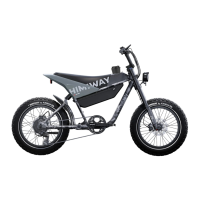
Total Payload Capacity of Himiway A7 Pro: 136 KG. Weight: 35 KG
Parking & Transport
Follow these basic parking, storage, and transport tips to ensure your bike is well cared
for, both on and off the road:
When walking with the bike, turn off the power to avoid accidental acceleration, or
use Walk Mode.
Though our bikes are water resistant (IPX4 Water Resistance), please do not park
your bike outdoors in cold or inclement weather for extended periods.
When parking, switch the power and any lights off to conserve battery, remove the
key from the bike, and ensure the battery is secured and locked to the frame.
In public places, help keep your Himiway Bike safe and secure from theft by always
locking it up.
Make sure to not park, store or transport your Himiway Bike on a rack that is not
designed for the size and weight of the bike. When storing or carrying your bike on a
rack for transport, remove the battery to reduce the weight and make lifting or
loading easier.
•
•
•
•
•
The following list provides important tips for the safe operation of the Himiway A7 Pro
when used for carrying cargo:
Make sure to load the cargo as low as possible to lower the center of gravity and
improve stability.
Ensure your loads are properly secured and periodically check that nothing has
loosened.
Plan your route accordingly when cargo is loaded on the Himiway A7 Pro, considering
hill climbing ability, steering, and braking. Also account for moderately reduced range
when carrying extra cargo weight (or an additional passenger).
Try to get a feel for the cargo load in a flat and open private area before riding on
public roads.
Make sure to not use the front brake by itself, with or without cargo. Always apply the
rear brake first followed by the front brake. Failure of the front fork or loss of control
is possible when the front brake is operated independently, especially at higher
speeds.
The kickstand is not designed to hold the bike upright with cargo by itself, always
manually hold the bike upright when loading or carrying cargo.
◆ Cargo Safe Operation Tips:
1.
2.
3.
4.
5.
6.
18
WARNING: Different materials and components may respond differently to stress
and wear. If a component's service life is exceeded, it can suddenly fail and there
is a risk of injury. Any form of cracks, scratches or color changes on highly
stressed components indicate that the component life has expired and the part
should be replaced.
•
•
•
•
1.
2.
3.
4.
5.
6.


 To Next Page