To Next Page
Z
zromanSep 4, 2025
How to fix a loose cuff on HINGMED WBP-02A?
- MMadison ThomasSep 4, 2025
If the cuff is too loose, either from loose winding or a disconnected cuff, retighten the cuff or keep it on the proper arm position when inflating.

How to fix a loose cuff on HINGMED WBP-02A?
If the cuff is too loose, either from loose winding or a disconnected cuff, retighten the cuff or keep it on the proper arm position when inflating.
How to fix HINGMED WBP-02A cuff pressure beyond the max pressure setting?
To fix the HINGMED Blood Pressure Monitor cuff pressure when it exceeds the max pressure setting, reprogramming in PC software and set the inflation limit to higher level.
What to do if the HINGMED WBP-02A Blood Pressure Monitor memory is full and can no longer measure?
If the memory of your HINGMED Blood Pressure Monitor is full and it can no longer measure, upload and program the machine to release the memory.
How to resolve air pressure error in HINGMED Blood Pressure Monitor?
To resolve an air pressure error in your HINGMED Blood Pressure Monitor, potentially caused by the inability to open the valve, check whether the valve can work normally.
How to fix air leakage in HINGMED WBP-02A Blood Pressure Monitor?
To fix air leakage in your HINGMED Blood Pressure Monitor, possibly from a valve or air tube, tighten the metal connector and check the cuff. If the leakage is not resolved, contact your agent or dealer.
What to do if the HINGMED Blood Pressure Monitor shows excessive exercise?
If your HINGMED Blood Pressure Monitor indicates excessive exercise, possibly due to too much motion tolerance or interruption, keep calm while measurement and do not move the arm with cuff.
What to do if the HINGMED WBP-02A Blood Pressure Monitor starts a measurement right after the last one, and the cuff pressure is still above 15mmHg?
If you start a measurement right after the last one on your HINGMED Blood Pressure Monitor, and the cuff pressure is still above 15mmHg, restart the device after the cuff pressure goes down to below 15mmHg.
What to do if the HINGMED WBP-02A cuff pressure is above 15mmHg and cannot have another measurement?
If the cuff pressure on your HINGMED Blood Pressure Monitor is above 15mmHg and you cannot perform another measurement, restart the device after the cuff pressure goes down to below 15mmHg.
What to do if the HINGMED WBP-02A Blood Pressure Monitor gives a weak signal due to a weak pulse or loose cuff?
If your HINGMED Blood Pressure Monitor shows a weak signal, possibly due to a weak pulse or loose cuff, check whether the cuff is too loose and tighten it if necessary.
What to do if the HINGMED WBP-02A shows a system error?
If your HINGMED Blood Pressure Monitor displays a system error, press the “start/stop” button to measure again.
Explains the purpose, benefits, and strengths of 24-hour ambulatory blood pressure monitoring compared to spot measurements.
Details the intended applications and target patient population for the Hingmed Wearable Ambulatory Blood Pressure Monitor.
Lists contraindications and situations where the ABPM monitor should not be used due to potential risks.
Highlights critical warnings and precautions to ensure safe and proper operation of the blood pressure monitor.
Covers notices regarding battery, training, measurement, energy conservation, and environmental protection.
Lists all accessories included in the Hingmed ABPM package, including the main unit, cuffs, and software.
Describes the physical components of the ABPM monitor, its OLED display indicators, and operational symbols.
Provides instructions on how to charge the device's internal lithium battery using the provided charger.
Guides on correctly wearing the ABPM cuff on the arm and preparing the patient for accurate measurements.
Details the hardware requirements and step-by-step process for installing the necessary Hingmed PC software.
Covers connecting the monitor, programming settings, starting/finishing measurements, and retrieving data.
Provides a table of common error codes and their corresponding resolutions for troubleshooting the ABPM device.
Outlines procedures for inspecting, cleaning, and performing routine maintenance on the ABPM monitor.
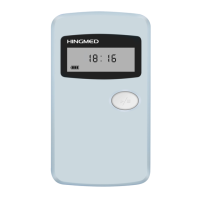
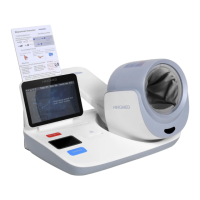
The Hingmed WBP-02A Hospital Wearable Ambulatory Blood Pressure Monitor is a medical instrument designed for the automatic monitoring of human blood pressure over a specified period, typically 1-2 days, at set intervals. This device aims to provide a comprehensive understanding of blood pressure fluctuations throughout the day, which is crucial for accurate diagnosis and management of hypertension and hypotension. Unlike traditional ABPM devices that often involve a long air tube wrapped around the patient's body, the WBP-02A Hospital features a compact, lightweight, and integrated design that is worn directly on the arm without an external air tube. This design enhances patient comfort and minimizes motion tolerance, leading to more consistent measurements.
The primary function of the WBP-02A Hospital is to measure systolic pressure, diastolic pressure, and pulse rate. These measurements are taken at different intervals over a 24-hour period, providing a detailed profile of the patient's blood pressure trends. The collected data can then be downloaded to a computer system via a USB cable. The accompanying Hingmed ABPM software system allows doctors to analyze these readings, aiding in diagnosis and treatment planning.
A key feature of the Hingmed WBP-02A is its ability to record the user's body position during blood pressure measurements. This information is particularly valuable for clinical research and the diagnosis of orthostatic hypertension, a condition where blood pressure is high only in standing or sitting postures but normal when lying down. By providing body position data, the monitor helps to reflect the patient's normal blood pressure situation more accurately under ambulatory conditions, which is extremely helpful for clinical diagnosis.
The device is especially useful for diagnosing various types of hypertension, including:
Beyond diagnosis, the WBP-02A also assists in:
The device is powered by a built-in rechargeable Lithium battery, eliminating the need for daily replacement of AA batteries, which is common in some other ABPM devices.
The WBP-02A is designed for ease of use, with a clear OLED screen displaying essential information such as historical memory, automatic measurement status, system time, heartbeat symbol, measurement time, and battery volume.
Proper maintenance is essential for the long-term safe and efficient operation of the WBP-02A.
The WBP-02A is designed to store a maximum of 300 readings. Once storage is full, the monitor cannot save new data until it is programmed again, which also deletes historical data, emphasizing the importance of retrieving data before reprogramming.
 General
| Model | WBP-02A |
|---|---|
| Measurement Method | Oscillometric |
| Accuracy (Pressure) | ±3 mmHg |
| Power Source | 4 x AA batteries or AC adapter |
| Memory | Yes |
| Display | LCD |
| Type | Upper Arm |
| Measurement Range (Pulse) | 40-180 bpm |
| Accuracy (Pulse) | ±5% |