EasyManua.ls Logo

Hisense AUC-36UR4SAEA1 - User Manual

Hisense AUC-36UR4SAEA1
136 pages
Print Icon
To Next Page IconTo Next Page
Loading...
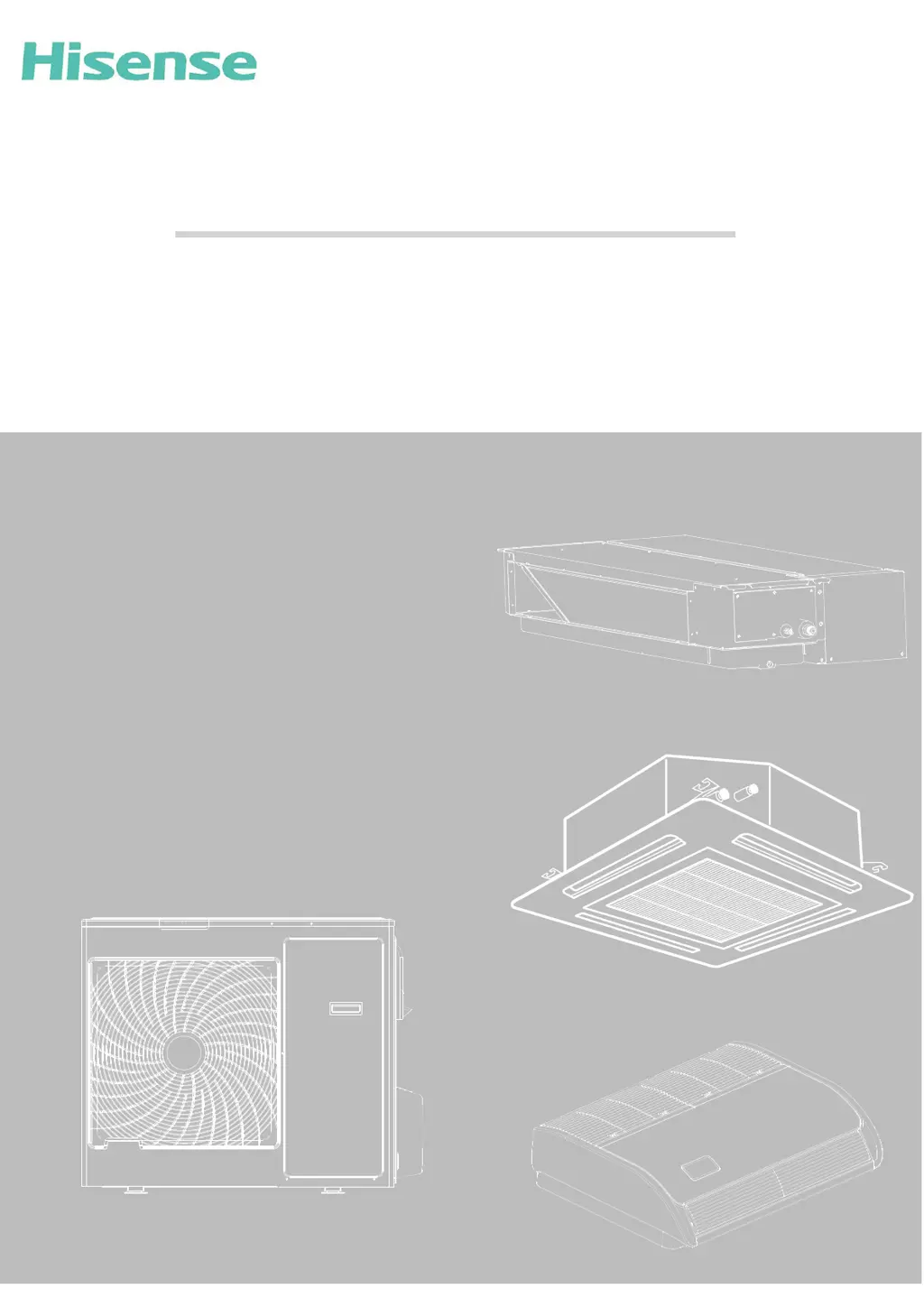
TECHNICAL&SERVICE MANUAL V3.3
—DC INVERTER AIR CONDITIONERS
MODEL:
AUD-18UX4SGKL
AUD-24UX4SZLH
AUD-36UX4SAMH
AUD-48UX6SPHH
AUD-60UX6SPHH
AUC-18UX4SGAA
AUC-24UX4SZEA
AUC-36UX4SAEA
AUC-48UX6SPFA
AUC-60UX6SPFA
AUC-18UR4SZAA1
AUC-24UR4SAEA1
AUC-36UR4SAEA1
AUV-18UR4SZA1
AUV-24UR4SAA1
AUV-36UR4SAB1
AUV-48UR6SPC
AUV-60UR6SPC
AUD-18UX4SZKL1
AUD-24UX4SALH1
AUD-36UX4SAMH1

Other manuals for Hisense AUC-36UR4SAEA1

Questions and Answers

  • M
    Michael MorrisSep 3, 2025
    What causes AC voltage to be abnormal in my Hisense AUC-36UR4SAEA1 Air Conditioner?
    • B
      Brandon JenkinsSep 3, 2025
      Abnormal AC voltage in your Hisense Air Conditioner can be due to: * AC voltage outside the range of 160V to 275V: This is a normal protection response; check the power supply. * Abnormal AC voltage in the sampling circuit on the drive board: Replace the drive board.
  • K
    kpenaSep 18, 2025
    What causes temperature sensor fault for the outlet tube of the condenser in Hisense AUC-36UR4SAEA1 Air Conditioner?
    • V
      Vickie HowardSep 18, 2025
      A temperature sensor fault for the outlet tube of the condenser in your Hisense Air Conditioner may be due to: * Loose wiring: Reconnect the wiring of the temperature sensor for the outlet tube of the condenser. * Sensor failure: Replace the temperature sensor. * Sampling circuit issue: Replace the outdoor control board.
  • T
    Travis MillerSep 16, 2025
    What causes temperature sensor fault for the inlet tube of the condenser in Hisense AUC-36UR4SAEA1 Air Conditioner?
    • M
      Mr. Mark Garcia MDSep 16, 2025
      A temperature sensor fault for the inlet tube of the condenser in your Hisense Air Conditioner might be caused by: * Loose wiring: Reconnect the wiring of the temperature sensor for the inlet tube of the condenser. * Sensor failure: Replace the temperature sensor. * Sampling circuit issue: Replace the outdoor control board.
  • D
    Denise WestSep 14, 2025
    What causes suction temperature sensor fault in Hisense Air Conditioner?
    • J
      Jennifer CoxSep 14, 2025
      A suction temperature sensor fault in your Hisense Air Conditioner may be caused by: * Loose wiring: Reconnect the wiring of the suction temperature sensor. * Sensor failure: Replace the suction temperature sensor. * Sampling circuit issue: Replace the outdoor control board.
  • E
    Erica NelsonSep 12, 2025
    What causes outdoor coil temperature sensor fault in Hisense Air Conditioner?
    • J
      Jennifer AndersonSep 12, 2025
      An outdoor coil temperature sensor fault in your Hisense Air Conditioner can be due to: * A loose connection of the outdoor coil temperature sensor: Reconnect the sensor. * A failure of the sensor itself: Replace the outdoor coil temperature sensor. * A failure in the sampling circuit: Replace the outdoor control board components.
  • A
    Alicia RivasSep 12, 2025
    How to troubleshoot defrosting sensor fault in Hisense AUC-36UR4SAEA1?
    • B
      brittney41Sep 12, 2025
      A defrosting sensor fault in your Hisense Air Conditioner could be due to: * Loose wiring: Reconnect the wiring of the defrosting sensor. * Sensor failure: Replace the defrosting sensor. * Sampling circuit issue: Replace the outdoor control board.
  • M
    Mathew McconnellSep 9, 2025
    What causes outdoor ambient temperature sensor fault in Hisense AUC-36UR4SAEA1?
    • S
      Samuel MasonSep 9, 2025
      An outdoor ambient temperature sensor fault in your Hisense Air Conditioner may arise from: * A loose connection of the outdoor ambient temperature sensor: Reconnect the sensor. * A failure of the sensor itself: Replace the outdoor ambient temperature sensor. * A failure in the sampling circuit: Replace the outdoor control board components.
  • N
    Nathaniel DunnSep 7, 2025
    How to fix Hisense Air Conditioner indoor EE fault?
    • R
      Renee FlemingSep 7, 2025
      An indoor EE fault in your Hisense Air Conditioner can be caused by: * A faulty EE component: Replace the EE component. * A failure in the EE control circuit of the control board: Replace the control board. * Incorrect insertion of the EE component: Reinsert the EE component correctly.
  • M
    Matthew BurkeSep 5, 2025
    Why my Hisense AUC-36UR4SAEA1 Air Conditioner phase current imbalance fault?
    • J
      Jennifer StoneSep 5, 2025
      A phase current imbalance fault in your Hisense Air Conditioner can be caused by: * Supply voltage fluctuations exceeding 4%: This triggers normal protection. Other potential solutions include: * Reconnect the wire according to the wiring diagram. * Replace the AC contactor. * Replace the compressor.
  • V
    Victor WashingtonAug 20, 2025
    What to do if my Hisense Air Conditioner has communication failure between the indoor and outdoor unit?
    • C
      Christopher PruittAug 20, 2025
      If your Hisense Air Conditioner is experiencing communication failures between the indoor and outdoor units, it could be due to: * Incorrectly connected cables. Reconnect the connection cable according to the wiring diagram. * Loose communication cables. Reconnect the communication cables, ensuring connections are secure at both the control boards and terminals. * Faulty communication cables. Replace the communication cables. * A faulty indoor control board. Consider replacing the indoor control board. * A faulty outdoor control board. Replace the outdoor control board.

Summary

1. GENERAL

1.1 Features

Highlights key features of the Duct Type Air Conditioner, including space-saving design and efficiency.

1.2 Product Lineup

Overview of the product range, showing available types and capacities (18, 24, 36, 48, 60).

1.3 MODEL IDENTIFICATION

Explains the coding system used for identifying air conditioner models and their specifications.

1.4 Product Picture

Visuals of Duct Type indoor and outdoor units for various models.

DISPLAY PANEL:

Description of indicators and buttons on the Cassette Type display panel.

2. SPECIFICATIONS

Duct Type

Detailed technical specifications for Duct Type air conditioners, including power, capacity, and ratings.

Cassette type

Technical specifications for Cassette Type air conditioners, covering capacity, input, and current.

Ceiling & Floor type

Technical specifications for Ceiling & Floor Type air conditioners, detailing capacity, input, and ratings.

3. OUTLINES AND DIMENSION

3-1 INDOOR

Dimensional drawings and measurements for indoor units, specifically for Duct Type.

3-2.OUTDOOR

Dimensional drawings and measurements for outdoor units, including various models like 18K.

4. Diagrams&DATA

4.1 Piping Diagrams

Illustrates the refrigerant flow diagrams for 18k, 24k & 36k, and 48k&60k types.

4-2 MAX. Refrigerant pipe length and height difference

Specifies maximum refrigerant pipe length and height difference limitations for different models.

4-3 ELECTRIC Diagrams

Shows electrical wiring diagrams for 18K/36K and 48K/60K models.

4-4 Air flow and ESP Chart Diagrams(for duct type)

Presents airflow and ESP charts for 18K and 24K duct type models.

4.5 PERFORMANCE CURVE

Graphs illustrating cooling capacity performance curves for 18K, 24K, and 36K models.

5. ELECTRICAL DATA

5-1.Electrical wiring diagrams

Wiring diagrams for the indoor units, covering Duct Type and Cassette Type.

5-2. Electric control Board

Details of the indoor control board for Duct Type and Cassette Type units.

2.Control board for outdoor unit

Illustrates the control boards for outdoor units, including AUW-18U4SG and AUW-24U4SZ.

5-3. DIP SWITCH SETTING OF OUTDOOR

Instructions for setting outdoor unit dip switches for various models.

5-4. Digital Display Switch of Outdoor

Introduction to the digital display switch for checking outdoor running parameters.

5-5. Static Pressure Setting (only for duct type)

Guidance on changing static pressure for duct type air conditioners.

5-6 System Parameter Adjustment

Procedure for adjusting internal control parameters via the remote controller.

5-7. Sensor parameter

Data tables for outdoor compressor discharge temperature sensor parameters.

6. CONTROL MODEL

6-1 Indoor control mode

Details indoor control modes, including emergency switch, timer functions, and sleep mode.

6-2 Outdoor mode control

Explains control functions for outdoor units: anti-freeze, overload protection, and oil-return.

7. TROUBLE SHOOTING

HOW TO CHECK FAULT CODES

Guide on checking fault codes displayed on indoor units for different types.

2.OUTDOOR UNIT FAULT CODE DISPLAY

Explains how fault codes are indicated by lamps on the outdoor control board.

3.Fault code display ( Driver Board )

Describes fault code display via driver board flashing lamps and digital tubes.

Sheet 1 Outdoor Error Code

Table listing outdoor error codes, possible reasons, and how to deal with them.

Sheet 2 Indoor Error Code List

Table listing indoor error codes, possible reasons, and solutions.

8. CHECKING COMPONENTS

8-1. Check refrigerant system

Procedure for checking the refrigerant system, including pressure and temperature readings.

8-2.Check parts unit

Tests and checks for specific components like indoor fan motors.

4. INDUCTANCE

Checking procedures for inductance, including common errors.

5. STEP MOTOR

Testing resistance for step motor windings.

6. FUSE

Procedure for checking fuse continuity using a multimeter.

7.CAPACITOR

Method for testing capacitor functionality using a multimeter.

3. COMPRESSOR

Procedures for examining and repairing compressors, including wiring diagrams.

Hisense AUC-36UR4SAEA1 Specifications

General IconGeneral
Cooling Capacity (BTU)36000 BTU
RefrigerantR410A
Indoor Unit Weight15 kg
Power Supply220-240V, 50Hz
Noise Level (Outdoor Unit)56 dB(A)
TypeSplit System

Related product manuals