EasyManua.ls Logo

Hisense Refrigerator - User Manual

Hisense Refrigerator
13 pages
Print Icon
To Next Page IconTo Next Page
Loading...

Questions and Answers

  • J
    johnsontheresaAug 14, 2025
    What to do if my Hisense is not working correctly?
    • M
      michellesteeleAug 14, 2025
      If your Hisense Refrigerator isn't working, check if the power cord is properly plugged into the outlet. Also, inspect the fuse or circuit of your power supply and replace it if needed. If the ambient temperature is too low, try setting the chamber temperature to a colder level. It's also normal for the freezer not to operate during the automatic defrost cycle, or shortly after being switched on, to protect the compressor.
  • A
    Angela NguyenAug 18, 2025
    Why is the temperature inside my Hisense Refrigerator too warm?
    • K
      Kathryn JohnsonAug 18, 2025
      The temperature inside your Hisense Refrigerator might be too warm if you've left the doors open too long or too frequently, if something is keeping the doors open, or if the appliance doesn't have enough clearance on the sides, back, and top.
  • R
    rachel21Aug 21, 2025
    Why does my Hisense Refrigerator have a layer of frost in the compartment?
    • J
      Joseph CarterAug 21, 2025
      Frost can form in your Hisense Refrigerator if the air outlets are blocked by food, preventing sufficient ventilation. Make sure food is arranged to allow proper airflow. Also, ensure the door is fully closed. To remove the frost, please refer to cleaning and care chapter.
  • P
    Pamela OchoaAug 25, 2025
    How to stop water from dripping on the floor from my Hisense Refrigerator?
    • H
      haleaaronAug 25, 2025
      If water is dripping from your Hisense Refrigerator onto the floor, the water pan (at the rear bottom) might not be level. Alternatively, the draining spout (underneath the top of the compressor depot) may not be directing water into the pan properly, or the spout could be blocked. Pull the refrigerator away from the wall to inspect the pan and spout.
  • C
    Carlos ThompsonAug 28, 2025
    How to reduce noise from my Hisense ?
    • D
      David LambAug 28, 2025
      Some noises from your Hisense Refrigerator are normal, such as: Compressor running noises. Air movement noise from the small fan motor. Gurgling sounds like water boiling. Popping during defrosting. Clicking before the compressor starts. Unusual noises may be due to the cabinet not being level, the back of the appliance touching the wall, or items inside falling or rolling.
  • A
    Ashley JonesAug 31, 2025
    What to do if the light is not working in my Hisense ?
    • J
      Joshua JenningsAug 31, 2025
      If the light in your Hisense Refrigerator isn't working, the LED light might be damaged. Refer to replace LED lights in cleaning and care chapter. Alternatively, the control system may have disabled the lights because the door was left open too long; try closing and reopening the door to reactivate them.
  • E
    Emily BaileySep 3, 2025
    Why is my Hisense Refrigerator motor running continuously?
    • H
      Hannah MurphySep 4, 2025
      It's normal to frequently hear the motor running, especially if: the temperature setting is colder than necessary; a large quantity of warm food has recently been stored; the outside temperature is too high; the doors are opened too often or for too long; or just after installation or after the appliance has been switched off for a long time.
  • J
    Jeremy MartinSep 7, 2025
    What to do if the doors on my Hisense can't be closed easily?
    • A
      amanda86Sep 7, 2025
      Check if the top of your Hisense Refrigerator is tilted back by 10-15mm, which allows the doors to self-close. Also, make sure nothing inside is blocking the doors from closing properly.
  • G
    grodriguezSep 12, 2025
    Why does my Hisense have odours from the compartments?
    • R
      Reginald BarnesSep 12, 2025
      Odours in your Hisense Refrigerator may be due to the interior needing a clean, or certain foods, containers, or wrappings causing the odours.

Summary

Brief Introduction

Important Safety Instructions

General Safety and Daily Use

General safety guidelines and daily usage recommendations.

Safety for Children and Infirm Persons

Safety About Electricity

Hazard of Fire

Installing Your New Appliance

Ventilation of Appliance

Guidelines for ensuring proper ventilation for efficient cooling.

Installing Your New Appliance

Leveling of Appliance

Steps to level the appliance for stability and vibration reduction.

After the Installation

Post-installation cleaning recommendation.

Installing the Door Handles

Instructions for installing and securing the door handles.

Description of the Appliance

Display Controls

Adjusting the Temperature

Guide on how to set and adjust refrigerator and freezer temperatures.

Super Cool

Feature for rapid cooling of food.

Super Freeze

Feature for fast freezing of food.

Energy Saving

Mode for optimizing energy consumption.

Smart

Mode for automatic temperature adjustment.

Holiday

Function for energy saving during extended absences.

Door Alarm

Alarm system for open doors.

Temperature Alarm

Alarm for high freezer temperature.

Using Your Appliance

Using Your Refrigerator Compartment

Guidelines for storing food in the refrigerator.

Door Rack

Information on using the door racks for storage.

Bottle Holder Operation

How to use the bottle holder feature.

Using Your Appliance

Shelf in Refrigerator Chamber

Details on adjusting and cleaning refrigerator shelves.

Bottle Rack

Use of the bottle rack for storing beverages.

Crispers

Instructions for using and removing crisper drawers.

Crisper Cover

Function of the crisper cover for humidity control.

Using Your Freezer Drawer

Guidelines for storing food in the freezer drawers.

The Drawers

How to remove and handle freezer drawers.

Twistable Ice Maker

Instructions for using the ice maker to create ice cubes.

Helpful Hints and Tips

Energy Saving Tips

Recommendations for optimizing appliance energy efficiency.

Hints for Fresh Food Refrigeration

Tips for proper storage of fresh food.

Hints for Refrigeration

Specific guidance for refrigerating various food types.

Hints for Freezing

Advice for effective food freezing.

Hints for the Storage of Frozen Food

Best practices for storing pre-frozen foods.

Switching Off Your Appliance

Steps to take when the appliance is turned off for a long period.

Cleaning and Care

Exterior Cleaning

Instructions for cleaning the appliance's outer surfaces.

Interior Cleaning

Guide for cleaning the inside of the refrigerator and freezer.

Door Seals Cleaning

How to clean and maintain the door seals.

Replacing the LED Light

Steps for replacing the interior LED light.

Troubleshooting

Appliance is Not Working Correctly

Troubleshooting steps for a non-functional appliance.

Odours from the Compartments

Causes and solutions for odors within the compartments.

Noise from the Appliance

Identifying and addressing unusual appliance noises.

The Motor Runs Continuously

Reasons why the motor might run constantly.

A Layer of Frost Occurs in the Compartment

Troubleshooting frost buildup in the compartment.

Troubleshooting

Temperature Inside is Too Warm

Causes and solutions for a warm interior.

Temperature Inside is Too Cold

Causes and solutions for a too cold interior.

Doors Cant Be Closed Easily

Reasons why doors may not close properly.

Water Drips on the Floor

Troubleshooting water leakage onto the floor.

The Light is Not Working

Solutions for a non-functional interior light.

Disposal of the Appliance

Packaging Materials

Information on recycling packaging materials.

Before Disposal of the Appliance

Steps to take before disposing of the appliance.

Correct Disposal of this Product

Proper methods for disposing of the appliance as electronic waste.

Overview

This document is the User's Operation Manual for a Hisense Refrigerator, model RF15N1BSD, designed for household and similar applications. It provides comprehensive instructions for safe operation, installation, usage, maintenance, and troubleshooting.

Function Description:

The Hisense Refrigerator is designed to store food, keeping it fresh and frozen as required. It features separate compartments for refrigeration and freezing, with adjustable temperature settings for optimal food preservation. The appliance includes various storage solutions such as glass shelves, door racks, crisper drawers for vegetables and fruits, and a twistable ice maker for producing and storing ice cubes. Specific modes like "Super Cool" and "Super Freeze" are available for rapid cooling and freezing, while "Energy Saving" and "Holiday" modes optimize power consumption under different usage scenarios. The refrigerator also incorporates an alarm system for open doors and temperature fluctuations.

Important Technical Specifications:

  • Power Supply: Single phase alternating current of 115V/60Hz. An A.C. automatic voltage regulator of more than 350W is recommended if voltage fluctuates excessively.
  • Refrigerant: Contains a small quantity of R600a, an environmentally friendly but flammable refrigerant.
  • Room Space Requirement: The room space must be at least 1m³ per 8g of refrigerant. The exact amount of refrigerant is indicated on the rating plate inside the appliance.
  • Operating Temperature Range: Performs well from 12.8°C to 43.3°C. Operation outside this range for extended periods may affect performance.
  • Ventilation Requirements:
    • Back to wall: at least 75mm (3")
    • Top to wall: at least 100mm (4")
    • Side to wall: at least 100mm (4")
    • Door opening angle: 132°
  • Dimensions (RF15N1BSD):
    • Width (W): 700mm (27.5in)
    • Width with door open 132° (W1): 287.5mm (11.3in)
    • Depth (D): 625mm (24.6in)
    • Depth with door open 132° (D1): 992.5mm (39in)
  • Leveling: Adjustable feet allow for tilting the top backwards by approximately 10mm (4") or 0.5° to enable self-closing doors. Rollers are for forward/backward movement only.
  • LED Lighting: Interior LED light. Replacement should be performed by a qualified electrician or authorized service engineer.

Usage Features:

  • Control Panel: Features two temperature display areas, six mode icons, and three touch buttons. Backlighting activates upon power-on and turns off after 60 seconds of inactivity with doors closed.
  • Temperature Adjustment: Recommended initial settings are 3°C for the refrigerator and -18°C for the freezer. Temperatures can be adjusted using the "Room" and "Temp." buttons.
    • Refrigerator temperature range: 2°C to 8°C.
    • Freezer temperature range: -15°C to -21°C.
  • Modes:
    • Super Cool: Rapidly cools food, maintaining freshness longer. Automatically switches off after 6 hours, setting refrigerator to 2°C.
    • Super Freeze: Quickly lowers freezer temperature to freeze food faster, preserving vitamins and nutrition. Automatically switches off after 26 hours, setting freezer to -24°C.
    • Energy Saving: Automatically sets refrigerator to 8°C and freezer to -15°C to minimize energy consumption.
    • Smart: Automatically adjusts refrigerator temperature.
    • Holiday: Sets refrigerator to 15°C to minimize energy consumption during extended absence. No food should be stored in the fridge during this mode.
  • Door Alarm: Sounds if fridge or freezer door is open for over 2 minutes, displaying "dA" on the control panel. Stops after 10 minutes.
  • Temperature Alarm: Indicates high freezer temperature due to power failure or other reasons, displaying "--". Buzzer sounds 10 times. Can be cleared by pressing the "Alarm" button for 3 seconds.
  • Storage Compartments:
    • Refrigerator: Glass shelves (adjustable height), door racks (adjustable), bottle rack, and crisper drawers with humidity control for vegetables and fruits.
    • Freezer: Drawers and baskets for frozen foods.
  • Twistable Ice Maker: Located in the freezer drawer. Water is poured into trays, and ice cubes are released into an ice box by twisting knobs.

Maintenance Features:

  • Cleaning:
    • Frequency: Regularly clean the appliance (exterior and interior) at least every two months.
    • Preparation: Switch off and unplug the appliance before cleaning.
    • Exterior: Wipe digital and display panels with a soft, clean cloth. Clean doors, handles, and cabinet surfaces with mild detergent and soft cloth. Avoid sharp objects, thinners, car detergent, Clorox, ethereal oil, abrasive cleansers, or organic solvents.
    • Interior: Clean with a weak solution of bicarbonate of soda, rinse with warm water, and dry thoroughly. Remove shelves and baskets for cleaning.
    • Defrosting (Automatic): While automatic, excessive frost buildup from frequent door opening may require manual defrosting. Remove food, unplug, leave doors open, and ventilate. Clean after defrosting. Avoid sharp objects for frost removal.
    • Door Seals: Keep clean to prevent sticking and tearing. Wash with mild detergent and warm water, rinse, and dry thoroughly.
  • LED Light Replacement: User replacement is not recommended. Contact customer helpline for assistance. If necessary, the process involves unplugging, removing the light cover, detaching the old LED light, and snapping a new one into place.
  • Disposal: Do not dispose of as household waste. Packaging materials are recyclable. Before disposal, pull out the mains plug, cut the power cord, and discard. Refrigerant and gases must be disposed of professionally to prevent eye injuries or ignition. Ensure the refrigerant circuit tubing is not damaged. Dispose of the product at an appropriate waste collection point for recycling electrical and electronic equipment.

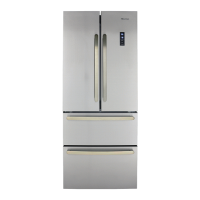
Hisense Refrigerator Specifications

General IconGeneral
BrandHisense
ModelRefrigerator
CategoryRefrigerator
LanguageEnglish

Related product manuals