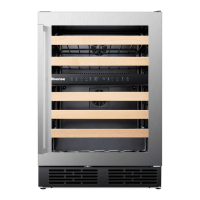
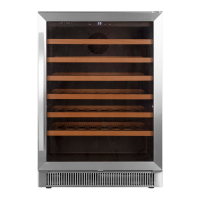
This document is a Use & Care Guide for Hisense Wine Storage Appliances, specifically models RW18W4NSWGF and RW18W4NWLGF. It provides comprehensive instructions for installation, operation, and maintenance of the wine cooler.
The primary function of this appliance is the exclusive storage of wine. It is designed to maintain optimal conditions for wine preservation, making it suitable for various environments such as kitchen areas in shops, offices, hotels, motels, residential settings, bed and breakfast environments, and catering applications. The appliance is equipped with metal shelves and has a capacity to store up to 54 standard Bordeaux 750ml bottles.
Usage Features:
The wine cooler features a control panel located at the top of the refrigerator chamber, which includes several buttons for managing its functions:
- Standby Key: Allows the user to put the appliance into standby mode to save energy when not in use for a period. To enter or exit standby mode, press and hold this key for more than 3 seconds. In standby mode, cooling stops, and the display shows "OF".
- Light On/Off Key: Controls the interior LED light. Pressing this button turns the light on or off. The light automatically turns off after 10 seconds of closing the door to prevent prolonged exposure of wine to light.
- °F and °C Change Key: Enables switching the temperature display between Fahrenheit and Celsius degrees.
- Temperature Control Keys (Up/Down): Used to set the desired temperature. When pressed for the first time, the LED readout shows the previously set temperature. Each press increases or decreases the temperature by 1°C or 1°F. The temperature range for the appliance is from 5°C (41°F) to 20°C (68°F). The factory preset temperature is 12°C (54°F). It's important to note that the appliance may have a 2°C (3.6°F) to 3°C (5.4°F) variance between the top and bottom shelves.
- Cancel Alarm Key: Used to clear an over-temperature alarm.
The display panel illuminates for 3 seconds upon power-on, beeps for 1 second, and then enters normal display status. Icons are always lit until the screen activates. A screen saver activates if no button is pressed or the door is not opened/closed for 60 seconds. Any button press or door action exits the screen saver. Each valid button press emits a short sound, and the temperature setting takes effect and is stored after 10 seconds of operation without further key presses.
The appliance also includes a Door Alarm that sounds if the fridge door is open for over 2 minutes. The buzzer sounds 3 times per minute and stops automatically after 8 minutes or when the door is closed.
For optimal wine preservation, the guide provides tips:
- Store wine in the dark. The door is made of anti-UV darkened double glass to protect wine from light.
- Lay bottles down to prevent corks from drying out.
- Avoid frequent or prolonged use of the appliance light.
- Handle bottles with care to avoid agitating the wine.
- Follow recommendations regarding quality, duration, and optimum storage temperature.
The appliance is designed for ambient temperatures between +16°C and +43°C. Performance and energy consumption may be affected if ambient temperatures fall outside this range.
Maintenance Features:
Regular cleaning and care are essential for the appliance's hygiene and appearance.
- Before Cleaning: Always switch off and unplug the appliance to avoid electrical shock.
- Cleaning the Wine Refrigerator (Interior): Unplug the appliance and remove bottles. Wash the interior with a warm water and baking soda solution (approximately 2 tablespoons of baking soda to 4 cups of water). Shelves should be washed with a mild detergent solution. The bottom part of the storage area may need periodic wiping due to condensation, as the refrigerator is designed to retain humidity.
- Exterior Cleaning: To maintain good appearance, clean regularly. Spray water onto a cleaning cloth (not directly onto the appliance surface) for even moisture distribution. Clean the door with a mild detergent and wipe dry with a soft cloth.
- Prohibited Cleaning Agents: Do not use sharp objects, thinners, car detergents, Clorox, oils, abrasive cleansers, or organic solvents like Benzene, as these can damage the surface and pose a fire risk.
- Defrosting: The inner lining has channels for refrigerant. Do not use sharp instruments to scrape off frost or ice. If solid ice forms, allow it to thaw by defrosting the appliance.
- Refrigerant Circuit: The appliance contains isobutene (R600a) refrigerant. During transportation and installation, ensure no components of the refrigerant circuit are damaged.
- Ventilation: Adequate ventilation around the appliance is crucial for cooling efficiency and heat dissipation. A minimum of 1/2 inch of space from the back and top, and 1/4 inch from the sides, is recommended. Avoid damp areas, direct sunlight, rain, frost, and heat sources.
- Leveling: The appliance should be level to eliminate vibration. This can be achieved by adjusting the feet until they touch the floor and tilting the top backward by 10-15mm (or 1°) to allow the doors to self-close.
Door Reversal:
The door opening side can be reversed from right to left. This process requires specific tools (8mm socket wrench, thin-blade screwdriver, putty knife, Phillips head screwdriver, adjustable wrench, 8mm wrench) and involves several steps:
- Disconnect power.
- Remove the door by lifting it straight up from the hinge, being careful not to lose any washers.
- Unscrew and remove the grille cover from the cabinet.
- Transform the bottom hinge from right to left by unscrewing the right hinge screws, relaxing the hinge axis, and installing it on the left hole.
- Flip the grille cover 180 degrees and reattach it to the right side slot.
- Reattach the grille cover to the wine cabinet.
- Change the axle hole parts by removing the top right axle hole part, turning the door 180 degrees, removing the reinforcement part and magnet supporter, and then installing the top left axle hole part into the door hole. Reattach the reinforcement part and magnet supporter.
- Turn the door 180 degrees, place it on the cabinet using the hinge and screws, and use the screw hole cover (right) to hide the holes on the top right side of the wine cabinet.
Troubleshooting:
The guide includes a troubleshooting section to help users diagnose and resolve common issues before contacting service. It covers problems such as wine being too warm, heavy frost buildup, unusual noises, compressor not starting immediately, and water on the floor, providing possible causes and remedies. Users are warned not to attempt repairs themselves and to contact a qualified technician if problems persist.
Disposal:
The appliance should not be disposed of as household waste. It must be taken to an appropriate waste collection point for recycling electrical and electronic equipment. Before disposal, pull out the power cord and cut it off. Refrigerant and insulation gases must be disposed of professionally to prevent eye injuries or ignition, ensuring the refrigerant circuit is not damaged.

 Need help?
 General

 To Next Page