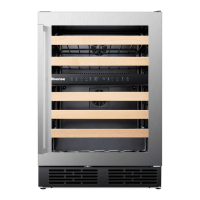
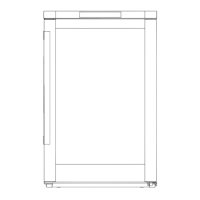
This document is a service manual for a wine cooler, providing comprehensive instructions for troubleshooting, disassembly, and maintenance. It is designed for service technicians and includes detailed diagrams and step-by-step procedures to ensure safe and effective servicing of the appliance.
Function Description
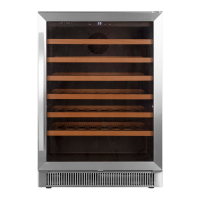
The wine cooler is designed to store wine at optimal temperatures, ensuring its quality and longevity. It utilizes a refrigeration cycle to maintain the desired internal temperature, controlled by a PCB (Printed Circuit Board) that manages various components such as the compressor, fans, and sensors. The device features an internal light for visibility and shelves for organized storage of wine bottles. Some models include dual-zone temperature control, allowing different sections of the cooler to be maintained at separate temperatures, catering to various types of wine that require specific storage conditions.
Usage Features
The wine cooler is equipped with several features to enhance its usability and performance:
- Temperature Control Panel: An intuitive control panel, often located at the top of the interior, allows users to set and monitor the temperature. For models with dual zones, separate controls are provided for the upper and lower zones.
- LED Lighting: Internal LED lights illuminate the interior, making it easy to view the wine collection without opening the door for extended periods, which helps maintain stable internal temperatures.
- Adjustable Shelves: The cooler includes shelves designed to hold wine bottles securely. These shelves can be removed or adjusted to accommodate different bottle sizes and quantities. Some models feature protective stoppers on the shelves to prevent bottles from falling.
- Magnetic Door Seal: The door is fitted with a magnetic gasket that ensures a tight seal, preventing warm air from entering and cold air from escaping, thus maintaining temperature consistency and energy efficiency.
- Reed Switch: A reed switch detects whether the door is open or closed, which can trigger actions such as turning off the internal light or adjusting the refrigeration cycle to compensate for temperature fluctuations.
- Low Noise Operation: The design aims to minimize operational noise, ensuring the cooler can be placed in various living environments without causing disturbance. The manual acknowledges that some rattling or gurgling sounds from the refrigerant flow are normal.
Maintenance Features
The service manual outlines various maintenance and troubleshooting procedures to ensure the wine cooler operates efficiently and reliably:
- Safety Precautions: Before any servicing, technicians are instructed to read and adhere to safety precautions, including unplugging the unit to prevent electric shock, wearing protective gloves, and being cautious with sharp evaporator fins. This emphasizes a strong focus on technician safety.
- Parts Identification: Detailed diagrams illustrate the location and names of all major components, such as the control panel, fan, shelves, LED light, reed switch, compressor, and hinges, facilitating accurate identification during service.
- Disassembly Procedures: Step-by-step instructions are provided for disassembling various parts, including the door, shelves, lamp, magnetic switch, display board box, control board, transformer, sensor, and fan. These procedures often involve loosening screws, separating housings, and carefully pulling components. For instance, removing shelves may require lifting one side or pressing down plastic notches, depending on the model.
- Troubleshooting Guides: Comprehensive troubleshooting charts are included to diagnose common issues. These charts cover problems such as the appliance not operating, insufficient cooling, no cooling, non-functional lights, vibrations, and the door not closing properly.
- Compressor Components Troubleshooting: A flowchart guides technicians through checking the resistance of the motor compressor, PTC-starter, and OLP (Overload Protector) to identify faults in the compressor system.
- Electric Components Troubleshooting: Another section addresses issues with other electrical components, detailing checks for current flow, voltage, and capacity in starting devices, OLP, compressor coil, and circuit parts. It also covers fan motor issues and excessive frost on the evaporator.
- Service Diagnosis Chart: This chart lists common problems, their possible causes (e.g., not plugged in, circuit breaker tripped, door opened too often, dirty gasket), and suggested remedies.
- Refrigerating Cycle Troubleshooting: A detailed chart helps diagnose problems related to the refrigerating cycle, such as partial or whole leakage and clogs. It examines the state of the set, evaporator, and compressor temperature, providing remarks on refrigerant discharge and potential faulty components like the capillary tube.
- Leakage Detection: A flowchart specifically for leakage detection guides technicians through observing refrigerant discharge, checking for frost formation in the evaporator, and identifying oil leaks to pinpoint gas leakage or clogged components.
- Control PCB Description: Diagrams of the control PCB for different models (RW54N1SSD and RW46N1DSD) are provided, showing the layout and connections of various components like LED lights, fans, sensors, the compressor, and power inputs. This aids in diagnosing electrical faults and replacing the PCB if necessary.
- Sensor and Fan Service: Specific instructions are given for servicing the sensor and fan, including how to access and separate these components from their housings and covers. This is crucial for addressing cooling performance issues.
- Component Replacement: The manual implicitly supports component replacement by guiding technicians through disassembly and diagnosis, allowing them to identify and swap out faulty parts such as the compressor, PTC-starter, OLP, or other electrical components.
Overall, the manual emphasizes a systematic approach to servicing, ensuring that technicians can efficiently identify, diagnose, and resolve issues, thereby extending the lifespan and maintaining the performance of the wine cooler.


 To Next Page
 General