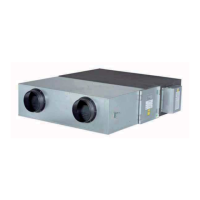
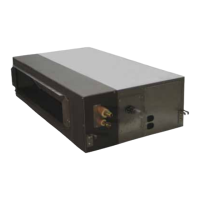
The Hitachi KPI Energy Recovery Ventilation Unit is designed to recover energy from the exhaust air stream in a ventilation system and transfer it to the supplied fresh air, thereby reducing the load on the air conditioning system. This manual covers several models, including KPI-252E2E, KPI-502(E/H)2E, KPI-802(E/H)2E, KPI-1002(E/H)2E, KPI-1502(E/H)2E, KPI-2002(E/H)2E, and KPI-3002H2E.
Function Description
The KPI units operate in different modes to optimize energy recovery and ventilation:
- Total Heat Exchange Mode: In this mode, return air from the indoor side passes through a total heat exchanger element before being exhausted outside. Simultaneously, outdoor air is supplied through the same total heat exchanger, allowing for efficient energy transfer.
- Bypass Ventilation Mode: When heat exchange is not desired, the unit can operate in bypass mode. In this configuration, return air from the indoor side is exhausted directly without passing through the heat exchanger.
- Automatic Choice Mode (Factory Setting): This intelligent mode automatically selects the optimal operation mode (Total Heat Exchange or Bypass) based on prevailing temperature conditions, including outdoor, indoor, and set temperatures.
Important Technical Specifications
The units are designed for operation within an indoor temperature range of -10°C to 43°C. The manual provides detailed dimensional drawings for each model series, including overall dimensions (A, B, C), ceiling support dimensions (D, E, F), and duct connection dimensions (G, H, J). For instance, the KPI-252E2E has dimensions of 978 (A) x 756 (B) x 268 (C) mm, with ceiling support dimensions of 698 (D) x 698 (E) x 1030 (F) mm, and duct connection dimensions of 150 (G) x 83 (H) x 381 (J) mm. Larger models like the KPI-3002H2E have significantly larger dimensions, with A=2124 mm, B=1245 mm, C=650 mm, D=2040 mm, E=1380 mm, F=1300 mm, G=450 mm, H=82 mm, and J=622 mm.
Electrical wiring connections are crucial for safe and proper operation. The manual specifies minimum wire sizes for the power source according to EN60 335-1, with current ratings ranging from ≤6A (0.75 mm²) to 40<i≤63A (10 mm²). For currents exceeding 63A, series connection of cables is not recommended. Main switches, circuit breakers (CB), and earth leakage breakers (ELB) are also specified for each model, with CB ratings from 6A to 16A and ELB ratings of 2/40/30 (poles/A/mA).
The fan motor internal thermostat settings vary by model, with cut-out temperatures ranging from 125°C±10°C to 155°C±5°C and cut-in temperatures from 85°C±10°C to 125°C±15°C. Fuse ratings for the control circuit are consistently 5A across all models, while fan unit fuses range from 2(x2)T [6X32]A for smaller models to 6(x2)gG [10X38]A for the KPI-3002H2E.
Usage Features
The unit is controlled via a Liquid Crystal Remote Control (PC-ART), which allows for various settings and monitoring. Key features include:
- Fan Speed Selection: Users can choose between High, Medium, and Low fan speeds. In DRY mode, the fan speed automatically defaults to LOW and cannot be manually adjusted.
- Operation Mode Selection: The remote control allows selection of Fan, Cool, Heat, Dry, or Auto (Cool/Heat) modes.
- Ventilation Mode Selection: This function, available when the KPI unit is connected, allows selection of Automatic ventilation, Heat Exchange Ventilation, or Bypass Ventilation.
- Temperature Setting: The desired temperature can be adjusted using the TEMP switches, with a range of 19°C to 30°C for COOL, DRY, and FAN modes, and 17°C to 30°C for HEAT mode.
- Optional Functions: Several optional functions can be configured via DSW settings on the PC-ART, such as Pre-Cool/Pre-Heat periods (0, 30, or 60 minutes delay), CO2 Sensor operation (activating high speed until CO2 sensor deactivates), Fan stoppage delay (3 minutes after remote control is switched off to cool electrical heater), High ventilation after switching ON (30 minutes at high speed), and Fixed high speed.
- System Integration: The KPI units can be integrated into standard connection systems (controlling up to 16 indoor units and KPI units) or central station systems (controlling up to 160 indoor units across 64 refrigeration series). They are compatible with Hitachi Computer Controlled Network System CS-NET, allowing for comprehensive control and monitoring.
Maintenance Features
Regular maintenance is essential for optimal performance and longevity of the KPI units. The manual outlines clear procedures for cleaning air filters and the total heat exchanger element:
- Air Filter Cleaning: For KPI-(252~2002)(E/H)2E models, the service cover is opened by pulling back hinges. Air filters located at the bottom left and right are removed. Dust can be vacuumed, and stubborn dirt can be cleaned with warm water (30-40°C) and mild detergent. Filters should be dried on a flat surface without rubbing or exposing them to flame. For KPI-3002H2E models, the filter access door is opened, filters are pulled out, vacuumed, and washed with cold or lukewarm water and neutral detergent, then air-dried. Air filters should be cleaned at least once a year.
- Total Heat Exchanger Element Cleaning: For KPI-(252~2002)(E/H)2E models, the service cover is opened, and the two heat exchanger elements are removed. Dust and dirt are vacuumed from the exposed surfaces using a brush attachment. The elements should not be washed with water or cleaned with a hard vacuum nozzle to avoid damage. For KPI-(502~2002)H2E and KPI-3002H2E models, aluminum heat exchangers can be cleaned using vapor. The total heat exchanger element should be cleaned at least once every two years.
- Thermistor Service: For KPI-(252~2002)(E/H)2E models, the fan cover screws are removed to access the thermistors. Care must be taken to secure the fan unit, which has hinges, before removing screws to prevent it from falling.
- Alarm Codes: The system provides alarm codes (e.g., 96 for room temperature thermistor failure, 97 for outdoor temperature thermistor failure) displayed on the remote control to indicate abnormalities. If an alarm occurs, the unit stops, and a message is displayed after 8 minutes.
- Troubleshooting: The manual provides guidance for common issues like smells from the unit (suggesting air filter and heat exchanger cleaning) and advises contacting a service contractor if problems persist after basic checks, providing model name, problem description, and alarm code.
Safety is paramount, with warnings against improper installation, handling, and maintenance procedures, emphasizing the importance of qualified personnel for certain tasks and adherence to local and national regulations.

 Need help?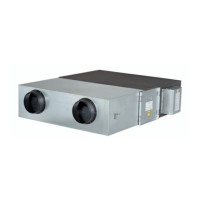

 To Next Page
 General