7
8
Specifications
Using Your Helmet Correctly
Inspect your helmet
To ensure that your helmet is in the best condition to maximize your protection, always inspect your helmet for damage
before riding :
•
Check the visor(shield) and visor(shield) ratchet
– re-tighten
visor(shield)
ratchet screws if necessary. Be sure not to over-
tighten any screws. Plastic base plate screws can break and plastic screws can strip the screw sleeves if over-tightened.
• C
heck
for helmet damage. If your helmet is damaged or cracked, stop using it immediately. See “Helmet Replacement” (p. 15)
section for further information. If your helmet has been dropped, you may not be able to see the damage.
• C
heck for worn or damaged parts.
Plastic components may wear out over time. If you find worn or damaged parts, replace them
or purchase a new helmet. See “Replacement Parts” (p. 15) for information on parts replacement.
Fasten the Retention System
Fasten the retention system (chin strap) as tight as possible under your jaw without causing pain. There must be no slack in the
strap, and the strap must be snug up against your jaw. If the retention system is not tight, your helmet may become dislodged or
knocked off in an accident.
To reduce the risk of serious injury or death, always use your helmet correctly.
If parts fall off while riding, your vision may be blocked which could cause an accident.
• Check the retention system (chin strap) for damage. If it is frayed or ripped, replace the helmet.
• Check that all pads are in place. Both of the cheek pads and the crown pads must be in place.
To reduce the risk of serious injury or death and to help prevent damage to your helmet :
• Never adjust your helmet accessories while riding – Only make helmet adjustments when stopped.
• Never
drop your helmet – Dropping your helmet may crack the shell or damage the protective foam. The damage may
not be visible. Your helmet is only designed for ONE impact. Refer to “Helmet Replacement” (p. 15) for more information
on what to do after helmet has been dropped.
• Never wear anything between your head and your helmet – this may reduce the effectiveness of your helmet.
• Never
hang or hook your helmet on anything including mirror stalks or sissy bars - Doing so may cause damage
to the helmet protective foam or liner.
• Never use
insect repellent on or around your helmet – insect repellant may damage your helmet’s visor(shield), shell,
protective
foam, or other components.
• Never
expose helmet to gasoline or gasoline fumes – Gasoline may damage your helmet’s visor(shield), shell,
protective
foam, or other components.
•
Never use a dark or tinted face visor(shield) at night or in low visibility conditions.
- If you have any questions on what other substances may damage your helmet, please contact us.
• Always
wear eye protection – If you are not using a helmet with a face visor(shield), always wear eye protection when
riding.
Always lock your face visor(shield) in place when you are riding.
• Always
be alert for sounds – Your helmet may impair your hearing. However, your helmet is not a form of hearing protection.
• Always store your helmet in its helmet bag when not in use to help reduce accidental surface damage.
Shell Cleaning
Interior Cleaning
Only use approved methods to clean the helmet. Using other unapproved chemicals or methods may damage the helmet shell
or lining. A damaged helmet may increase your risk of serious injury or death in an accident.
Glossy Finish. HJC recommends cleaning your helmet with products designed for automotive cleaning and polishing. All HJC
helmets are finished with an automotive type base coat/clear coat finish. Rubbing compounds can be used for deep cleaning to
remove many scratches and scuffs. Follow the product’s instructions diligently. Over polishing with rubbing compounds can cause
light abrasions which may dull the finish of your helmet. Stickers and decals will leave adhesive residue when removed. To remove
the adhesive residue, use alcohol swabs. Be certain to immediately wipe away the excess liquid and clean the area with soap and
water once the adhesive residue is removed. Do not use excessive pressure while rubbing when attempting to remove the adhesive
residue, instead use multiple light treatments.
Non-Glossy Finish. For our flat finish (non-glossy) helmets, we recommend using warm water and mild soap. Use multiple
treatments for heavier dirt. Do not use excessive pressure or rubbing compounds while cleaning the surface as a “glossy” effect
could be created, running the flat finish appearance.
Vent Cleaning
Dirt and debris can find its way into venting of your HJC helmet. Compressed air cans used for cleaning computer keyboards
may be used to blow the debris from the ventilation system. It is recommended that you remove any removable pads before
doing this process.
Maintaining Your Helmet Correctly
1. Please clean helmets from dust, bugs or grass within one day.
Cleaning progress
1) Clean the helmet with warm water and cloth.
2) If there are any remains left, dry the helmet and remove any remaining contamination with rubber eraser.
※ Do not use any alcohol or thinner to clean the helmet because they may damage the paint.
2. Avoid oil contamination as it is extremely difficult to clean once exposed.
■
Visor(Shield) Cleaning
Although we recommend changing a helmet every 3 to 5 years, the accumulation of sweat, humidity and dirt can deteriorate
the fabric and stitching and this may cause odor. To wash HJC removable pads, hand washing is recommended. If you use
a washing machine, please use on “Delicate” setting and air dry. HJC do not recommend using spin-dryer for the interior
pads as it may damage the material. For non-removable interiors, HJC recommends using anti-bacteria and mildew
eliminating products such as “Helmet Fresh.” or other similar product.
The helmet visor(shield) is made of polycarbonate materials with a polyurethane abrasion resistance coating. It should be
cleaned using mild soap and warm water. Never use hot water, salt water, benzene, thinner, gasoline or any other harsh
agents. Additionally the use of commercial visor(shield) cleaners is not recommended because they may affect the quality
of the visor(shield) material. Treat carefully when cleaning the visor(shield) to preserve the abrasion resistant coating. When
deep scratches are visible, it is highly recommended that the helmet visor(shield) be replaced. Tinted visor(shield) are for
“Day time use only” and are not suitable for use at night or in conditions of poor visibility.
Do not apply paint, stickers, petrol, or other solvents to this helmet.
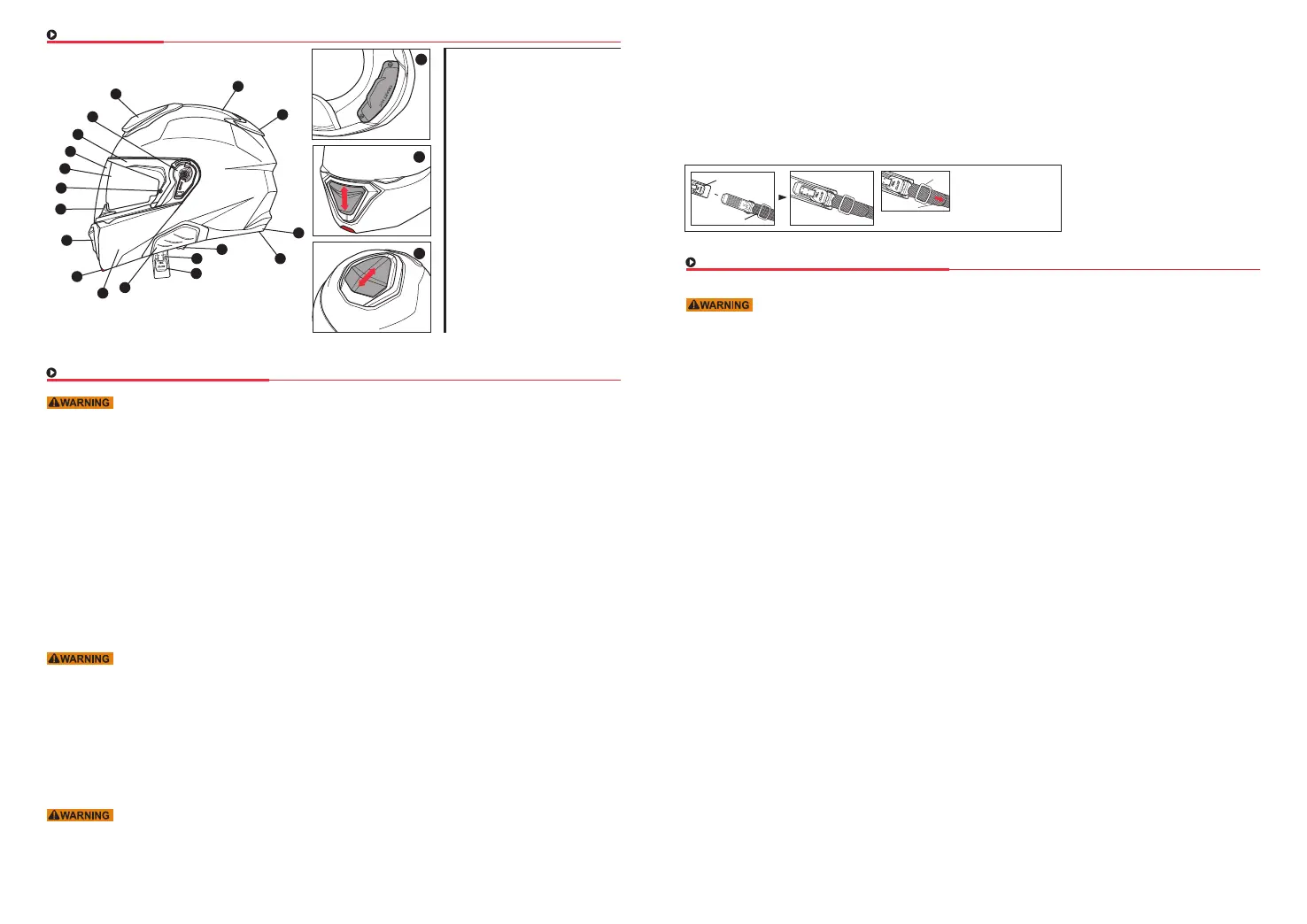
1. Outer Shell
2. Rear Venturi Exhausts
3. Shell gasket
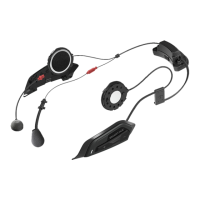
4. Bluetooth Cover
5. Sun Shield Lever
6. Chin Strap
7. Micro Buckle
8. Bluetooth UI Cover
9. Modular Chin Bar
10. Chin Bar Lever
11. Lower Vent
12. Breath deflector
13. Pinlock Pins
14. HJ-V12 Sun shield
15. HJ-33 Visor(Shield)
16. Eyeport Gasket
17. Visor(Shield) Ratchet
18. Top Vent
Micro Buckle
Hold the clip and pull
the chin strap as directed
above to adjust the fit.
Chin strap
Micro buckle
Clip
Chin strap
Check Your Face Visor(Shield)
If your face visor(shield) is scratched or damaged it may reduce the visibility-replace if necessary.
Always make sure you can see well enough to safely operate your motorcycle.
4
18
11
1
12
11
10
2
13
3
14
4
15
5
16
6
17
7
18
8
9
CLOSE
OPEN
CLOSE
OPEN


 To Next Page
 Loading...