Need help?
Do you have a question about the Holmes HAP716 and is the answer not in the manual?
Explains the 3-prong plug and grounding requirements for safe electrical operation.
Explains ions, how the ionizer works, and its effects on air purification and potential buildup.
Advises on safe use and selection of extension cords to prevent hazards.
Details what the HEPA air cleaner removes from the air, including allergens and pollutants.
Explains HEPA filter capabilities in removing airborne pollutants at 0.3 microns or larger.
Details high, medium, and low speed settings for optimal air filtration and room circulation.
Covers the filter monitor light and steps for initial setup and operation.
Guides on unpacking, placement, and basic operating instructions for the air purifier.
Provides step-by-step guidance on replacing HEPA filters and resetting the filter monitor.
Lists common problems like unit not operating, decreased airflow, and excessive noise with their solutions.
Directs users to the website and phone number for additional product information.
Outlines the terms, conditions, and coverage of the 5-year limited warranty for the product.
Explains the limitations on the manufacturer's liability for incidental or consequential damages.
Provides instructions on how to contact customer service for warranty service in the US and Canada.
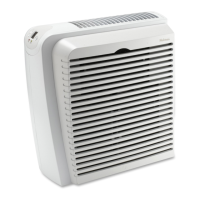
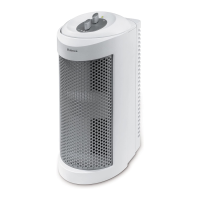
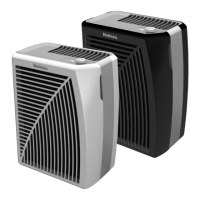
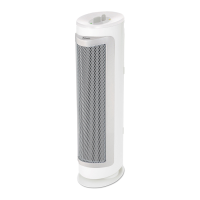
This document describes the Holmes True HEPA Tower Allergen Remover, model HAP716, an air purifier designed to improve indoor air quality.
The Holmes True HEPA Tower Allergen Remover is an air purification device that utilizes a True HEPA filter system to remove airborne allergens and pollutants. Its primary function is to clean the air in a room by capturing particles as small as 0.3 microns. These particles include common allergens such as ragweed pollen, grass pollen, tree pollen, household dust, dust mite debris, mold spores, pet dander, and smoke. The device is equipped with a rugged motor designed for continuous operation, ensuring consistent air filtration over many years. An optional ionizer feature further enhances the air purification process by releasing negative ions into the filtered air. These negative ions attach to small airborne particles, causing them to become negatively charged and potentially join with positively charged particles (like dust, pollen, smoke, and pet dander) to form larger particles that are more easily captured by the filter system. The ionizer produces less ozone than the UL established limits, but it is recommended to use it in well-ventilated areas with the fan on, especially if there are birds or small pets, as high concentrations of ozone can be harmful. The unit is designed for household use and should be operated in rooms with temperatures between 40°F and 110°F.
Before using the air purifier, it is important to unpack it carefully and select a firm, level surface free of obstructions to the air inlet or filtered air outlet. If the filter is covered by a plastic bag, it must be removed before use and the filters placed into the unit. The filtered air outlet should not be pointed towards a wall. The device operates on a 120V AC electrical outlet and is equipped with a 3-prong grounding plug for safety, which helps prevent static charge buildup from the ionizer. If a 3-slot grounded receptacle is not available, a ground adapter can be used, ensuring the green grounding wire is connected to a permanent ground.
The air purifier offers three operating speeds: LOW (1), MEDIUM (2), and HIGH (3). For optimum air filtration, continuous operation on the MEDIUM (2) setting is recommended. For quieter operation, such as in a bedroom, the LOW (1) setting can be selected. When high levels of air pollution are present, the HIGH (3) setting can be used to quickly circulate and filter the room air. The desired speed is selected by moving a knob on the top of the unit. To activate the ionizer, its control knob should be turned to the ON position, which will illuminate the ionizer light. An indicator light on the unit also signals when it's time to replace the filters, eliminating guesswork.
The ionizer may occasionally produce a popping or cracking sound, which is normal and indicates the discharge of a small buildup of ions. After extended use, dust may accumulate around the grills or front panel, which is a sign of the ionizer's air cleaning effectiveness and can be removed with a soft brush or a clean, damp cloth. If particles are attracting to surfaces throughout the home, it may be beneficial to run the ionizer less often or check the filter condition more frequently. Excessive pet dander, dust, or smoke can decrease the filter's life expectancy and interfere with the ionization process.
Regular cleaning and maintenance are crucial for the optimal performance of the air purifier. Before any cleaning or maintenance, the unit must be turned off and unplugged. The outside of the air purifier can be cleaned with a soft, clean, and dampened cloth. The rear air inlet grill is removable and washable in warm, soapy water (it is not dishwasher safe); it should be thoroughly dried before being replaced. The filtered air outlet can be cleaned of dust using a small, soft brush. If cleaning the inside of the air purifier, only a dry, soft cloth should be used, and moisture must not come into contact with the main housing.
The True HEPA filters are not washable and should not be reused; they must be replaced. If new filters come in plastic bags, these must be removed before installation. The filter monitor light indicates when filter replacement is necessary. Under normal conditions of continuous use, HEPA filters typically need replacement every 10-12 months, though filter life can vary depending on air quality and usage.
To replace the filters:
The manual also provides troubleshooting tips for common issues such as the unit not operating, decreased airflow, or excessive noise, suggesting checks for proper plugging, power, filter installation, and obstructions. For further information or to purchase replacement filters, users can visit the Holmes website or contact customer service.
 General
| Filter Type | HEPA |
|---|---|
| Model | HAP716 |
| Room Size | Large |
| Fan Speeds | 3 |
| Number of Speeds | 3 |
| Dimensions | 11.25 x 9.25 x 24.25 inches |
| Weight | 12.8 pounds |
| Voltage | 120V |
| Noise Level | 50 dB |
| Power Consumption | 50W |

 To Next Page