
 Need help?
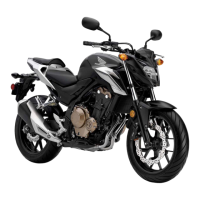
Do you have a question about the Honda CB500F 2016 and is the answer not in the manual?
General safety advice for motorcycle operation and rider awareness.
Guidelines to enhance rider safety and awareness during operation.
Information provided by safety and information labels on the motorcycle.
Precautions for safe riding, including protective apparel.
Precautions to follow while riding, covering break-in and brakes.
Advice on adding accessories and making modifications to the motorcycle.
Guidelines for properly loading luggage and cargo onto the motorcycle.
Identification and location of major motorcycle parts.
Explanation of the instrument panel, including speedometer, tachometer, and meters.
Understanding the meaning and function of various indicator and warning lights.
Operation of essential controls like ignition, stop switch, and buttons.
Step-by-step guide to starting the motorcycle's engine.
Recommended shift points for optimal performance and longevity.
Guidelines and precautions for refueling the motorcycle.
Explains why regular maintenance is essential for safety and performance.
Details the required maintenance intervals for various motorcycle components.
Covers pre-ride inspections and periodic checks for safe operation.
Procedures for checking, adding, and changing engine oil and filter.
Steps for checking, adding, and changing the motorcycle's coolant.
How to check brake fluid, pads, and adjust the brake light switch.
Inspecting, adjusting, and cleaning the drive chain.
How to check and adjust clutch lever and throttle freeplay.
Adjusting front and rear suspension spring preload for load or road conditions.
Diagnosing and resolving problems with starting the motorcycle engine.
Steps to take if the engine overheats or coolant levels are low.
Explains the meaning and troubleshooting for various warning lights.
Guidance on emergency tire repair and procedures for removing wheels.
Troubleshooting common electrical issues like battery, bulbs, and fuses.
Details about ignition keys, key tags, and the ignition cut-off system.
Guidelines for washing, polishing, and storing the motorcycle properly.
Safe methods for transporting the motorcycle and environmental guidelines.
Information on VIN, engine numbers, and emission control systems.
Explanation of warranty coverage, service procedures, and owner's rights.
Procedure for reporting vehicle safety defects to authorities and Honda.
Key specifications including dimensions, weight, engine, and battery details.
Technical data for tires, fluids, lubricants, and chain specifications.
Critical torque values required for proper assembly and maintenance.
 General
| Bore x Stroke | 67.0mm x 66.8mm |
|---|---|
| Compression Ratio | 10.7:1 |
| Fuel System | PGM-FI with 34mm throttle bodies |
| Ignition | Computer-controlled digital transistorized with electronic advance |
| Transmission | 6-speed |
| Final Drive | O-ring-sealed chain |
| Front Suspension | 41mm telescopic fork; 4.3 inches travel |
| Rear Suspension | Pro-Link single shock with nine-position spring preload adjustability; 4.7 inches travel |
| Wheelbase | 55.5 inches |
| Seat Height | 30.9 inches |
| Fuel Capacity | 4.4 gallons |
| Engine Type | 471cc liquid-cooled parallel-twin |
| Front Brake | Single 320mm disc with two-piston caliper |
| Rear Brake | 240mm disc with single-piston caliper |
| Front Tire | 120/70ZR-17 |
| Rear Tire | 160/60ZR-17 |
| Curb Weight | 414 pounds |


 To Next Page