
 Need help?
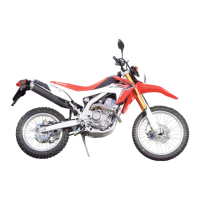
Do you have a question about the Honda CRF250L and is the answer not in the manual?
Essential advice for safe riding and protecting yourself and others.
Critical actions for rider and passenger safety, including gear and riding posture.
Guidelines for proper operation, running-in, and defensive riding techniques.
Safety implications and warnings regarding motorcycle accessories and modifications.
Specific safety instructions and considerations for riding the motorcycle off-road.
Guidelines for safely carrying luggage and cargo, including weight limits.
Visual guide to identify key motorcycle components and their locations.
Explanation of the dashboard displays, including speedometer and odometer.
Understanding the dashboard indicator lights such as neutral and turn signals.
Operation and function of essential controls like the engine stop and start switches.
Step-by-step procedure for safely starting the motorcycle's engine.
Instructions on how to safely open the fuel filler cap and refuel the motorcycle.
Location and use of the helmet holder and the tool kit for convenience.
Explains why regular maintenance is crucial for safety, performance, and longevity.
Details required maintenance tasks and their recommended intervals for optimal performance.
General principles and pre-ride inspection procedures for safe operation.
Emphasizes using genuine Honda parts or approved equivalents for reliability.
Procedures for servicing, cleaning terminals, and handling the motorcycle battery.
Guidance on inspecting and replacing blown fuses to maintain electrical system function.
Procedures for checking, adding, and changing engine oil for optimal lubrication.
How to check and add coolant to the cooling system to prevent overheating.
Checking brake fluid level and brake pad wear for safety.
Instructions for inspecting and adjusting the drive chain slack and wear.
Guidance on inspecting wheel rims and spokes for damage and proper spoke tension.
How to check and adjust the clutch lever freeplay for proper engagement.
Procedures for checking and adjusting the throttle grip freeplay for smooth operation.
Adjusting headlight aim and brake light switch for proper function.
Steps to diagnose and resolve issues when the engine fails to start.
Identifying and addressing causes and solutions for engine overheating problems.
Explaining the meaning of dashboard warning lights like the PGM-FI indicator.
Procedures and precautions for dealing with tyre punctures and repairs.
Diagnosing and fixing issues with the battery, lights, and fuses.
Guidance on recording, storing, and duplicating ignition keys.
Details on odometer, tripmeters, document bag, and ignition cut-off system.
Recommendations and warnings regarding the use of fuels containing alcohol additives.
Important guidelines for protecting the motorcycle's catalytic converter.
Proper methods for cleaning, polishing, and maintaining the motorcycle's appearance.
Procedures for preparing and storing the motorcycle for extended periods.
Safe methods and precautions for transporting the motorcycle.
Recommendations for environmentally conscious practices during use and disposal.
Information on the location of frame and engine serial numbers for identification.
Key physical and dimensional specifications of the motorcycle.
Detailed technical data including tyre, fluid, and spark plug specifications.
Specified torque values for various fasteners and components during maintenance.
 General
| Displacement | 249.6cc |
|---|---|
| Bore x Stroke | 76.0mm x 55.0mm |
| Compression Ratio | 10.7:1 |
| Transmission | 6-speed |
| Front Suspension | 43mm inverted fork |
| Rear Suspension | Pro-Link single shock |
| Rear Brake | Single 220mm disc |
| Front Tire | 3.00-21 |
| Rear Tire | 120/80-18 |
| Wheelbase | 56.9 inches |
| Fuel Capacity | 2.1 gallons |
| Ignition | Computer-controlled digital transistorized with electronic advance |
| Final Drive | Chain |
| Engine Type | Single-cylinder, liquid-cooled, 4-stroke |
| Fuel System | PGM-FI |
| Front Brake | Single 256mm disc |
| Seat Height | 34.4 inches |
| Ground Clearance | 10.0 inches |


 To Next Page