38
c.
Inspection
(I)
Contract
th
e
front
cushion
with
both
hands
from the top as
it
is completely assembled
and
check
to
see
if
it functions properly.
(2)
Check
if
any noise comes from
the
cushions
by contracting as above.
(3)
Front
cushion spring.
S1andard Valve
Load 541r.J/20.
8mm
(118.61b/2. 79in)
Load I.
2k&/I0.
8 mm (
18.
I lb
/O.
4J in)
Free
len11h
148.5mm
Fig.
69
4.4
Rear Cushion
d. Rczssembly can
be
performed
in
IM ren!rse order
of
disassembly
(Note)
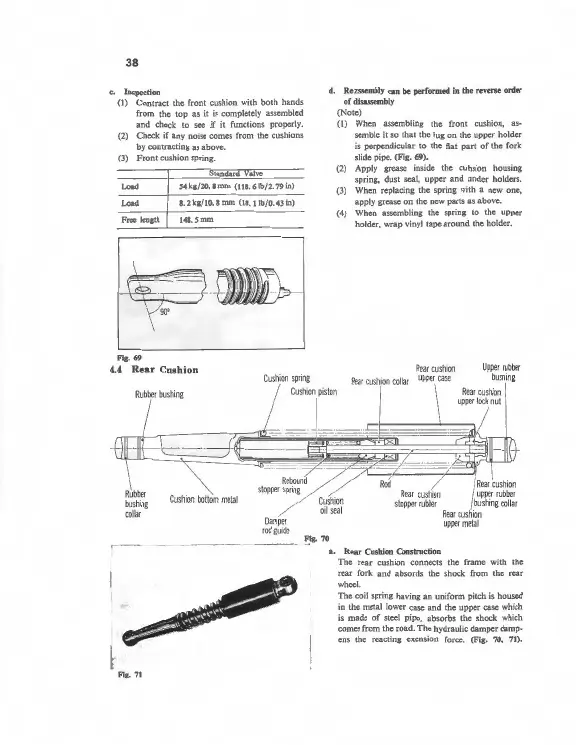
(I) When assembling the front cushion, as-
semble
it
so
that the lug
on
the
upper
holder
is
perpendicular
10
the flat part
of
the fork
slide pipe.
(F
i
g.6
9).
(2) Apply grease inside the cuhsion housing
spring. dust seal, upper and under holders.
(3) When replacing the spring with a new one.
apply grease on the new parts as above.
(4J When assembling the spring
to
the upper
holder, wrap vinyl tape
around
the holder.
Rearcush1011
Cush1on~nng
R
II
uppercase
/
c,.sh,oop,slon
ea,cusrcoar
\
Rubber
bushmg
collar
Cushioo
bottom
metal
Rebound
stoppe1
sprmg
Damper
rodgu1de
=--
C
Cushioo
01
l
seal
Rod
. I
/,
Rea
r
cushion
Rear
cush
i
on
upperrubber
stopper
rubber
bushtrigcollar
Rear
cushion
upper
metal
F_ig.
70
I ~
f
Flf:.71
a.
R"-r
Cushion Construction
The
rear cushion connects the frame with the
rear fork
and
absords the shock from the rear
wheel.
The
coil spring havina an uniform
pi1ch
is housed
in the metal lower case
and
the upper case which
is
made
of
steel pipe, absorbs the s
hoc
k which
comes from the
road.
The
hydraulic
damper
damp•
ens
the reacting exension force. (Fig. 70, 71),


 To Next Page