Need help?
Do you have a question about the Honda WMP20 and is the answer not in the manual?
Provides critical safety warnings and hazard communication for pump operation.
Guidelines for safe and proper pump operation.
Critical safety precautions to follow during maintenance tasks.
Common causes and solutions for engine starting issues.
Troubleshooting steps for identifying and resolving reduced engine power.
Diagnosing and resolving issues causing reduced water flow.
Identifying causes and solutions when the pump fails to move water.
Advises on maintenance, using genuine parts, and avoiding tampering.
Guidelines for fuel stabilization and preparation for different storage durations.
Details on warranty coverage, what's covered, and how to qualify.
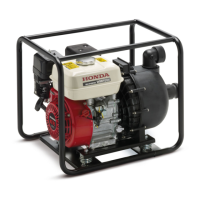
This document is the owner's manual for the Honda WMP20X Multi-Purpose Pump, providing comprehensive information on its operation, maintenance, and safety. The manual emphasizes the importance of reading and understanding its contents before operating the pump, even for experienced users, to ensure safe and efficient use. It also highlights the employer's responsibilities regarding employee training and safety when operating the pump.
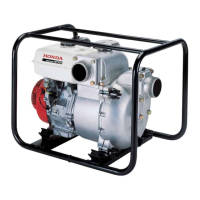
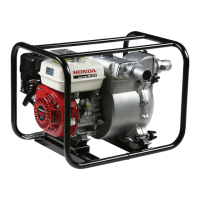
The Honda WMP20X is a multi-purpose pump designed for various liquid transfer tasks. Its primary function is to pump liquids, with specific guidelines on approved types of liquids to prevent damage to the pump or injury to the operator. The pump is equipped with an engine that drives the pumping mechanism, and its performance is influenced by factors such as total head, suction head, and the type of liquid being pumped. It features a self-priming centrifugal design, allowing it to draw liquid without external assistance once the pump chamber is filled with priming liquid. The pump is designed for safe and dependable service when operated according to instructions and intended use, making it suitable for a range of industrial and agricultural applications.
Before initial use, proper assembly is crucial for operator safety and machine reliability. The manual provides detailed instructions for installing rubber mounts, outlet elbows, and hose couplings, emphasizing the correct torque for bolts. It also specifies that the pump is shipped without oil in the engine and requires the addition of recommended oil to the filler hole's bottom edge before starting. Users are advised to register their pump with Honda for important service information.
Before each operation, a pre-operation inspection is mandatory. This includes checking for leaks, damage, proper control operation, tightened connections, intact shields, hose conditions, air filter, oil level, and fuel level. The pumping area must also be inspected, especially if discharge hoses cross roadways, to prevent pump case failure.
Connecting the suction and discharge hoses correctly is vital for pump performance. The suction hose must be reinforced to prevent collapse, and a strainer should always be attached to its end to prevent debris from entering the pump. The pump must be primed by filling the pump chamber completely with water before starting the engine; operating it dry will destroy the pump seal.
The pump is designed to handle specific industrial and agricultural chemicals, which are listed in tables within the manual. It's crucial to verify that the liquid to be pumped is listed and to flush the pump with fresh water after each use. Pumping flammable liquids or liquids for human consumption is strictly prohibited.
Starting the engine involves turning the fuel valve ON, moving the choke lever to CLOSED (unless the engine is warm), turning the ignition switch ON, and pulling the starter grip briskly. The throttle lever can be adjusted to control pump output, with the FULL position providing the highest output volume. Stopping the engine in an emergency involves turning the ignition switch to OFF. For normal shutdown, the throttle lever should be moved to IDLE, followed by turning the ignition switch to OFF and the fuel valve to OFF. After each use, the pump chamber should be drained and flushed with fresh water.
Safety precautions are heavily emphasized throughout the manual. Users are warned about carbon monoxide hazards, hot exhaust parts, and the flammability of gasoline. Protective clothing, including heavy-duty gloves and hearing protection, is recommended. Shields and guards must remain in place during operation. The manual also provides troubleshooting guides for common issues like the engine not starting, loss of power, low pump output, or the pump not pumping at all.
Proper maintenance is essential for safe, economical, and trouble-free operation, and it also helps reduce air pollution. The manual includes a detailed maintenance schedule, specifying intervals for various tasks such as checking oil level, cleaning air filter, flushing pump chamber, changing engine oil, inspecting and replacing spark plugs, cleaning spark arrester, and cleaning sediment cup. More frequent service is required for pumps operated under severe conditions (high-load, high-temperature, wet, or dusty environments).
Engine oil changes are recommended after the first 20 hours of use and every 100 hours thereafter, or more often in dusty conditions. The manual provides step-by-step instructions for draining used oil and refilling with recommended SAE 10W-30 oil.
The air filter should be checked after each use and cleaned every 50 hours, or more often in dusty areas. Replacement is recommended every 300 hours. Instructions for inspecting, cleaning (both paper and foam elements), and reassembling the air filter are provided, with a warning against operating the engine with a dry or damaged air filter.
The spark plug should be checked annually or every 100 hours and replaced every 300 hours. Instructions for removing, inspecting, cleaning, gapping, and reinstalling the spark plug are included.
For models equipped with a spark arrester (an optional part), it must be serviced every 100 hours to maintain proper function. The manual details how to remove, clean carbon deposits from, inspect, and reinstall the spark arrester.
The sediment cup should be cleaned periodically by turning the fuel valve OFF, removing the cup and O-ring, washing them in nonflammable solvent, drying thoroughly, and reinstalling them securely.
Storage preparation is crucial for preventing rust, corrosion, and starting problems. This involves draining or treating the fuel, changing the oil and coating the engine cylinder, cleaning the pump and engine, and choosing a suitable storage location. The manual provides specific procedures for draining the fuel tank and carburetor, adding oil to the engine cylinder to prevent rust, and cleaning the pump. When removing the pump from storage, users are advised to refill the tank with fresh gasoline and check the pump as described in the "BEFORE EACH OPERATION" section.
The manual also covers emission control system maintenance, emphasizing that proper maintenance is required to keep emissions within standards. It outlines the warranty coverage for emission-related parts and the owner's responsibilities. Honda recommends using genuine Honda parts for repairs to ensure quality and reliability.
 General
| Maximum Suction Head | 8 m |
|---|---|
| Starting System | Recoil |
| Suction Lift | 8 m |
| Displacement | 118 cc |
| Max Output | 3.1 HP at 3, 600 rpm |
| Pump Type | Centrifugal |
| Max Head | 32 m |
| Fuel Tank Capacity | 2.0 liters |
| Discharge Port Diameter | 50 mm (2 inches) |
| Suction Port Diameter | 50 mm (2 inches) |
| Oil Capacity | 0.56 liters |
| Outlet Diameter | 50 mm (2 inches) |

 To Next Page