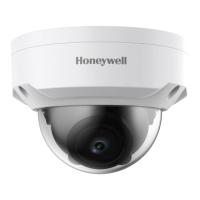
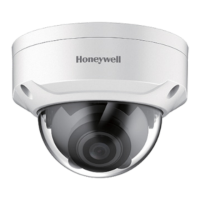
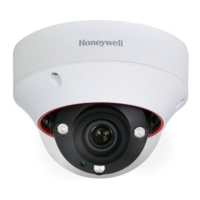
This document provides installation and usage instructions for Honeywell Outdoor IR Rugged IP Dome Cameras, specifically models H4W2GR1, H4W2GR2, H4L2GR1, and H4W4GR1. These cameras are designed for outdoor surveillance, featuring robust construction and infrared capabilities for low-light conditions.
Function Description:
The Honeywell Outdoor IR Rugged IP Dome Cameras are designed for video surveillance in various outdoor environments. They capture video footage, which can be accessed and managed via an IP network. The integrated infrared (IR) functionality allows for clear image capture even in complete darkness, making them suitable for 24/7 monitoring. The rugged design ensures durability against environmental factors. The cameras support both Power over Ethernet (PoE) and external 12V/24V power sources, offering flexible installation options. They are equipped with a Micro SD card slot for local storage, providing a backup or standalone recording solution. The cameras feature pan and tilt adjustments for precise aiming and an LDR (Light Dependent Resistor) for automatic IR activation based on ambient light levels.
Important Technical Specifications:
- Models: H4W2GR1, H4W2GR2, H4L2GR1, H4W4GR1.
- Power: PoE (IEEE 802.3af standard) or 12V/24V (Optional). When using 24V AC, a UPS is recommended to comply with EN50130-4 requirements.
- Mounting: Supports various mounting options with Ø8mm screws and M5/M20/3/4" NPT fittings.
- Video Standard: Supports both PAL and NTSC video standards, selectable via software settings.
- Operating Temperature: Recommended range of -40°F to 140°F (-40°C to 60°C).
- Storage: Micro SD card slot for local storage.
- Network Connectivity: IP-based, allowing for remote access and management.
- IR Illumination: Integrated IR LEDs for night vision, controlled by an LDR.
- Adjustments: Mechanical pan and tilt for camera orientation.
- Compliance:
- FCC Part 15 Class A for digital devices.
- Canadian ICES-003.
- European Parliament and Council Directive on the Restrictions of the use of certain hazardous substances in electrical and electronic equipment (2011/65/EU).
- General Product Safety Directive (2001/95/EC).
- EMC Directive (2014/30/EU), conforming to EN 55022 (emissions), EN 50130-4 (immunity), and EN 60950-1 (electrical equipment safety).
- CSA Certified/UL Listed LPS or Class 2 power adapters are required for electrical safety.
- PoE is not intended to be connected to exposed (outside plant) networks.
Usage Features:
- Installation: The manual details the physical installation process, including mounting the camera base, attaching the dome, and connecting power and network cables. It provides instructions for using different mounting accessories (M5 screws, M20 fittings, 3/4" NPT fittings). The camera allows for mechanical adjustment of pan and tilt angles to achieve the desired field of view.
- Initial Setup: Upon first power-up, users are prompted to change the default password for security. The Honeywell IPC Tool software is used to discover cameras on the network, configure network settings (IP address, subnet mask, gateway), and access the camera's web interface for advanced settings.
- Web Interface: The camera's web interface provides comprehensive control over various settings, including:
- General Settings: Device name, language, video standard (PAL/NTSC), status LED control.
- Camera Setup: Compression settings, image adjustments.
- Network Setup: IP configuration (DHCP/Static), port settings.
- Alarm Setup: Configuration of alarm inputs/outputs and event triggers.
- Video Analytics: Advanced video analysis features.
- Storage Setup: Management of Micro SD card storage.
- System Setup: Firmware upgrade, user management, log viewing.
- Remote Access: The camera can be accessed remotely via its IP address using a web browser, allowing for live view, playback of recorded footage, and configuration changes from any network-connected device.
- IR Functionality: The integrated IR illuminators automatically activate in low-light conditions, ensuring continuous surveillance even in complete darkness. The LDR sensor detects ambient light levels to control IR activation.
- Rugged Design: The camera is built to withstand harsh outdoor conditions, making it suitable for a wide range of applications.
Maintenance Features:
- Password Management: Users are required to change the default password upon initial setup and can manage user accounts and permissions through the web interface.
- Firmware Upgrade: The camera's firmware can be upgraded via the web interface, allowing for performance improvements, bug fixes, and new features.
- Cleaning: The manual advises against using strong or abrasive detergents when cleaning the camera.
- Troubleshooting: The IPC Tool assists in discovering and managing cameras on the network, which can be helpful for troubleshooting connectivity issues.
- Environmental Considerations: The manual emphasizes avoiding operation or storage in extremely humid, dusty, hot/cold environments outside the specified temperature range, and away from strong electromagnetic radiation sources, to ensure optimal performance and longevity.
- Disposal: The product should be disposed of according to applicable local laws, regulations, and procedures for Waste Electrical and Electronic Equipment (WEEE) at the end of its useful life.

 Need help?
 General

 To Next Page