5.4 Programming the hand transmitter buttons on
an integrated radio receiver
Briefly press the small 1. P button (see Figure 1) once
(for channel 1 = impulse command), twice
(for channel 2 = light command) or three times
(for channel 3 =partial opening command).
Pressing the small P button again will immediately end
radio programming.
Depending on the channel being programmed, the rim of
the large T button will flash 1x (for channel 1) or 2x
(for channel 2) or 3x (for channel 3). During this time,
a hand transmitter button can be programmed for the
desired function.
Press the hand transmitter button to be programmed 2.
until the rim of the large T button flashes rapidly.
The radio code of this hand transmitter button is now
stored in the integrated radio receiver.
5.5 Deleting all data in an integrated radio receiver
Press and hold the small
▶
P button.
The rim of the large T button flashes slowly, signalling the
readiness for deletion. The flashing then becomes more
rapid. Afterwards, the programmed radio codes of all
hand transmitters are deleted.
5.5.1 Connecting an external radio receiver *
Instead of the integrated radio receiver, an external
1/2/3-channel radio receiver can be used for the impulse
function (channel 1), light function (channel 2) and partial
opening (channel 3) to control the roller garage door operator.
Insert the plug of the receiver in the corresponding socket
(see Figure 4). To avoid double assignments, delete the data
of the integrated radio receiver when using an external radio
receiver (see Deleting all data in an integrated radio receiver,
page 29).
Excerpt from the declaration of conformity 5.6
for the receiver
Conformity of the abovementioned product with the
requirements of the directives according to article 3 of the
R & TTE directives 1999/5/EC was verified by compliance
with the following standards:
EN 60950:2000ō
EN 300 220-1ō
EN 300 220-3ō
EN 301 489-1ō
EN 300 489-3ō
The original declaration of conformity can be requested from
the manufacturer.
* Accessory, not included as standard equipment!
6 Operation
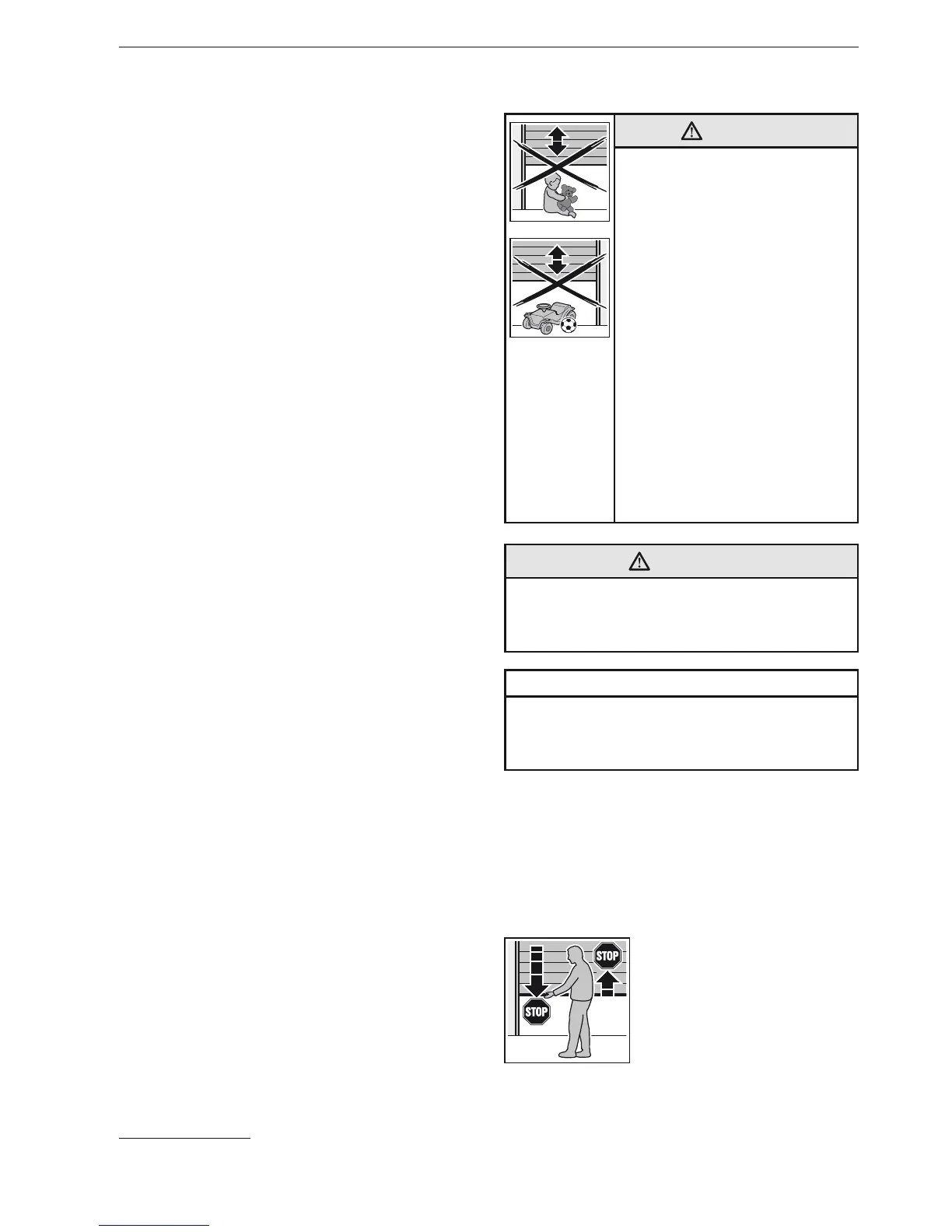
WARNING
Danger of injury during door travel
If people or objects are in the area
around the door while the door is in
motion, this can lead to injuries or
damage.
Children are not allowed to play
▶
near the door system.
Make sure that no persons or
▶
objects are in the door's area of
travel.
If the door has only one safety
▶
device, only operate the roller
garage door operator if you are
within sight of the door's area of
travel.
Monitor the door travel until the
▶
door has reached the end-of-travel
position.
Only drive or pass through remote
▶
control door systems if the door is
in the Open end-of-travel position!
Never stay standing under the open
▶
door.
CAUTION
Danger of crushing in the side guide
Do not reach into the side guide with your fingers during
door travel, as this can cause crushing.
Do not reach into the guide rail during door travel.
▶
ATTENTION
Overloading the release knob
The release knob can be damaged by overloading.
Do not hang on the release knob with your body
▶
weight.
Instructing users6.1
All persons using the roller garage door operator must
▶
be shown how to operate it properly and safely.
Demonstrate and test the mechanical release as well as
▶
the safety reversal.
Function check6.2
To check the safety reversal,
▶
stop the door with both hands
while it is closing.
The door system must stop and
initiate the safety reversal. The
door system must also switch off
and stop the door while it is
opening.
TR10A073-B RE / 02.2012 29
ENGLISH



 To Next Page
 Loading...