
 Need help?
Do you have a question about the Hornby CLASS 67 and is the answer not in the manual?
Maintain clean running surfaces by wiping rails and wheels with a non-fluffy cloth or Hornby Track Cleaning Rubber (R8087).
The sealed 5-pole motor requires no maintenance. Replacement should be done by a Hornby Service Dealer.
Check and remove fluff, fabric fibres, or pet hairs from chassis and axles using tweezers.
Lubricate moving parts approximately every 6 months or 100 hours of running.
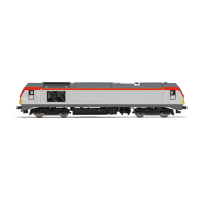
This document provides comprehensive operating and maintenance instructions for the Hornby Class 67 Bo-Bo Diesel Electric Locomotive, a precision-built model designed for enthusiasts. It emphasizes careful handling, proper setup, and regular maintenance to ensure many years of good service.
The Hornby Class 67 locomotive is a highly detailed model, produced to a super-detail standard. This means it incorporates delicate, protruding details and many small parts, necessitating careful handling to avoid damage. It is designed for indoor use only and is not suitable for children under 3 years of age due to small parts that present a choking hazard and some components with functional sharp edges.
The locomotive operates on a variable 12-volt DC power supply, which should be obtained from a suitable Power Controller connected to the normal domestic mains electricity supply. It is crucial never to connect the locomotive directly to the mains electricity supply. Before use, users must ensure their transformer is the correct voltage for their mains supply and is a "Transformer for Toys." The transformer should be regularly examined for damage to its casing, plug pins, and cables. If any damage is found, the transformer must be replaced with a new Hornby recommended unit and not used until then. Users should never attempt to open the transformer themselves. The locomotive should not be connected to more than the recommended number of power supplies, and the output terminals of the transformer must not be connected directly or indirectly to the output of any other AC circuit derived from a transformer or mains power supply. Before cleaning any part of the locomotive, the transformer must be disconnected from the mains electricity supply. Liquid should not be used for cleaning. These safety details should be retained for future reference.
The locomotive will typically draw a current of between 2 and 4 amps, depending on the track configuration and whether gradients are included. A current surge will occur when starting the locomotive. For optimal operation, the locomotive should not be operated on track curves of less than 438mm radius, which corresponds to Hornby 2nd radius track.
To remove the coupling bar, the locomotive should be held upside down, and the coupling bar gently pushed downwards to disengage, then pulled out. The body of the locomotive can be removed by unclipping it from the sides and easing it off by lifting upwards. When replacing the body, it is important to ensure it is clipped securely back into place. The locomotive is "DCC READY," indicating its compatibility with Digital Command Control systems.
If the locomotive ceases to respond normally to the power controller or runs badly, several checks should be performed:
Track Cleaning: In normal use, model railway layouts will accumulate a blackish deposit on the running surfaces of the rails. Some of this deposit will transfer onto the locomotive's pick-up wheels. This deposit, if allowed to build up, can have adverse effects: the driving wheels will not achieve maximum traction, and there will be a reduction in the power reaching the locomotive motor. Therefore, it is essential to keep both the track and wheels clean. This can be done by wiping the surfaces with a clean, non-fluffy cloth. More stubborn deposits can be removed using the Hornby Track Cleaning Rubber, reference R8087, available from Hornby Service Dealers.
Motor: The locomotive is fitted with a sealed, long-life, 5-pole motor that requires no maintenance. After considerable use, the motor may require replacement, which should be carried out by a Hornby Service Dealer.
Chassis: The locomotive chassis may, from time to time, pick up fluff, fabric fibers, and pet hairs, which can become entangled in the gears and around axles. For this reason, it is not advisable to run the locomotive on track laid on a carpet. It is important to check the chassis regularly and remove any such debris with small tweezers.
Lubrication: Although the locomotive is lubricated during manufacture, the lubricant can sometimes dry out in storage. Lubrication should be carried out at approximately 6-monthly intervals, or every 100 hours of running. Only small single drops of light machine oil should be applied to the places indicated in red in Fig.6. This is best achieved by making a simple oil "dropper" as illustrated in Fig.5. A straightened paper clip inserted into a cork can be used with a bottle cap as a container for the oil. A small drop of oil can then be picked up by the dropper and applied precisely. Any excess oil, especially from the locomotive body, should be immediately wiped off. Only moving parts should be lubricated.
Locomotive Bodywork: The locomotive body is overall spray painted, and the rest of the decoration is applied by a printed process, not transfers.
Television Suppression: The Hornby locomotive incorporates radio and television interference suppressors. If interference is experienced despite these precautions, it may be due to the close proximity of the model railway layout to receivers, aerials, or their "downlines." In such cases, moving the layout further away from aerials and receivers is recommended. It is most important that track and wheels are kept absolutely clean.
Spare Parts and Service: Spare parts packs can be obtained from Hornby Service Dealers, who also offer a repair service.
Important Handling Note: Only remove the locomotive from the EPS tray by carefully lifting it out, using the finger holes provided. This locomotive is made to exacting fine scale standards and therefore necessarily incorporates small, delicate, protruding parts – handle with care. Before using the model, users should read through the Operating and Maintenance Instructions in this leaflet.
 General
| Class | 67 |
|---|---|
| Finish | Painted |
| Wheel Configuration | Bo-Bo |
| Type | Locomotive |
| Scale | OO |
| Power Source | Electric |
| Control | DCC Ready |
| Features | directional lighting, sprung buffers |
| Era | Era 11 (2016-Present) |
| DCC Type | DCC Ready |
| Operator | DB Schenker |
| DCC Status | DCC Ready |


 To Next Page