
 Need help?
Do you have a question about the Hotpoint H2F HL626 UK and is the answer not in the manual?
Identifies all numbered parts of the dishwasher appliance diagram for user understanding.
Details the buttons and indicator lights on the dishwasher's control panel for operation.
Instructions for correctly filling the salt reservoir to prevent limescale.
Guide to adjusting water hardness for optimal softener performance.
How to fill the rinse aid dispenser for improved drying results.
Steps to modify rinse aid quantity for better drying performance.
Instructions for loading detergent into the dispenser for effective cleaning.
Details the Eco programme for efficient cleaning and compliance with standards.
Recommends the Intensive programme for heavily soiled crockery like pans.
Explains the Mixed programme for normally soiled dishes with dried food.
Describes the Rapid 28' programme for lightly-soiled, half loads without drying.
Use the Soak programme to refresh crockery intended for later washing.
Use Half Load to save resources when washing fewer dishes.
Allows delaying the start time of a wash cycle by 2, 4, or 8 hours.
Optimizes performance for combined detergents in tablet form.
Stops the active cycle and drains water from the dishwasher.
Guidelines for loading delicate and light dishes into the upper rack.
Instructions for loading pots, plates, and larger items into the lower rack.
How to adjust the upper rack height for optimal loading space.
Explains how to fold/unfold flaps for better crockery arrangement, especially for wine glasses.
Guide to arranging cutlery in the basket for effective cleaning and safety.
Covers checking connections, switching on, loading, and starting the dishwasher.
Explains how to modify a running program or resume after interruptions.
Advice on loading racks, unsuitable items, and preventing damage.
Tips for efficient energy use and maintaining appliance hygiene.
Instructions for cleaning the three-part filter assembly to ensure proper drainage.
How to clean spray arms to ensure water distribution and prevent blockages.
Explains the water softener's function and salt regeneration process.
Procedure to clean the water inlet hose before connection if unused.
Addresses salt/rinse aid indicators and dishwasher not starting.
Solutions for drainage issues and excessive operational noise.
Troubleshoots dishes not clean, dishwasher not filling, and LED blinking.
Addresses issues where the dishwasher finishes the cycle prematurely.
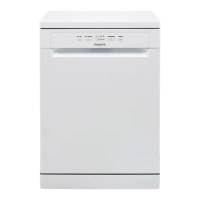
This document provides a comprehensive guide for the Hotpoint dishwasher, covering its functions, usage, and maintenance.
The Hotpoint dishwasher features an upper rack, foldable flaps, and an upper rack height adjuster for flexible loading. It includes upper and lower spray arms for thorough cleaning, a lower rack, and a cutlery basket. Essential components like the filter assembly, salt reservoir, and detergent and rinse aid dispensers are easily accessible. The control panel is intuitive, featuring an On-Off/Reset button, program selection, Half Load, Rinse Aid refill indicator, Salt refill indicator, program indicator lights, Delay indicator, Delay button, Tablet (Tab) button, and a Start/Pause button with a Drain out function.
Before the first use, it's crucial to remove stoppers from the racks and retaining elastic elements from the upper rack.
The salt reservoir, located in the lower part of the dishwasher, must be filled to prevent limescale formation. The SALT REFILL indicator light on the control panel signals when a refill is needed. To fill, remove the lower rack, unscrew the reservoir cap, and for the first time, fill with water before adding approximately 1 kg of dishwasher salt using the provided funnel. Ensure the cap is screwed on tightly to prevent detergent from entering. Always complete this procedure before starting a wash cycle to avoid corrosion.
Proper water hardness setting is essential for the water softener to function effectively. This information can be obtained from your local water supplier. To set, switch the appliance on and off, then press and hold the START/Pause button for 5 seconds until a beep is heard. Switch the appliance back on, and use the P button to select the desired hardness level according to the Water Hardness Table provided in the manual.
Rinse aid facilitates dish drying and should be refilled when the RINSE AID REFILL indicator light is lit. Open the dispenser by pressing and pulling up the tab on the lid, pour in up to 110 ml of rinse aid, and close the lid until it clicks. Never pour rinse aid directly into the appliance tub.
If drying results are unsatisfactory, the rinse aid dosage can be adjusted. Switch the dishwasher on and off, press the START/Pause button three times (a beep will be heard), then switch it back on. The program indicator light for the current level will flash, allowing you to use the P button to select the desired rinse aid quantity. Levels range from 1 (ECO, no rinse aid supplied) to 5. Bluish streaks indicate too much rinse aid (set to 2-3), while water drops or limescale marks suggest too little (set to 4-5).
To open the detergent dispenser, use the opening device C. Introduce detergent into the dry dispenser D, referring to the dosing indications inside. For pre-washing, detergent can be placed directly inside the tub. Remove any detergent residues from the edges and close the cover until it clicks. The dispenser opens automatically during the program. For all-in-one detergents, use the TABLET button to optimize washing and drying results. Only use detergents designed for dishwashers to prevent malfunction or damage.
The dishwasher offers several programs tailored to different soiling levels and load types:
Pre-treatment of dishes is not required for any program. Not all options can be used simultaneously. Program durations are indicative and may vary based on factors like water temperature, pressure, room temperature, detergent amount, load type, load balancing, selected options, and sensor calibration.
Options are selected directly via the control panel buttons. If an option is incompatible with the selected program, the corresponding LED will flash rapidly three times, and a beep will sound, preventing the option from being enabled.
Load delicate and light dishes such as glasses, cups, saucers, and small salad bowls.
The upper basket's height can be adjusted to accommodate bulky crockery in the lower basket or create more space upwards. The upper rack height adjuster allows lifting the rack by simply holding its sides. To lower it, press the levers (A) on the sides and move the basket downwards. It is recommended not to adjust the rack height when it is loaded, and never raise or lower it on one side only.
Side foldable flaps can be folded or unfolded to optimize crockery arrangement. Wine glasses can be placed safely by inserting their stems into the corresponding slots. To unfold, slide the flap up and rotate or release it. To fold, rotate and slide the flaps down or pull them up and attach them to the snaps.
Load pots, lids, plates, salad bowls, and cutlery. Large plates and lids should be placed at the sides to avoid interference with the spray arm.
The cutlery basket, equipped with top grilles for improved arrangement, should be positioned only at the front of the lower rack. Knives and sharp utensils must be placed with points facing downwards or horizontally in the tip-up compartments on the upper rack.
The machine automatically switches off during extended periods of inactivity to minimize electricity consumption. If crockery is lightly soiled or pre-rinsed, reduce the detergent amount.
If a wrong program was selected and has just begun, press and hold the ON/OFF button to switch off the machine. Switch it back on, select the new program and options, then press START/PAUSE.
Without switching off, open the door (beware of hot steam), place crockery inside, close the door, and press START/PAUSE to resume the cycle.
If the door is opened or there's a power cut, the cycle stops. Once the door is closed or power is restored, press START/PAUSE to resume.
Remove all food residues from crockery and empty glasses before loading. Pre-rinsing under running water is unnecessary. Arrange crockery firmly, with openings facing downwards, and concave/convex parts obliquely for proper water flow. Ensure lids, handles, trays, and frying pans do not obstruct spray arm rotation. Place small items in the cutlery basket. Heavily soiled dishes and pans should be in the lower basket for stronger water sprays.
Avoid wooden crockery and cutlery, delicate decorated glasses, artistic handicraft, antique crockery, synthetic materials not resistant to high temperatures, copper, tin crockery, and crockery soiled with ash, wax, lubricating grease, or ink. Glass decorations and aluminium/silver pieces may change colour or fade. Some crystal objects may become opaque after multiple wash cycles.
Use only dishwasher-safe glasses and porcelain. Use a delicate detergent. Collect glasses and cutlery immediately after the wash cycle.
Dishwasher use typically consumes less energy and water than hand dishwashing. Maximize efficiency by fully loading the dishwasher. For partial loads, use dedicated options like Half Load. Incorrect loading or overloading increases resource usage and reduces cleaning/drying performance. Manual pre-rinsing is not recommended.
To prevent odour and sediment buildup, run a high-temperature program at least once a month with a teaspoon of detergent and no load.
Regularly clean the filter assembly to prevent clogging and ensure proper wastewater flow. Clogged filters can cause malfunction, performance loss, and increased resource usage. The dishwasher must not be used without filters or if they are loose.
At least once a month or every 30 cycles, check and clean the filter assembly thoroughly under running water with a non-metallic brush:
Food residues can encrust and block the spray arm holes. Periodically check and clean them with a small non-metallic brush. To remove the upper spray arm, turn the plastic locking ring anti-clockwise. The upper spray arm should be replaced with the side having more holes facing upwards. The lower spray arm can be removed by pulling it upwards.
The water softener automatically reduces water hardness, preventing scale buildup and improving cleaning efficiency. This system regenerates with salt, so the salt container must be refilled when empty. Regeneration frequency depends on water hardness settings (e.g., once per 6 Eco cycles for hardness level 3). Regeneration occurs during the final rinse and finishes in the drying phase, consuming approximately 3.5L of water, taking up to 5 additional minutes, and consuming below 0.005kWh of energy.
If water hoses are new or unused for an extended period, let the water run until it is clear and free of impurities before connecting. This prevents blockages and damage to the dishwasher.
 General
| Water fill | Cold, Hot |
|---|---|
| Cord length | 1.3 m |
| Control type | Buttons |
| Product size | Full size (60 cm) |
| Tub material | Stainless steel |
| Product height | Standard (80 - 85 cm) |
| Inlet hose length | 1.55 m |
| Number of baskets | 2 basket(s) |
| Custom panel-ready | No |
| Outlet hose length | 1.5 m |
| Appliance placement | Freestanding |
| Control panel color | White |
| Cutlery compartment type | Basket |
| Baskets adjustable placement | Upper |
| Upper basket adjustable height | Yes |
| Cycle time | 215 min |
| Noise level | 46 dB |
| Drying system | Static |
| Delay start (max) | 8 h |
| Dishwashing programs | Eco, Intensive, Mixed, Quick, Soak |
| Left-on mode duration | 12 min |
| Number of spray zones | 1 |
| Number of place settings | 14 place settings |
| Number of washing programs | 5 |
| Number of temperature settings | 3 |
| Maximum hot water supply temperature | 60 °C |
| Current | 13 A |
| Connected load | 1900 W |
| Power plug type | Type G |
| AC input voltage | 220-240 V |
| AC input frequency | 50 Hz |
| Energy efficiency scale | A to G |
| Power consumption (off) | 0.5 W |
| Power consumption (left-on) | 6 W |
| Water consumption per cycle | 9.5 L |
| Energy consumption per cycle | 0.95 kWh |
| Package depth | 675 mm |
| Package width | 625 mm |
| Package height | 910 mm |
| Package volume | 0.302 cm³ |
| Package weight | 44900 g |
| Drying class | A |
| Country of origin | Poland |
| Dimensions (WxDxH) | 600 x 590 x 850 mm |
| Annual water consumption | 2660 L |
| Annual energy consumption | 266 kWh |
| Customs product code (TARIC) | 84221100 |
 Weight and Dimensions
| Depth | 595 mm |
|---|---|
| Width | 600 mm |
| Height | 850 mm |
| Weight | 43100 g |


 To Next Page