Need help?
Do you have a question about the Hover-1 MAVERICK and is the answer not in the manual?
Emphasizes reading the manual to prevent damage, injury, or death.
Notes on charger use, operating temperature, and riding conditions.
Effects of cold temperatures on Maverick performance and potential risks.
Guidelines for safe operation, avoiding water, drops, and unauthorized repairs.
Considerations for specific rider groups and the need for supervision.
Explanation of NOTES, CAUTION, and WARNING symbols for hazard awareness.
Introduces the Maverick as a personal transporter and the manual's role.
Details the items included with the Hover-1 Maverick electric scooter.
Identifies key components of the Maverick via a diagram and labels.
Explains the technology behind balance, motion control, and stabilization.
Lists detailed specs: model, weight, speed, range, battery, power, and dimensions.
Covers powering on/off, foot mat sensors, battery status, and running indicators.
Ensures proper scooter readiness and recommends appropriate safety gear and attire.
Detailed steps for safely mounting, balancing, and riding the Maverick.
Discusses terrain, rider weight, temperature, and speed's impact on travel distance.
Instructions for recalibrating the Maverick if it exhibits balance or operational issues.
Details battery type, charge time, voltage, and capacity for the Maverick.
Safe handling, charging, and disposal instructions for the lithium-ion battery.
Info on warranty, customer service contacts, and troubleshooting resources.
Information on electronic waste disposal compliance and conformity declarations.
Key information and cautions found on the charger's identification label.
Key information and compliance marks found on the scooter's identification label.
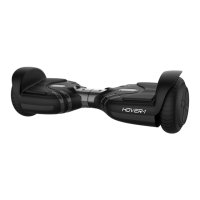
The Hover-1 Maverick is a personal electric scooter designed for individual transportation. It operates using digital electronic gyroscopes and acceleration sensors to maintain balance and motion, responding to the user's center of gravity. The scooter's control system drives motors located within the wheels, and a built-in inertia dynamic stabilization system assists with balance when moving forward and backward, though not during turns.
To ensure safe operation, users must familiarize themselves with all instructions, warnings, and safety features outlined in the manual. Before each ride, it's crucial to perform a pre-ride checklist to confirm the Maverick is in proper working order. This includes ensuring the battery is fully charged and that the screws on the front and back tires are firmly locked. If any part of the scooter is damaged or not functioning correctly, it should not be ridden until repaired.
When riding, always wear appropriate safety and protective gear, including a helmet that meets CPSC or CE safety standards. Helmets should fit properly with the chin strap in place to provide full head protection. Comfortable, flat, closed-toe shoes are recommended. Users should practice in a flat, open area at slower speeds to become comfortable with the scooter's functions before riding in public.
The Maverick is designed for use on flat and even paved surfaces. It is not intended for off-road use, skate parks, empty pools, or similar terrains. Avoid riding over bumps or objects greater than ½ inch. If uneven pavement is encountered, it's best to lift the Maverick over the obstruction. Do not operate the scooter in or near puddles of water, mud, sand, stones, gravel, debris, or rough terrain.
Operating the Maverick involves shifting your weight to control movement, acceleration, deceleration, and stopping. To increase stability, especially during turns at higher speeds, shift your weight to overcome centrifugal force. When first learning, it typically takes 3-5 minutes to get comfortable standing and maintaining balance. A spotter can provide additional security. The device is intuitive, sensing even slight motions, so any anxiety about stepping on may trigger unwanted movement. To turn, focus on the desired direction and remain relaxed. Avoid sharp turns or high speeds, and do not ride quickly along slopes, as this may cause injury. If bumps or uneven surfaces are encountered, bend your knees to absorb shock and vibration, then dismount and carry the Maverick to a safe operating surface.
Dismounting involves lifting one leg and placing the foot back on the ground (stepping back), then stepping off completely. It's important to lift feet completely off the foot mats to prevent the Maverick from spinning.
Safety precautions extend to environmental conditions and rider behavior. Do not ride in inclement weather such as snow, rain, hail, or extreme heat or cold. Avoid operating the Maverick in crowded areas or while talking, texting, or looking at your phone. It should not be ridden near motor vehicles or on public roads, nor should it be used to travel up or down steep hills. The Maverick is intended for a single individual; do not attempt to operate it with two or more people or carry anything while riding. Individuals with a lack of balance or pregnant women should not operate the Maverick. It is recommended for riders aged 8 and older. At higher speeds, be mindful of longer stopping distances. Never step forward off the Maverick, attempt to jump on or off, or perform stunts or tricks.
The Maverick is not equipped with reflectors, so riding in low-visibility conditions like fog, dusk, or night is not recommended. If riding in such conditions, keep your headlight on and wear bright, reflective clothing to increase visibility and prevent collisions. Always obey local traffic laws, including red and green lights, one-way streets, stop signs, and pedestrian crosswalks. Ride with traffic, not against it, and defensively, expecting the unexpected. Give pedestrians the right-of-way and alert them if passing from behind. Slow down at all street intersections and look left and right before crossing.
The device features a battery indicator located in the middle of the Maverick. A green LED light indicates a full charge, a red flashing LED with beeping signifies low battery, and a yellow light indicates charging. When the LED turns red, the Maverick needs recharging. A running indicator LED lights up green when the foot mats are triggered, signifying the system is in the running state. If an error occurs, this light turns red, and safety alerts will be triggered.
Safety alerts include a red running indicator light and a beep sound, prompting the user to cease operation. These alerts occur in situations such as unsafe riding surfaces (uneven, too steep), when the platform is tilted more than 10 degrees forward or backward upon stepping on, low battery voltage, during charging, when the platform tilts due to excess speed, overheating, or if the Maverick rocks back and forth for over 30 seconds. If the system enters protection mode, the alarm indicator will light up, and the board will vibrate, typically when the battery is running low. If the platform tilts more than 10 degrees, the Maverick will power off suddenly, potentially causing the rider to lose balance. If tires are blocked, the Maverick will stop after 2 seconds. The engine will power off after 15 seconds if the battery level depletes below protection mode or if a high discharge current is sustained (e.g., driving up a steep slope for a long time). If the Maverick turns off during a safety alert, all operation systems will halt. Do not attempt to ride it until the system is reset by turning it off and back on.
Charging the Maverick requires ensuring the charging port is clean and dry, free from dust or debris. Plug the charger into a grounded wall outlet; the charging indicator light on the charger will be green. Connect the 3-pin charging cable to the Maverick's charging port. Do not force the charger, as this can damage the prongs or port. Once connected, the charger's indicator light will turn red, indicating charging. When it turns green, the Maverick is fully charged. A full charge can take up to 6 hours, during which a yellow flashing light will be visible on the scooter. Do not charge for more than 7.5 hours. After charging, unplug the charger from both the Maverick and the power outlet. Always power off the Maverick when charging.
Battery care and maintenance are crucial. The lithium-ion battery is built into the Maverick and should not be disassembled or separated from the scooter. Only use the supplied charger and charging cable; using other chargers or cables can lead to damage, overheating, fire risk, and voids the warranty. Do not connect the Maverick or battery to a car's cigarette lighter or place them near fire or direct sunlight, as this can cause additional heating, breaking, or ignition. If the battery does not recharge within the specified time, stop charging immediately, as it may become hot, rupture, or ignite. If the battery emits odor, overheats, or leaks, do not use the Maverick. Avoid touching leaking materials or breathing emitted fumes. Keep children and animals away from the battery. The battery contains dangerous substances; do not open it or insert anything into it. If exposed to any substance emitted from the battery, seek immediate medical assistance. Lithium-ion batteries are hazardous materials and must be recycled or disposed of properly according to local, state, and federal laws. Do not attempt to modify, change, or replace the battery.
For general care, do not expose the Maverick to liquid, moisture, or humidity, as this can damage internal circuitry. Avoid abrasive cleaning solvents. Do not expose the Maverick to extremely high or low temperatures, as this shortens component life, damages the battery, and distorts plastic parts. Do not dispose of the Maverick in fire. Avoid contact with sharp objects to prevent scratches. Do not allow the Maverick to fall from high places, as this can damage internal circuitry. Do not attempt to disassemble the Maverick without permission, as this will void the warranty. Only use the charger provided by Hover-1.
 General
| Type | Electric Scooter |
|---|---|
| Motor Power | 250W |
| Frame Material | Aluminum |
| Weight Capacity | 264 lbs |
| Battery | Lithium-ion |
| Charge Time | 5 hours |
| Brakes | Disc Brakes |

 To Next Page