2
Overview
Introduction
This Chapter provides the information you will need to know before
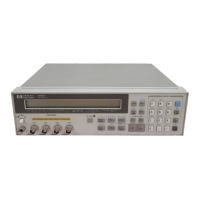
operating the Hewlett-Packard Mo del 4284A Precision LCR Meter.
Before using the HP 4284A, read through this Chapter so you can
quickly and eciently learn the HP 4284A's operation.
Product Introduction
The HP 4284A is a general purpose LCR meter for incoming
inspection of comp onents, quality control, and lab oratory use. The
HP 4284A is used for evaluating LCR components, materials, and
semiconductor devices over a wide range of frequencies (20 Hz to
1 MHz) and test signal levels (5 mV to 2 V
rms
,50
Ato20mA
rms
).
With Option 001 the HP 4284A's test signal lev
el range spans 5 mV
to 20 V
rms
, and 50
A to 100 mA
rms
.
The HP 4284A oers C-D measurements with a basic accuracy of
6
0.05% (C),
6
0.0005 (D) at all test frequencies with six digit
resolution (the dissipation factor resolution is 0.000001) on ev
ery
range.
With its built-in comparator, the HP 4284A can output
comparison/decision results for sorting comp onents into a maximum
of ten bins. By using the handler interface and scanner interface
options, the HP 4284A can easily be com
bined with a component
handler, a scanner, and a system controller to fully automate
component testing, sorting, and quality control data pro cessing.
The HP 4284A's new list sweep function permits entry of up to ten
frequencies, test signal levels, or bias level points to b e automatically
measured.
The HP-IB interface is a standard interface on the HP 4284A
and can b e used to build an automatic test system to completely
characterize new comp onents and materials, and to fully automatic
pro duction line testing.
The HP 4284A with Option 002 can apply a 0 to 20A (Maximum
40A : When two HP 42841As are paralleled.) DC current bias to
the DUT (Device Under Test). So, high current biased imp edance
measurement of coils or transformers can b e p erformed easy, fast and
safe.
Overview 2-1


 To Next Page
 Loading...