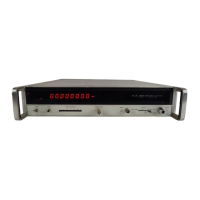
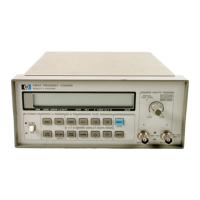
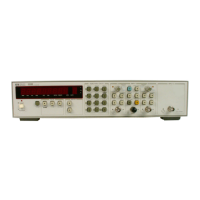
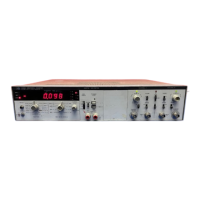
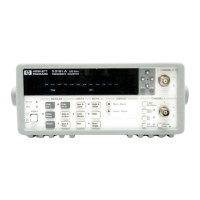
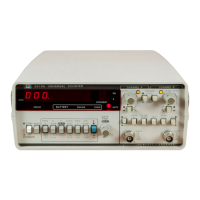
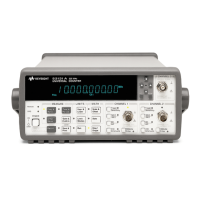
The Hewlett-Packard Model 5305B is a 1300 MHz Counter, designed to extend the frequency measuring capability of the 5300 Measuring System into the UHF range. This operating and service manual provides comprehensive information for its use and maintenance.
Function Description:
The 5305B Counter is a plug-on module for the HP 5300A or 5300B Measuring System, offering frequency measurements for both continuous wave (CW) and burst signals up to 1300 MHz. It features two separate input channels: Channel A for high-frequency measurements (90 MHz to 1300 MHz) and Channel B for lower frequencies (50 Hz to 100 MHz). A key feature is its high-resolution mode, which, for Channel B, uses a phase-locked multiplier to increase resolution by a factor of 1000, particularly useful for servicing equipment with tone modulation for digital encoding on the carrier. The counter also includes automatic gain control (AGC) for both channels or manual attenuator control for the high-frequency channel, fuse protection for the high-frequency channel, and probe power with an accessory preamp for enhanced sensitivity.
Important Technical Specifications:
- Frequency Range:
- Channel A: 90 MHz to 1300 MHz (prescaled by 16)
- Channel B: 50 Hz to 100 MHz (normal mode), 50 Hz to 10 kHz (high resolution mode)
- Sensitivity: 20 mV rms for both channels.
- Impedance:
- Channel A: 50 Ω
- Channel B: 1 MΩ shunted by less than 40 pF
- Attenuator (Channel A): Continuously variable for optimum noise suppression for signals up to 3.5V rms.
- Overload Protection:
- Channel A: 5V rms maximum, fuse protected.
- Channel B: 250V rms from 50 Hz to 10 kHz, declining to 10V rms above 10 MHz.
- Operating Dynamic Range (Channel A): > 47 dB
- Resolution (Selectable):
- Normal Mode (50 Hz to 1300 MHz): 0.1 Hz to 10000 Hz in decade steps, corresponding to gate times from 10 sec to 0.0001 sec (Channel B) and 160 s to 0.0016 s (Channel A).
- High Resolution Mode (50 Hz to 10 kHz): 0.0001, 0.001, 0.01, 0.1, 1, 10 Hz, corresponding to gate times from 10 to 0.0001 second (Channel B).
- Accuracy: ±1 digit displayed + time base accuracy.
- Display: Hz, kHz, MHz with positioned decimal point.
- Check Function: Counts internal 10 MHz reference frequency.
- Operating Temperature: 0° to 50°C.
- Power Requirements: Nominally 12 watts including mainframe.
- Weight: Net 1.0 kg (2-1/4 lbs.); Shipping 1.8 kg (4 lbs.).
- Dimensions (with mainframe): 89 mm H (3-1/2") x 160 mm W (6-1/4") x 248 mm L (9-3/4").
- Compatibility: 5300A (6 digits) or 5300B (8 digits) mainframes (5300B recommended).
- Accessories: 10855A Preamplifier (22 dB gain) for high-sensitivity UHF applications.
Usage Features:
- Front Panel Controls: The 5305B features intuitive front-panel controls for SAMPLE RATE, ATTENUATOR, RESOLUTION, and RANGE.
- Sample Rate: A "PUSH TO RESET" button for sample rate control, allowing adjustment for minimum display time.
- Resolution Switch: Determines the least-significant digit (LSD) displayed, enabling users to select the desired measurement precision.
- Range Switch: Allows selection of either Channel A (90 MHz-1300 MHz), Channel B (50 Hz-100 MHz), or the self-check mode (CHK). In the "B HIGH RESOLUTION" setting, frequencies up to 10 kHz can be measured with enhanced resolution.
- Attenuator Control (Channel A): Provides manual control for optimizing signal input, with MIN for minimum attenuation and MAX for maximum. An AGC circuit ensures a dynamic range greater than 47 dB.
- PREAMP POWER: A dedicated front-panel connector supplies +15V @ ≈ 40 mA to power the 10855A Preamplifier for high-sensitivity applications.
- Search Indicator ("S" annunciator): Lights up in high-resolution mode when the input is beyond the proper frequency range, too weak, or during signal acquisition.
- Automatic Hold (High Resolution Mode): The last valid reading is held in the display when the input signal is terminated.
- Self-Check Mode: A built-in function (CHK position on the RANGE switch) allows the system to count the internal 10 MHz clock signal, verifying the counting circuits' operation.
Maintenance Features:
- In-Cabinet Performance Check: A detailed procedure (Table 9E-5-1) is provided to verify the proper operation of all circuits in the counter and its associated mainframe. This check can be used for incoming inspection, periodic maintenance, troubleshooting, and post-repair verification.
- Instrument Access: Instructions are given for separating the 5305B plug-on assembly from the 5300 mainframe and for removing the board assembly from its cast housing, facilitating access for servicing.
- Periodic Maintenance: Recommends performing the In-Cabinet Performance Checks regularly to ensure proper operation.
- Maintenance and Repair:
- Board Removal: Emphasizes removing AC power and separating the board from the casting before any repair or servicing.
- Component Replacement: Advises using a low-heat soldering iron to prevent damage to circuit foil. Provides two methods for integrated circuit removal: "Solder Gobbler" for intact removal and "Clip Out" for defective ICs.
- Adjustments: Specific procedures are outlined for Channel A and Channel B adjustments, to be performed when performance tests indicate a need or after repairs affecting adjustment settings.
- Troubleshooting:
- Comprehensive troubleshooting information, including waveforms and schematic diagrams, is provided to isolate defective components.
- Guidance on using the self-check mode to quickly identify malfunctions.
- Procedures for troubleshooting specific channels (100 MHz and 1300 MHz) and common issues like "S" light on with no measurements, faulty displays, incorrect first readings, slow acquisition, and range limitations.
- Detailed checks for various circuit components (e.g., phase detector, VCO, loop amplifier, logic gates) and their expected behaviors.
- Replaceable Parts: A complete list of replaceable parts, including HP part numbers, descriptions, manufacturer codes, and manufacturer part numbers, is provided for easy ordering.
- Circuit Diagrams: Schematic diagrams and component location views are included to aid in understanding the counter's internal circuitry and for troubleshooting purposes.

 Need help?
 General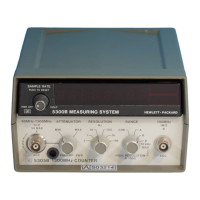

 To Next Page