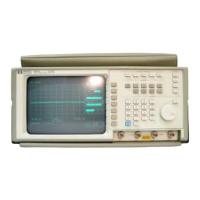
Need help?
Do you have a question about the HP 54111d and is the answer not in the manual?
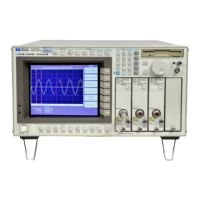
Provides introductory information about the HP 54112D Digitizing Oscilloscope and its service manual.
Details the capabilities and features of the HP 54112D, including its programmable nature and bandwidth.
Lists the technical specifications of the oscilloscope, including performance standards.
Details the operating characteristics of the instrument, including vertical and horizontal parameters.
Provides general characteristics like environmental limits, input power, and mechanical dimensions.
Outlines crucial safety precautions and warnings for operating and servicing the instrument.
Specifies the instruments covered by this manual, including serial number prefixes.
Lists available options for the HP 54112D, such as power cord options.
Details the accessories that are supplied with the HP 54112D.
Lists the recommended test equipment required for maintaining the HP 54112D.
Provides an introduction to the installation procedures for the HP 54112D.
Details the necessary preparations before using the instrument, including power requirements.
Specifies the recommended operating environment conditions for the instrument.
Provides guidelines for cleaning the instrument, emphasizing caution.
Describes the power cables used and their proper connection.
Explains how to connect the HP 54121A Four Channel Test Set to the mainframe.
Provides guidelines for storing and shipping the instrument to maintain its condition.
Details the recommended packaging procedures for shipping the instrument.
Provides an introduction to the performance tests section.
Describes the recommended calibration cycle for verifying instrument performance.
Outlines the requirements for performing calibration procedures on the HP 54112D.
Lists the essential test equipment needed to perform the calibration procedures.
Provides a template for recording the results of performance tests.
Details the types of probes recommended for use during performance tests.
Outlines the general procedures for conducting performance tests on the instrument.
Describes the one-key power-up procedure for instrument testing.
Details the procedure for checking the calibrator amplitude.
Explains how to test the voltage measurement accuracy of the instrument.
Describes the procedure for testing the vertical offset accuracy of the instrument.
Details the procedure for testing the bandwidth of the HP 54112D.
Explains how to test the time measurement accuracy of the instrument.
Details the procedure for testing the time interval accuracy.
Describes how to test the trigger sensitivity of the instrument.
Introduces the adjustments section, covering procedures for restoring peak operating capabilities.
Outlines the requirements for performing adjustments, including warranty and calibration cycles.
Lists the recommended test equipment required for performing adjustment procedures.
Explains how to access adjustments, noting that most are only available during routine calibration.
Describes the one-key power-up procedure for returning the instrument to default conditions.
Details adjustments that may be necessary after replacing an assembly.
Provides procedures for adjusting the power supply voltages.
Explains the procedures for performing clock and gap adjustments.
Describes the two frequency adjustments, GAIN and FLAT.
Details the procedure to adjust the amplitude of the front panel calibrator signal.
Explains software calibration procedures for internal routines and adjustments.
Describes the procedure for vertical calibration to calibrate vertical sensitivity.
Explains probe tip calibration for the vertical channel via A/D converters.
Details how to adjust the offset calibration values.
Explains trigger calibration for trigger levels and sensitivity.
Describes channel skew alignment to align signals input to channels and external trigger.
Explains the two compensation adjustments for channel attenuators.
Details adjustments for the Color CRT Module to compensate for magnetic influences.
Provides information for ordering parts and lists the names and addresses of manufacturers.
Lists abbreviations used in the parts list, schematics, and other sections.
Lists the replaceable parts, organized by electrical assemblies and chassis-mounted parts.
Explains the procedure for obtaining replacement parts through the Blue-stripe exchange program.
Provides instructions on how to order parts from Hewlett-Packard.
Describes the advantages of using the Hewlett-Packard direct mail order system.
Introduces the section on mainframe disassembly and replacement procedures.
Provides safety warnings and cautions for disassembly procedures.
Lists the specialized tools required for mainframe disassembly.
Details the procedures for removing major assemblies from the mainframe.
Provides removal and replacement procedures for card cage PC assemblies.
Details the removal and replacement of the primary power supply.
Covers the removal of the front panel, control keyboard, and display control assemblies.
Introduces the theory of operation section for the HP 54112D.
Explains the instrument theory, covering block diagrams and system theory.
Describes the acquisition system, including attenuators and sample clocks.
Explains the operation of the primary, digital, and analog power supplies.
Details the theory behind the Analog-to-Digital Converter (ADC) assembly.
Introduces the service menu keys section.
Describes the one-key power-up procedure for returning the instrument to default.
Explains the two-key power-up procedure for instrument reset.
Covers CAL MENUS, including Vertical Cal and Channel Skew Calibration.
Describes the ADC Reference Calibration procedure.
Details the probe tip calibration procedure.
Explains the trigger calibration procedure.
Describes the timebase calibration procedure.
Introduces the TEST MENU, providing access to various functions.
Details the CRT SETUP MENU options for display and pattern adjustments.
Introduces the self-tests and troubleshooting section for fault location.
Provides safety warnings and cautions for troubleshooting procedures.
Guides users through troubleshooting mainframe issues.
Explains the one key-down powerup procedure for troubleshooting.
Provides troubleshooting steps for issues where the display is not functioning.
Details troubleshooting procedures for power supply problems.
Guides users on troubleshooting software issues.
Provides methods for troubleshooting the core subsystem.
Outlines diagnostic routines for the data acquisition subsystem.
Describes the timebase tests to verify timebase functions.
General safety and handling precautions for accessory kit devices.
Provides guidance on inspecting incoming accessory kit devices.
Introduces the section on accessory kit devices and their uses.
Details the 7.5 cm beadless airline, its specifications, and usage.
Describes the Model 909D 50 Ohm Terminator, its specifications, and maintenance.
Provides operating and service information for the HP 11667B Power Splitter.
Explains operating conditions and procedures for making accurate measurements.
Provides instructions for handling precision 3.5 mm connectors.
Details visual inspection and cleaning procedures for connectors.
 General
| Brand | HP |
|---|---|
| Model | 54111d |
| Category | Test Equipment |
| Language | English |


 To Next Page