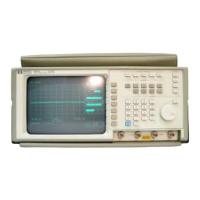
Need help?
Do you have a question about the HP 54600B and is the answer not in the manual?
Instructions for checking the instrument for damage and completeness after shipment.
Guide to connecting a signal to channel 1, including probe compensation.
How to use the Autoscale feature to automatically set up the display.
Guide to adjusting vertical settings using keys, knobs, and status line.
Guide to adjusting horizontal settings using time base keys, knobs, and status line.
Instructions on setting up trigger levels, sources, modes, and holdoff.
How to use delayed sweep for magnified analysis of signal portions.
Instructions for using storage keys like Autostore for capturing waveforms.
Methods for capturing glitches using peak detect and Autostore.
How to use automatic measurement functions for frequency.
How to perform automatic time measurements like rise and fall time.
How to perform automatic voltage measurements like Vrms and Vp-p.
Using cursors for custom voltage and time measurements on signals.
Techniques to reduce noise using trigger path settings and averaging.
Using XY mode for volts-versus-volts display and phase shift measurement.
How to select the TV display grid option for video analysis.
How to use video autoscaling for proper signal matching and setup.
Triggering on specific video lines, like VITS or closed captioning.
Triggering on Field 1 or Field 2 for analyzing video signal components.
Triggering on odd or even fields to analyze video signal envelopes and distortion.
Combining TV trigger, delayed sweep, and measurements for video analysis.
Using FFT for frequency domain analysis of harmonic distortion in video signals.
How to verify the electrical performance of the oscilloscope.
Procedures for adjusting hardware for optimum operating performance.
Procedures to help isolate problems to defective assemblies.
Instructions for removing and ordering replaceable assemblies.
Describes vertical system parameters like bandwidth, rise time, dynamic range.
Describes horizontal system parameters like sweep speeds, accuracy, resolution.
Describes trigger system parameters like sensitivity, sources, coupling, modes.
Details on acquisition system parameters like sample rate, resolution, record length.
Environmental and EMI characteristics of the instrument.
 General
| Type | Oscilloscope |
|---|---|
| Bandwidth | 100 MHz |
| Channels | 2 |
| Sample Rate | Up to 20 MSa/s |
| Vertical Sensitivity | 2 mV/div to 5 V/div |
| Vertical Resolution | 8 bits |
| Input Coupling | AC, DC, GND |
| Maximum Input Voltage | 400 V (DC + peak AC) |
| Trigger Modes | Auto, Normal, Single |
| Display | CRT |
| Input Impedance | 1 MΩ |
| Power Requirements | 100-240 VAC, 50/60 Hz |
| Memory Depth | 1 kpts per channel |

 To Next Page