Need help?
Do you have a question about the HP HP10BII and is the answer not in the manual?
Covers turning the calculator on/off, clearing display, error messages, memory, and setting decimal points.
Explains how to use memory for storing and recalling numbers, including constant key, M register, and numbered registers.
Covers clearing TVM registers, setting period modes (BEGIN/END), and establishing compounding frequency (P/YR).
Demonstrates calculating the present value of a single future amount with given interest and time periods.
Shows how to calculate the future value of a single present amount with given interest and time periods.
Explains how to find the present value of a series of equal payments over time (end-of-period).
Covers calculating present value when annuity payments occur at the beginning of periods.
Demonstrates calculating the future value of a series of equal payments over time (end-of-period).
Shows how to find the future value of annuity payments made at the beginning of periods.
Explains calculating NPV for cash flows using the CFj register with equal or uneven streams.
Demonstrates calculating IRR for cash flows using the CFj register with equal or uneven streams.
Explains how to calculate the present value of a bond based on interest payments, principal, and yield to maturity.
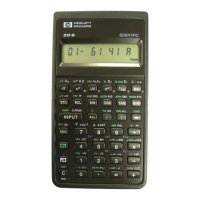
The HP 10BII is a versatile calculator designed to handle both statistical and financial operations, making it a valuable tool for a wide range of users. Its functionality is primarily accessed through a keypad featuring distinct mauve and orange "shift" keys, which are strategically located in the leftmost column. These shift keys serve to expand the calculator's capabilities, allowing users to access a broader array of functions beyond those directly printed on the keys.
The mauve shift key is dedicated to activating statistical functions and operations. These are typically indicated by mauve text printed above certain keys on the keypad, providing a clear visual cue for their use. This color-coding helps users quickly identify and engage the statistical tools needed for data analysis, probability calculations, and other related tasks.
Conversely, the orange shift key is designed to activate financial functions and operations. These are generally indicated by text printed on the bottom half of most keys on the keypad. This arrangement ensures that financial calculations, such as time value of money, bond valuation, and cash flow analysis, are readily accessible. The dual-shift system streamlines the user experience by categorizing functions and making them intuitive to locate and use.
One of the key usage features of the HP 10BII is its continuous memory. This means that any information previously stored in the calculator remains intact even after the device is turned off. This eliminates the need to re-enter data or settings, saving time and preventing potential errors, especially during complex or multi-step calculations. While the calculator can be manually turned off, it also boasts an automatic shut-off feature that activates approximately 10 minutes after the last use. This power-saving mechanism helps conserve battery life, a crucial aspect for portable devices.
The HP 10BII is powered by two lithium batteries, known for their longevity and reliable performance. To ensure users are aware of the battery status, the calculator includes a low battery indicator symbol. This symbol illuminates when the battery power is low, signaling that it's time for a replacement. This proactive alert helps prevent unexpected power loss during critical calculations.
User interaction with the HP 10BII is further enhanced by several intuitive features related to data entry and error correction. When a user is entering a number, a cursor, represented by an underscore (_), is visible on the display. This cursor provides visual feedback, confirming that the calculator is ready to accept numerical input. Should a user make an error during number entry, the back key (?), located on the keypad, can be used to erase the last digit entered. This allows for quick and precise corrections without having to re-enter the entire number.
If the cursor is not visible, pressing the back key (?) serves a different but equally important function: it clears the entire display and cancels any pending calculation. This is particularly useful for resetting the calculator to a neutral state or for abandoning an ongoing calculation that is no longer needed. Additionally, when entering a number, pressing the 'C' key will clear the display to zero, providing another convenient way to start fresh.
The manual also highlights the notation 'OS' to indicate the selection of the orange shift key, reinforcing the importance of this key for accessing financial functions. This consistent notation throughout the guide helps users understand and follow the keystroke sequences for various operations.
For maintenance and setup, the HP 10BII offers several critical functions. Users can turn the calculator on and off using specific keystrokes. Clearing the display of its current contents and canceling any current calculation is achieved by pressing 'C'. Error messages can be cleared, and the original contents of the display restored, by pressing '?' or 'C'. A comprehensive memory clear function, 'OS C All', clears all memory registers but does not reset the calculator's modes. This distinction is important as modes, such as the number of payments per year, payment timing (beginning or end of year), and the number of decimals displayed, are separate settings.
A more extensive reset can be performed by holding down 'ON', 'N', and 'FV' simultaneously. Releasing all three keys clears all memory and reverts all functions to their original factory settings. This is useful for troubleshooting or for starting with a clean slate. Statistical memory can be cleared independently using 'OS CL?'.
The display settings are also customizable. Users can set the number of decimal places displayed by selecting a number from 0 through 9 using 'OS DISP'. Alternatively, selecting '.' will cause the number of decimal places to "float," allowing the calculator to display as many decimal places as necessary for precision.
The HP 10BII also features robust memory capabilities, allowing users to store numbers for reuse in various ways. The 'K' or constant key can store a number and its operator for repetitive operations, which is highly efficient for calculations involving a recurring factor. For more general storage, the calculator includes a 3-key memory system: 'M' to store, 'RM' to recall, and 'M+' to sum numbers. This M register is a single storage location, and while it generally doesn't require clearing, it can be reset by pressing '0' followed by 'M'. Numbers can be added to the M register using 'M+' and subtracted using '+/-'.
Beyond the single M register, the HP 10BII provides 10 numbered registers, accessible via the 'OS STO' and 'RCL' keys. The 'OS STO' key copies the displayed number to a designated register, while 'RCL' copies a number from a register to the display. Storing and recalling numbers from these registers is a two-step process: first, pressing 'OS STO' or 'RCL' (which can be canceled by '?' or 'C'), and then entering the register number (0 through 9). These numbered registers are particularly useful for storing intermediate results or constants in complex multi-step calculations, enhancing the calculator's utility for advanced financial and statistical analysis.
 General
| Type | Financial Calculator |
|---|---|
| Display | LCD |
| Display Digits | 12 |
| Power Source | Battery |
| Warranty | 1 year limited |
| Features | Time-Value-of-Money, Cash Flows, Amortization, Depreciation, Statistics |


 To Next Page