Need help?
Do you have a question about the HP Pavilion Gaming 690 and is the answer not in the manual?
List of printed circuit boards or assemblies requiring selective treatment.
All types of batteries requiring selective treatment, including alkaline and lithium coin.
Components containing mercury, such as lamps and display backlights.
LCDs with a surface area greater than 100 sq cm requiring selective treatment.
Cathode Ray Tubes (CRT) that require selective treatment.
Capacitors or condensers containing PCB/PCT requiring selective treatment.
Large electrolytic capacitors/condensers (over 2.5 cm) requiring selective treatment.
External electrical cables and cords identified for selective treatment.
Gas discharge lamps that require selective treatment.
Plastics > 25g with brominated flame retardants requiring selective treatment.
Components with toner, ink, or semi-liquids requiring selective treatment.
Components and waste materials containing asbestos requiring selective treatment.
Materials containing refractory ceramic fibers requiring selective treatment.
Materials containing radioactive substances requiring selective treatment.
Phillips #2 screwdriver for access panel screws.
Torx T15 screwdriver for side bracket, lower case, PCI cover, and main bracket.
Initial step to remove the lower case from the housing.
Pull off ODD SATA and ODD power connectors.
Remove ODD and loosen screws to detach the HDD.
Step to remove the front bezel from the computer housing.
Loosen side bracket screws and remove it.
Pull off all cables connected to the motherboard.
Remove the PCI card from its slot.
Pull off the power supply unit (PSU) connector.
Loosen motherboard screws and remove it.
Loosen power supply unit screws and remove it.
This document outlines the disassembly process for the HP Pavilion Gaming Desktop PC 690, primarily for end-of-life recyclers and treatment facilities, ensuring compliance with EU directive 2002/96/EC (WEEE) regarding selective treatment of components and materials. The core function of this document is to provide a structured guide for the safe and efficient removal of specific parts that require special handling due to environmental or safety concerns.
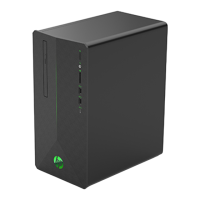
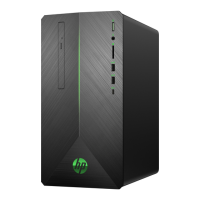
The device itself, the HP Pavilion Gaming Desktop PC 690, is a personal computer designed for gaming, implying a focus on performance and potentially more robust internal components compared to standard office desktops. As a gaming desktop, it is expected to offer features such as dedicated graphics processing units (GPUs), ample memory, and efficient cooling systems to handle demanding applications and games. Its design likely incorporates a tower-style chassis, providing sufficient space for these components and allowing for potential upgrades or modifications by users. The "Gaming Desktop PC" designation suggests that it is optimized for high-performance tasks, requiring a stable and powerful internal architecture.
From a usage perspective, the HP Pavilion Gaming Desktop PC 690 is intended for consumers who engage in gaming, content creation, or other resource-intensive activities. This means it would typically be connected to a monitor, keyboard, mouse, and other peripherals essential for a complete computing experience. The presence of various internal components like a Motherboard (MB), Printed Circuit Boards (PCBs), a Power Supply Unit (PSU), an Optical Disc Drive (ODD), and a Hard Disk Drive (HDD) indicates a standard desktop computer architecture. The inclusion of a PCI card suggests expandability, allowing users to add or upgrade components such as graphics cards, sound cards, or network adapters to enhance their experience. The design would likely prioritize airflow and cooling to prevent overheating during prolonged high-performance use, a common requirement for gaming systems. The external electrical cables and cords mentioned in the selective treatment list are standard for any desktop PC, connecting it to power outlets and peripherals.
Regarding maintenance and end-of-life considerations, this document provides a detailed guide for disassembly, which is crucial for responsible recycling. The instructions highlight specific tools required, such as Ph2 and T15 screwdrivers, indicating that standard tools are sufficient for most disassembly steps. The process involves systematically removing external panels, disconnecting cables, and unfastening screws to access and detach internal components. This structured approach ensures that parts requiring selective treatment, such as PCBs, batteries, and potentially plastics containing brominated flame retardants, are identified and separated correctly. The document explicitly lists components like PCBs/PCAs (with a surface greater than 10 sq cm) and batteries (all types, including lithium coin batteries on the motherboard) as requiring selective treatment, emphasizing their environmental impact if not handled properly. The absence of mercury-containing components, Liquid Crystal Displays (LCDs) over 100 sq cm, Cathode Ray Tubes (CRTs), capacitors containing PCB/PCT, and large electrolytic capacitors (greater than 2.5 cm in diameter or height) suggests that the device incorporates more modern and environmentally conscious designs in these areas. Similarly, the lack of components containing asbestos, refractory ceramic fibers, or radioactive substances indicates adherence to contemporary safety and material standards. The mention of "Plastics containing Brominated Flame Retardants weighing > 25 grams" as a selective treatment item underscores the importance of proper plastic recycling to mitigate environmental risks associated with these chemicals. The detailed steps, such as removing the lower case, disconnecting ODD SATA and power connectors, removing the ODD and HDD, detaching the front bezel, loosening side bracket screws, disconnecting all cables on the motherboard, removing PCI cards, pulling off PSU connectors, and finally loosening screws on the motherboard and PSU, provide a comprehensive roadmap for dismantling the device. This level of detail is invaluable for recyclers to ensure that all hazardous or valuable materials are extracted and processed according to environmental regulations, promoting a circular economy and reducing electronic waste. The document's focus on disassembly rather than repair suggests its primary utility is for end-of-life management, ensuring that the device's components are either recycled or disposed of responsibly.
 General
| Processor cache | 4 MB |
|---|---|
| Processor cores | 4 |
| Processor model | 2400G |
| Processor family | AMD Ryzen™ 5 |
| Processor threads | 8 |
| Processor frequency | 3.6 GHz |
| Processor cache type | L3 |
| Processor lithography | 14 nm |
| Processor manufacturer | AMD |
| Processor boost frequency | 3.9 GHz |
| Thermal Design Power (TDP) | 65 W |
| Number of processors installed | 1 |
| Audio system | High Definition Audio |
| Product type | PC |
| Market positioning | Gaming |
| Audio output channels | 5.1 channels |
| ECC | No |
| Memory slots | 2x DIMM |
| Internal memory | 8 GB |
| Memory clock speed | 2666 MHz |
| Internal memory type | DDR4-SDRAM |
| Maximum internal memory | 64 GB |
| Memory layout (slots x size) | 1 x 8 GB |
| Antenna type | 1x1 |
| Ethernet LAN | Yes |
| Wi-Fi standards | 802.11a, 802.11b, 802.11g, Wi-Fi 4 (802.11n), Wi-Fi 5 (802.11ac) |
| Bluetooth version | 4.2 |
| Cabling technology | 10/100/1000Base-T(X) |
| Top Wi-Fi standard | Wi-Fi 5 (802.11ac) |
| Ethernet LAN data rates | 10, 100, 1000 Mbit/s |
| WLAN controller manufacturer | Realtek |
| HDD speed | 7200 RPM |
| HDD interface | SATA |
| Storage media | HDD |
| Optical drive type | DVD±RW |
| Total storage capacity | 1000 GB |
| Compatible memory cards | SD, SDHC, SDXC |
| USB 2.0 ports quantity | 2 |
| USB 3.2 Gen 1 (3.1 Gen 1) Type-A ports quantity | 6 |
| USB 3.2 Gen 2 (3.1 Gen 2) Type-A ports quantity | 0 |
| Power supply | 310 W |
| Power supply input voltage | 100 - 240 V |
| Power supply input frequency | 50 - 60 Hz |
| Chassis type | Mini Tower |
| Product color | Gray |
| Country of origin | China |
| Placement supported | Vertical |
| Trial software | McAfee LiveSafe, Microsoft Office 365 |
| Pre-installed software | Netfix |
| Operating system architecture | 64-bit |
| HP segment | Home |
| HP Software provided | HP Audio Switch |
| Discrete GPU manufacturer | NVIDIA |
| Discrete graphics card model | NVIDIA® GeForce® GTX 1050 Ti |
| On-board graphics card model | AMD Radeon RX Vega 11 |
| Discrete graphics card memory | 4 GB |
| Discrete graphics memory type | GDDR5 |
| On-board graphics card base frequency | 1250 MHz |
 Weight and Dimensions
| Depth | 277 mm |
|---|---|
| Width | 170 mm |
| Height | 338 mm |
| Weight | 5150 g |
| Package depth | 499 mm |
| Package width | 390 mm |
| Package height | 291 mm |
| Package weight | 8000 g |

 To Next Page