EasyManua.ls Logo

HTP Invertig 221 AC/DC - User Manual

HTP Invertig 221 AC/DC
28 pages
Print Icon
To Next Page IconTo Next Page
Loading...
Invertig 221 AC/DC
Invertig 221DV AC/DC
Owners Manual
180 Joey Drive · Elk Grove Village, IL 60007 · Ph: 847-357-0700 · Fax: 847-357-0744 · Web: www.usaweld.com
Question and Answer IconNeed help?

Do you have a question about the HTP Invertig 221 AC/DC and is the answer not in the manual?

Summary

Manufacturers Warranty

Safety Suggestions

Electrical Connection and Safety

Details electrical requirements, connection procedures, and safety precautions for operating the welding machine.

FRONT PANEL CONNECTIONS

Negative Output Receptacle Usage

Explains connecting the TIG torch or electrode holder to the negative output terminal for welding.

Positive Output Receptacle Usage

Explains connecting the ground cable to the positive output terminal for welding operations.

REAR PANEL CONTROLS AND CONNECTIONS

FRONT PANEL CONTROLS

Encoder and Function Button Operation

Explains using the encoder and function button to select and adjust welding parameters.

Pre Gas Setting Adjustment

Details how to set the pre-gas flow time before arc initiation for weld protection.

Starting Current Setting

Adjusts the initial welding amperage for smooth arc starting, from 10% to 90%.

AC Frequency Setting

Adjusts the AC frequency from 20 Hz to 200 Hz to control arc characteristics.

AC Balance Setting

Adjusts AC balance from 10% to 90% to control cleaning and penetration.

Welding Mode Section

TIG 2 T Mode Operation

Details the 2-step TIG welding mode for trigger or foot pedal control.

TIG 4 T Mode Operation

Explains the 4-step TIG welding mode for lock-on trigger functionality.

TIG Spot Welding Mode

Describes the TIG spot welding mode for precise, timed weld spots.

TIG Repeat Mode Operation

Covers the TIG repeat mode for switching between two pre-programmed amperages.

Starting Current Adjustment

Storing Welding Programs

Recalling Welding Programs

Tungsten Electrodes

General Welding Parameters

Quick Set Up Guide

Filler Rod Selection Guide

Invertig 221 AC;DC (Single Voltage) Wiring Diagram

Invertig 221 DV AC;DC (Dual Voltage) Wiring Diagram

Summary

Manufacturers Warranty

Safety Suggestions

Electrical Connection and Safety

Details electrical requirements, connection procedures, and safety precautions for operating the welding machine.

FRONT PANEL CONNECTIONS

Negative Output Receptacle Usage

Explains connecting the TIG torch or electrode holder to the negative output terminal for welding.

Positive Output Receptacle Usage

Explains connecting the ground cable to the positive output terminal for welding operations.

REAR PANEL CONTROLS AND CONNECTIONS

FRONT PANEL CONTROLS

Encoder and Function Button Operation

Explains using the encoder and function button to select and adjust welding parameters.

Pre Gas Setting Adjustment

Details how to set the pre-gas flow time before arc initiation for weld protection.

Starting Current Setting

Adjusts the initial welding amperage for smooth arc starting, from 10% to 90%.

AC Frequency Setting

Adjusts the AC frequency from 20 Hz to 200 Hz to control arc characteristics.

AC Balance Setting

Adjusts AC balance from 10% to 90% to control cleaning and penetration.

Welding Mode Section

TIG 2 T Mode Operation

Details the 2-step TIG welding mode for trigger or foot pedal control.

TIG 4 T Mode Operation

Explains the 4-step TIG welding mode for lock-on trigger functionality.

TIG Spot Welding Mode

Describes the TIG spot welding mode for precise, timed weld spots.

TIG Repeat Mode Operation

Covers the TIG repeat mode for switching between two pre-programmed amperages.

Starting Current Adjustment

Storing Welding Programs

Recalling Welding Programs

Tungsten Electrodes

General Welding Parameters

Quick Set Up Guide

Filler Rod Selection Guide

Invertig 221 AC;DC (Single Voltage) Wiring Diagram

Invertig 221 DV AC;DC (Dual Voltage) Wiring Diagram

Overview

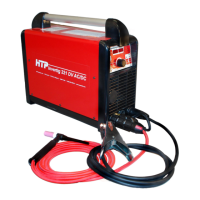
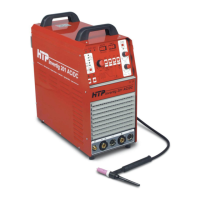
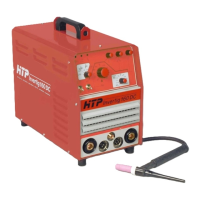
The HTP Invertig 221 AC/DC and Invertig 221DV AC/DC are advanced welding machines designed for both TIG (Tungsten Inert Gas) and Stick (Shielded Metal Arc Welding) processes. These inverter-based welders offer precise control over various welding parameters, making them suitable for a wide range of applications, from delicate aluminum work to robust steel fabrication. The dual voltage capability of the Invertig 221DV AC/DC provides enhanced versatility, allowing operation on either 110V or 230V power supplies, adapting to different workshop environments.

Function Description

At its core, the Invertig 221 series functions by converting incoming AC power into a high-frequency DC current, which is then used to create a stable and controllable welding arc. This inverter technology allows for a much smaller and lighter machine compared to traditional transformer-based welders, while also offering superior arc characteristics and energy efficiency.

For TIG welding, the machine supports both AC and DC modes. AC TIG is primarily used for welding aluminum and magnesium, where the alternating current helps to break up the oxide layer on the material's surface, providing a clean weld. The machine offers adjustable AC frequency and AC balance parameters, allowing the operator to fine-tune the arc for optimal penetration and cleaning action. Higher AC frequencies result in a more focused arc cone and better arc control, while lower frequencies increase heat input for thicker materials. AC balance controls the ratio of electrode negative (penetration) to electrode positive (cleaning) cycles, enabling the user to prioritize either deeper penetration or more aggressive cleaning based on the material's condition.

DC TIG is ideal for welding steel, stainless steel, and other non-ferrous metals (excluding aluminum and magnesium). In DC TIG, the torch is typically connected to the negative terminal (straight polarity) for maximum penetration and a cooler tungsten electrode. The machine provides stable DC output for smooth and consistent welds.

The Invertig 221 also supports Stick welding, offering a robust solution for thicker materials or outdoor applications where TIG might be impractical. It can perform Stick welding in both AC and DC modes, with adjustable amperage. The machine is designed to handle various electrode types, including 6010, and incorporates a Voltage Reduction Device (V.R.D.) for enhanced operator safety, though this feature can make electrode striking more challenging.

The machine's control panel is divided into two main sections: welding mode and welding parameter. The welding mode section allows selection between different operational modes, such as Stick, TIG 2T (two-touch), TIG 4T (four-touch), TIG Spot, and TIG Repeat. The welding parameter section provides granular control over settings like pre-gas, post-gas, slope up, slope down, starting current, peak current, final current, pulse frequency, and pulse duty cycle.

Usage Features

The Invertig 221 series is designed for user-friendly operation, with an intuitive front panel featuring digital displays for volts and amps, along with dedicated buttons and an encoder for parameter adjustment.

  • Encoder: This central knob is used to adjust all welding parameters. Turning it clockwise increases a setting, while counter-clockwise decreases it, providing precise control.
  • Function Button: This button cycles through the various welding parameters, allowing the operator to select and adjust specific settings like pre-gas, starting current, slope up, peak current, slope down, final current, and post-gas.
  • Welding Modes:
    • TIG 2T Mode: This is a common mode for TIG welding with a foot pedal or torch-mounted amperage control. The arc starts when the trigger is depressed and stops when released.
    • TIG 4T Mode: Similar to a "lock-on" trigger, this mode is used with TIG torches that have a trigger to start and stop the arc, allowing the operator to maintain the arc without continuously holding the trigger. It offers control over slope up and slope down, starting and final currents.
    • TIG Spot Mode: This mode allows for timed spot welds, useful for repetitive tack welds. The welding time can be adjusted, and the unit automatically stops after the set duration.
    • TIG Repeat Mode: This feature enables switching between two pre-programmed welding amperages using a trigger switch, facilitating complex welds that require alternating current levels.
    • Stick Welding Mode: Activates the machine for SMAW, with the ability to adjust amperage.
  • AC Welding Mode: Engages AC TIG welding for aluminum and magnesium. Within this mode, the "Set AC" button allows adjustment of AC frequency, AC balance, electrode negative amperage, and electrode positive amperage. This independent control over AC parameters is a key advantage of inverter welders, enabling superior arc shaping and cleaning.
  • Pulse Mode: The "Pulse" button activates the pulse welding feature, which cycles between a peak current and a background current at a specified frequency and duty cycle. Pulsing helps to reduce heat input, control the weld puddle, and improve penetration, especially on thin materials or when welding out-of-position.
  • HF ON/Lift Arc: The "HF ON" button enables high-frequency arc starting, which provides a non-contact ignition of the arc, preventing tungsten contamination. Alternatively, the machine supports "Lift Arc" starting, where the tungsten briefly touches the workpiece and then lifts off to initiate the arc, useful in environments sensitive to high-frequency interference.
  • Program Storage: The Invertig 221 can store up to 64 separate welding programs, allowing operators to save and recall specific parameter sets for different jobs, ensuring consistency and efficiency.

Maintenance Features

Proper maintenance is crucial for the longevity and optimal performance of the Invertig 221 series.

  • Cooling System: The machine is equipped with cooling fans to prevent overheating. A thermoswitch indicator lamp illuminates if the duty cycle is exceeded and the machine overheats, automatically shutting down welding output. The operator should leave the machine plugged in and turned on to allow the fans to cool the unit down, typically for 15-30 minutes, until the thermoswitch resets.
  • Cable Inspection: Regular inspection of welding cables for wear, cracks, and damage is recommended. Damaged cables should be replaced immediately to prevent potential electrical shocks.
  • Tungsten Electrode Care: Tungsten electrodes are consumable items and require proper sharpening to maintain arc stability and weld quality. A fine grinding wheel should be used, dedicated solely to tungsten, to prevent contamination. A 15 to 30-degree angle is generally desired, with grinding marks running lengthwise.
  • Shield Gas Management: The use of 100% Argon shield gas is essential for TIG welding to prevent weld contamination. The correct flow rate (typically 15-30 CFH) should be maintained, as excessive flow wastes gas and insufficient flow compromises shielding.
  • Consumables: TIG torch consumables, such as tungsten, collets, collet bodies, and ceramic nozzles, are subject to wear and tear and should be replaced as needed. The manual provides detailed diagrams and part lists for these items, including various sizes and configurations (standard, gas lens, short).
  • Electrical Connections: All electrical connections should be performed by a qualified electrician in accordance with local and national electrical codes to ensure safety and proper operation. The Invertig 221DV's auto-sensing dual voltage capability simplifies power connection, but correct plug wiring is critical.
  • Cleaning Practices: For AC TIG welding, especially with lower AC balance settings that prioritize penetration over cleaning, proper cleaning of the workpiece is critical to prevent impurities from affecting the weld.
  • Warranty: The manufacturer provides a three-year warranty against defects in material and workmanship for the welding machine itself, with specific exclusions for consumable items and the TIG welding torch (90 days). Warranty transfer is possible under certain conditions.

HTP Invertig 221 AC/DC Specifications

General IconGeneral
Output Current Range5-220A
Cooling SystemFan-cooled
Protection ClassIP21S
Welding ProcessesTIG, Stick
Weight40 lbs (18.14 kg)

Related product manuals