Need help?
Do you have a question about the Huawei E160E and is the answer not in the manual?
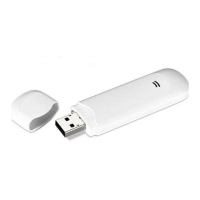
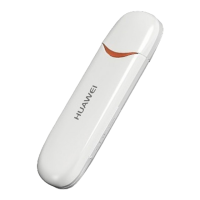
Connects the E160E to a computer.
Insert the subscriber identity module/UMTS subscriber identity module (SIM/USIM) card.
Where you insert the Micro Secure Digital Memory (SD) card.
Connects the E160E to an external antenna.
A hole for attaching a strap.
Indicates the status of the E160E through color and blinking patterns.
Specifies system requirements for using the E160E.
Step-by-step instructions for preparing the E160E.
Instructions for inserting the optional Micro SD card.
Step-by-step guide to connect the E160E to a computer.
How to launch the E160E management software after installation.
Procedure for physically disconnecting the E160E from the computer.
Steps to uninstall the E160E management software.
Guidance on avoiding interference with other electronic devices.
Advice on using the device around medical equipment and hearing aids.
Precautions for use in environments with inflammable and explosive materials.
Safety guidelines for using the device while driving and on airplanes.
Warning about potential dangers to children from device components.
Information on proper disposal and recycling of device materials.
Compliance with the restriction of hazardous substances directive.
Advises users to follow laws and respect privacy while using the device.
Instructions for cleaning, maintaining, and handling the device.
Information on limitations for emergency communication.
Guidelines for safe usage of the device near the body.
Approvals and notices for specific regions like EU and US.
Compliance statement for the US Federal Communications Commission rules.
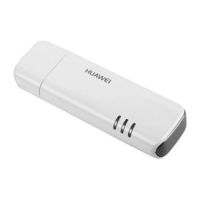
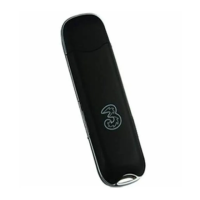
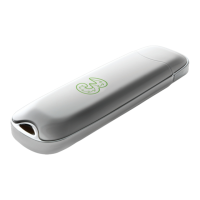
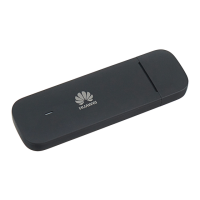
The Huawei E160E HSDPA USB Stick, referred to as the E160E, is a wireless device designed to provide high-speed internet access through a wireless network. This manual outlines its physical characteristics, installation process, and safety guidelines.
The E160E serves as a portable modem, allowing users to connect to the internet via a cellular network. It supports various network technologies, including GSM, GPRS, EDGE, UMTS, WCDMA, and HSDPA, enabling flexible connectivity options. The device features a USB interface for connecting to a computer, a SIM/USIM card slot for network authentication, and a Micro SD card slot for optional data storage. An external antenna jack is also provided for enhanced signal reception.
The E160E is designed for ease of use and portability. To get started, users need to prepare the device by inserting a USIM/SIM card into its dedicated slot. The card slot is first removed from the E160E, the USIM/SIM card is inserted, and then the card slot is reinserted into the device. Optionally, a Micro SD card can be inserted into its slot for additional storage, though it's crucial not to remove the Micro SD card while it's in use to prevent data corruption or device damage.
Connecting the E160E to a computer is straightforward. Users simply plug the E160E into a USB Type A Receptacle on their laptop or desktop computer. It is compatible with USB 2.0 High Speed. For optimal signal strength, a USB cable can be used to connect the E160E to the computer. The installation process is largely automated; once connected, the operating system (OS) detects the new hardware and initiates an installation wizard. Users follow the prompts, and upon successful installation, a shortcut icon for the E160E management program appears on the desktop. The management program launches automatically after installation and whenever the E160E is connected to the PC. It can also be launched manually by double-clicking the desktop shortcut. Removing the E160E from the computer is as simple as directly unplugging it. To uninstall the management program, users access the "Add/Remove Program" option in the Control Panel via the Start Menu, ensuring the program is exited before removal.
The E160E includes an indicator light that communicates its status through different colors and blinking patterns. When powered on, the indicator blinks green (on for 100ms, off for 100ms, then on for 100ms, off for 2700ms). If registered to a GSM/GPRS/EDGE network, it blinks green (on for 100ms, off for 2900ms). Registration to a UMTS network is indicated by a blue blinking light (on for 100ms, off for 2900ms). A solid green light signifies connection to a GPRS/EDGE network, while a solid blue light indicates a WCDMA network connection. A solid cyan light means the device is connected to an HSDPA network. If the indicator is off, it means the E160E has been removed.
The device is compatible with various operating systems, including Windows 2000 SP4, Windows XP SP2, Windows Vista, and Mac OS X 10.4 and 10.5 with the latest upgrades. The computer's hardware system should meet or exceed the recommended system requirements for the installed OS version, and the display resolution should be 800 × 600 or above.
Proper care and maintenance are essential for the longevity and safe operation of the E160E. It is normal for the device to become warm during use or charging. Before cleaning or maintaining the E160E, all applications should be stopped, and the device should be disconnected from the PC.
Users are advised to handle the wireless device and its accessories with care and keep them in a clean environment, away from fire or lit cigarettes. Protection from water and vapor is crucial, and the device should be kept dry. Dropping, throwing, or bending the E160E should be avoided. For cleaning, a damp and soft antistatic cloth is recommended; chemical agents such as alcohol, benzene, chemical detergents, or powders should not be used. The device should not be left in places with extremely low or high temperatures.
Only accessories approved by the manufacturer should be used. In case of any abnormality with the wireless device or its accessories, users should contact an authorized service center. Dismantling the wireless device or its accessories is not recommended, as it will void the warranty.
Safety information emphasizes avoiding interference with electric devices and adhering to rules and regulations in medical facilities. Users of electronic medical devices should consult their doctor or device manufacturer regarding potential radio wave interference. The E160E should not be used in areas with inflammables and explosives, such as gas stations, fuel depots, or areas where the air contains chemical substances or particles, or areas marked with "Explosives" or "Power off bi-direction wireless equipment." It is also suggested to stop the engine of a vehicle in such areas.
Traffic security guidelines advise observing local laws and regulations and not using the wireless device while driving. RF signals may affect motor vehicle electronic systems, so consulting the vehicle manufacturer for more information is recommended. The wireless device should not be placed over or in the deployment area of an airbag, as it could cause injury if the airbag inflates. Airline regulations must be observed, and the wireless device should be switched off when boarding to prevent interference with plane control signals.
For children's safety, they should not use the wireless device without guidance, as small and sharp components could pose a danger or cause suffocation if swallowed.
Environmental protection is also highlighted, encouraging users to observe local regulations for disposing of packaging materials, used wireless devices, and accessories, promoting recycling. The E160E complies with the Waste Electrical and Electronic Equipment Directive 2002/96/EC (WEEE Directive) and the Restriction of the Use of Certain Hazardous Substances in Electrical and Electronic Equipment Directive 2002/95/EC (RoHS Directive).
It is important to note that the E160E functions through receiving and transmitting radio signals, and therefore, connection cannot be guaranteed in all conditions. In emergencies, users should not rely solely on the wireless device for essential communications. The device is a radio transmitter and receiver, designed to comply with international guidelines for exposure to radio waves, with a Specific Absorption Rate (SAR) limit of 2.0 W/kg. For body-worn operation, the device must be used with a minimum separation of 1.5 cm from the body to ensure compliance with RF exposure guidelines.
 General
| Model | E160E |
|---|---|
| Device Type | USB Modem |
| Network Standards | HSDPA/UMTS/EDGE/GPRS/GSM |
| Max Download Speed | 3.6 Mbps |
| Max Upload Speed | 384 Kbps |
| Interface | USB 2.0 |
| SIM Card Type | Standard SIM |
| Antenna | Internal |
| Frequency Bands | HSDPA/UMTS 2100 MHz, GSM/GPRS/EDGE 850/900/1800/1900 MHz |
| Compatibility | Windows XP/Vista, Mac OS X |
| Weight | 40g |

 To Next Page