Appendix
54/55 >>
Assembling DC Power Cables
23
a
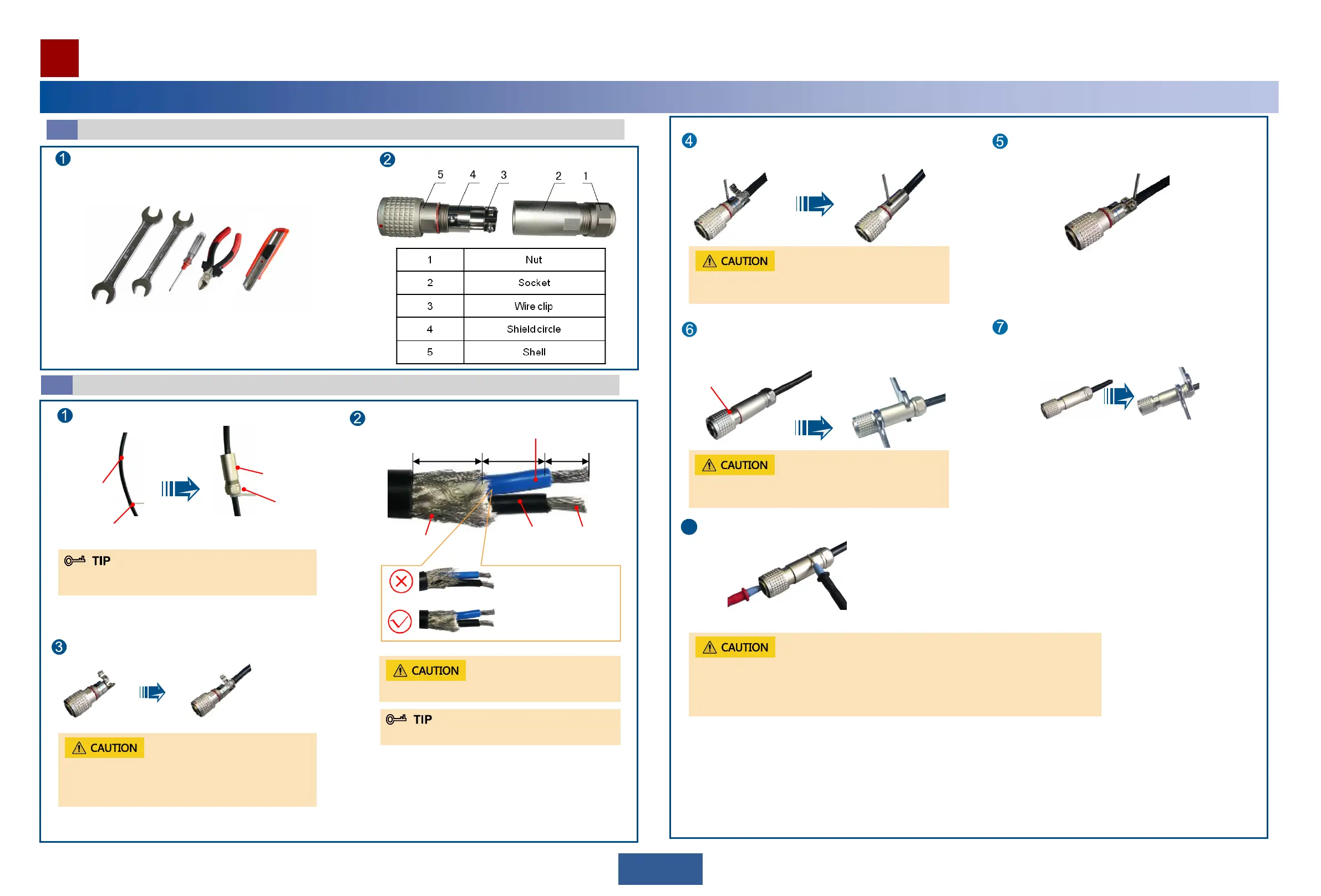
Prepare for the assembly.
a
Prepare the following tools: dual-head bayonet wrench
(22 mm, 24 mm), dual-head bayonet wrench (19 mm, 22
mm), 0#x50 mm Phillips screwdriver, diagonal pliers, and
utility knife.
Components of the connector are shown as follows.
a
Bind a cable tie to the cable, remove the socket and
nut from a connector, and install them on the cable.
Remove the cable sheath.
The filling material beneath
the shield layer is retained.
The filling material beneath
the shield layer is removed.
16± 1 mm 13± 1 mm 8±1 mm
Shield layer
Core
wire
Brown: 0 V power
cable (connected to
the positive terminal)
Cable tie
Assembly end
Socket
Nut
The cable tie prevents the socket from slipping down.
Blue: -48 V power cable
(connected to the negative
terminal)
Open the wire clip and correctly insert the core wires
to the negative and positive holes.
Check the length to remove with the 1:1 peeling indicator.
Assemble the cable.
b
Close the wire clip and tighten the screw to compact
the shield layer.
Prepare the nut and socket and apply a force not less
than 1.2 N·m to tighten the nut.
Prepare the socket and shell and apply a force not less
than 1.2 N·m to tighten the socket.
Tighten the compact screw in the "+" hole, rotate the
connector 180 degrees, and tighten the compact screw
in the "-" hole.
Rotate the connector
180 degrees.
Red rubber ring
8
Test the DC power cable with a multimeter.
The negative and positive holes are marked with silk
prints. Correctly insert the core wires to the negative
and positive holes
Retain the filling material beneath the shield layer.
Apply 2 kg of force to pull the cable and check whether
the cable is secured in the connector.
When the socket and shell are properly tightened, the
red rubber ring on the connector cannot be seen.
Avoid short-circuits between the positive and negative holes.
Avoid short-circuits between the shell and the positive/negative hole.
A continuity test between the shield layer and the metal shell is successful.
A continuity test between the core wire and its corresponding hole is successful.


 To Next Page